AI智能总结
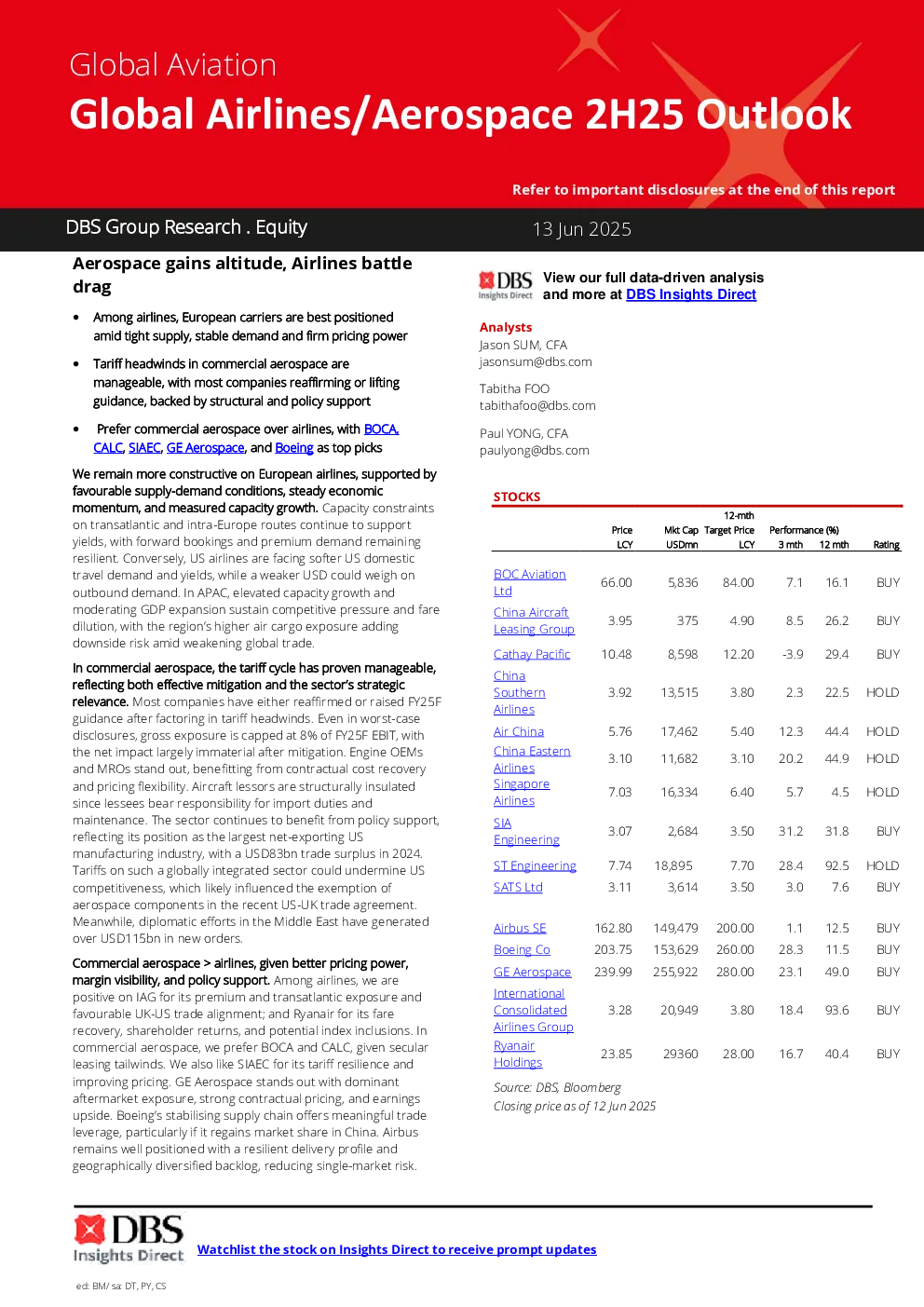
Global Airlines/Aerospace 2H25 Outlook Refer to important disclosures at the end of this report DBS Group Research . Equity 13 Jun 2025 Aerospace gains altitude, Airlines battledrag View our full data-driven analysisand more atDBS Insights Direct •Among airlines, Europeancarriersare bestpositionedamidtightsupply, stable demand andfirmpricingpower Analysts Jason SUM, CFAjasonsum@dbs.com •Tariff headwinds in commercial aerospace aremanageable,withmost companies reaffirming or liftingguidance, backed bystructural and policy support Tabitha FOOtabithafoo@dbs.com •Prefer commercialaerospaceoverairlines, withBOCA,CALC,SIAEC,GEAerospace,andBoeingas top picks Paul YONG, CFApaulyong@dbs.com We remain more constructive on European airlines, supported byfavourablesupply-demand conditions, steady economicmomentum, and measured capacity growth.Capacity constraintson transatlantic and intra-Europe routes continue to supportyields, withforward bookings and premium demand remainingresilient.Conversely,US airlines are facingsofterUSdomestictraveldemand and yields, whilea weaker USDcouldweigh onoutbound demand. In APAC, elevated capacity growth andmoderating GDP expansion sustain competitive pressureandfaredilution,with the region’s higherair cargo exposure addingdownside riskamidweakening global trade. In commercial aerospace, the tariff cycle has proven manageable,reflecting both effective mitigation and the sector’s strategic relevance.Mostcompanies have either reaffirmed or raised FY25Fguidance after factoring in tariff headwinds.Even in worst-casedisclosures, gross exposure is capped at 8% of FY25F EBIT, withthe net impact largely immaterial aftermitigation.Engine OEMsand MROsstand out,benefittingfrom contractual cost recoveryand pricing flexibility. Aircraft lessors are structurally insulatedsince lesseesbearresponsibilityfor import duties andmaintenance.The sector continues to benefit from policy support,reflecting its position as the largest net-exporting USmanufacturing industry,with a USD83bn trade surplus in2024.Tariffs on such a globally integrated sectorcouldundermineUScompetitiveness,whichlikely influencedthe exemption ofaerospace components in the recent US-UKtradeagreement.Meanwhile, diplomatic efforts in the Middle East havegeneratedover USD115bn in new orders. Commercial aerospace>airlines, givenbetterpricing power,margin visibility, andpolicy support.Among airlines, we arepositive on IAG for its premiumandtransatlantic exposure andfavourable UK-US trade alignment;and Ryanair for its farerecovery, shareholder returns, andpotentialindex inclusions. Incommercial aerospace, we prefer BOCA and CALC,givensecularleasing tailwinds.We also like SIAEC for its tariff resilience andimproving pricing. GEAerospacestands out with dominantaftermarket exposure, strong contractual pricing, andearningsupside.Boeing’sstabilisingsupply chainoffers meaningful tradeleverage, particularly if it regainsmarket share in China.Airbusremains well positioned with a resilient delivery profileandgeographically diversified backlog,reducingsingle-marketrisk. ed:BM/ sa:DT, PY, CS US Airlines Domesticmarket remains under pressure, while earlyindicators point to softening internationaltraveldemand. An uncertain macroeconomic backdropdrove a thirdconsecutive month ofUS domestic trafficdeclinesin April25, bringing year-to-date traffic down 1.1% y/y.International markets alsosoftened, with air passengertraffic between Europe and North America falling 1.0% y/yin March–the first y/y contraction on that corridor sinceearly 2021. InboundUStravelmirrored thistrend, withinternational visitor arrivals down 5% y/y in February25and a sharper 10% y/y in March25. The drop in March wasbroad-based, led by an 18% y/y fall in arrivals from the UKandover10% y/y from Germany, whiledouble-digitdeclineswere also registered inseveral other key markets,including South Korea and Spain.International air trafficrebounded in April, with transatlantic trafficup2.4% y/yand international visitor arrivals to the USup2.8% y/y, likelydue tothe timing of Easter, which fell in April this yearversusMarch 2024. While the three major US network carriers beat earningsexpectations in 1Q25, the outlook is clouded by domesticdemand concerns.Delta continued to see resilientperformancein premiumcabins, loyalty programmes, andinternational network, though domestic main cabindemandwas weak. United similarly reported strongperformance inthepremium and international segmentsbut noted persistent softness in off-peak domestic andgovernment-related travel. American appeared particularlyexposed to the downturn among the three networkcarriers, given its greater reliance on the domestic market,which has seenasharp deceleration. At a May industryconference, Southwestreportedno inflectionpoint yet,while American acknowledgedstabilised but weaker-than-expected conditions.Notably, several US airlines, includingDelta, American, Southwest, and Alaska,withdrew full-yearguidance citi