AI智能总结
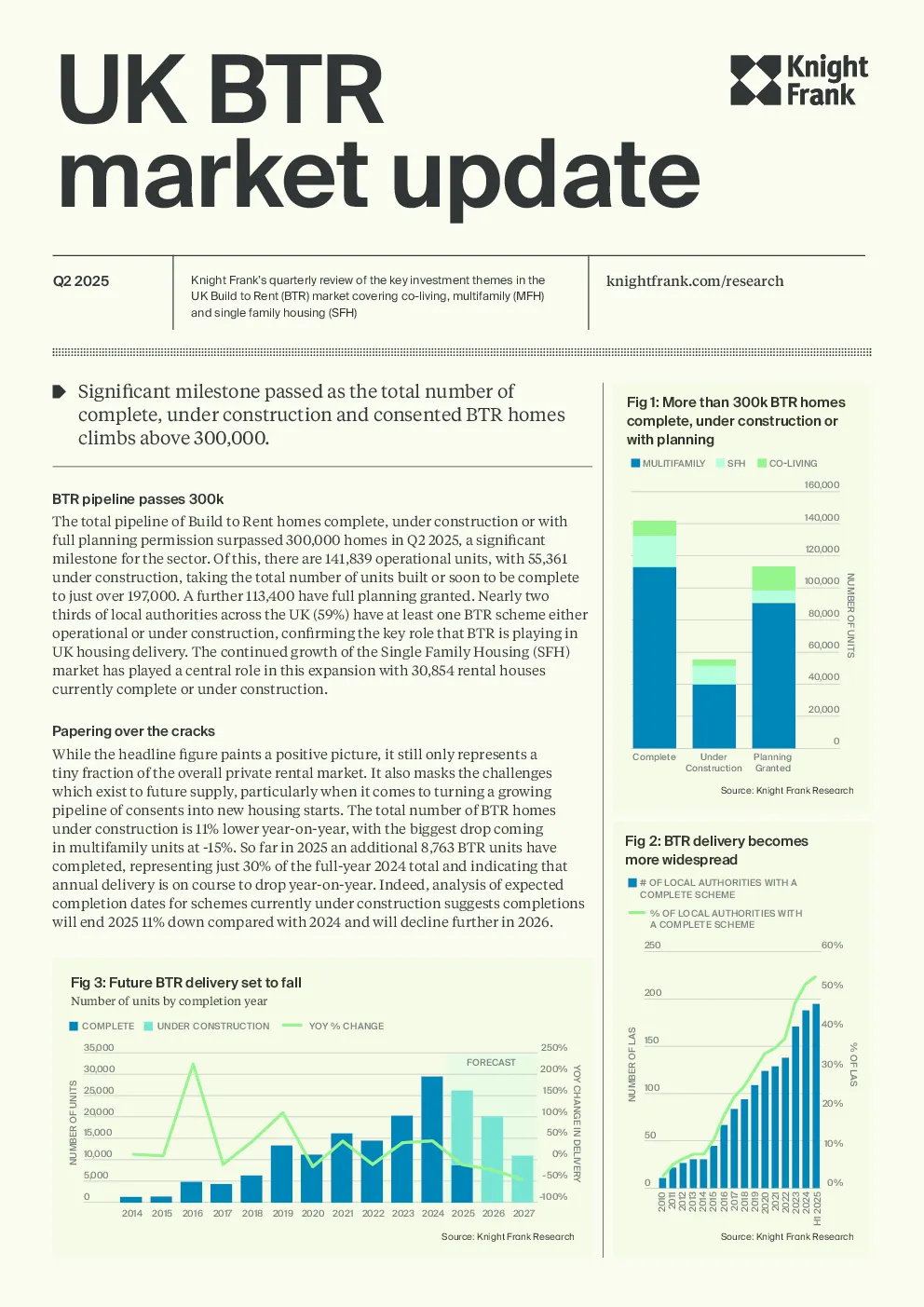
Source: Knight Frank ResearchSource: Knight Frank ResearchSFHCO-LIVINGPlanningGranted20142015201620172018201920202021 2Significant delays at the Building Safety Regulator (BSR) are currentlyblocking schemes across the country, while concerns over developmentviability, driven by build cost inflation and the economic climate, arecontributing to a cautious market. Taken together, these factors are slowingdown delivery, as projects aren’t proceeding from planning through toconstruction and delivery. This represents a threat to delivery of housingof all tenures, particularly in urban areas. However, as build and financingcosts ease and as government reforms to the BSR – which include theintroduction of a new fast track process to speed up decisions – take hold,we expect new starts will recover, supporting future delivery.Things can only get better?The outlook for the remainder of the Parliament also looks more positive,with specific mention for BTR in the Government’s long-term housingstrategy. The Planning Reform Working Paper also favours a multi-tenureapproach to delivery on large sites noting that BTR sites can “build out upto 60% faster than conventional models”. Tackling backlogs and delays atthe Building Safety Regulator, combined with planning reforms startingto bed in, could help provide more certainty around delivery. There’s nodoubt that the sector’s ability to rapidly deliver high-quality, professionallymanaged homes will remain a vital part of the UK’s housing mix and theGovernment’s ambitious 1.5 million homes target.UK BTR investment tops £2 billion in H1Investment into the UK Build-to-Rent sector exceeded £1 billion in Q2,bringing total spend for the first half of 2025 to £2.2 billion. While thisrepresents a decline compared to the same period last year - both on aquarterly and half-yearly basis – it reflects the ongoing growth in SingleFamily Housing, where deals typically involve smaller lot sizes. Over £730million was invested in SFH across 17 transactions during Q2, with stronginterest from both domestic and international capital. SFH has accountedfor 49% of total BTR investment so far this year, with an average deal sizeof £40 million. In addition, investors continue to deploy capital in themultifamily market. In Q2, five multifamily deals were completed, with acombined value of £280 million. Once again, the driving force behind UKBTR investment has been deals funding future development. In 2025 todate, 83% of transactions have been for the development of new homes.Fig 6: BTR transaction volumes by sub-sectorSFHMULTIFAMILYSFH % OF TOTAL (RHS)CO-LIVING2020202120222023Q1Q2Q3Q4Q1Q2Q3Q4Q1Q2Q3Q4Q1Q2Q32520151050NUMBER OF DEALS 3Jump in deal volumesAlthough overall investment value trails the record-breaking first half of 2024,deal volumes have increased, up by 28% on Q2 2024 and by 17% compared withH1 pointing to an active investment market. Key transactions in Q2 included theoperational multifamily assets Slate Yard in Manchester and Solasta Riversidein Glasgow, L&G's first BTR disposal. On the SFH side, Newhall in Harlow andWhitehouse in Milton Keynes completed. Knight Frank advised on all four deals.Demand for rental homes is high…Our analysis of time on the market shows that the median time to let a BTR homeacross the UK in the second quarter of 2025 was just 17 days, highlighting theongoing strong demand from tenants for purpose-built professionally managedrental accommodation. While demand remains strong, average time on the markethas ticked up when compared to the frenzied rental market seen post-pandemic,reflecting a return to a more seasonal lettings environment. A slight increase in theaverage time taken to let a property also reflects the fact that the acute nature of thesupply and demand imbalance is easing. There are 18% more rental homes on themarket than this time last year, but that’s still a quarter lower than in 2019.…but rental inflation is easingFurther evidence of a market returning to pre-pandemic levels can been seenwhen looking at rental inflation, which all the major indices suggest is moderatingfrom recent highs. In some markets, the easing can be attributed to the increase insupply over the past year which is currently being absorbed. Our expectation is thatrents across the UK PRS sector will grow by 4% over 2025, though there is room foroutperformance in more affordable areas close to large cities.Not all markets are equalOur analysis of the UK private rented sector indicates that the recent moderation inrental inflation is being led by the top end of the market. Price segmentation revealsthat the sharpest slowdown is occurring in the most expensive areas, while rentalgrowth in more affordable areas remains more resilient. For BTR investors, thistrend underscores the relative outperformance of schemes targeting the mid andcore markets. Looking ahead, we expect growing investor interest in mid-marketBTR opportunities, which align with a broader demand base. These schem