AI智能总结
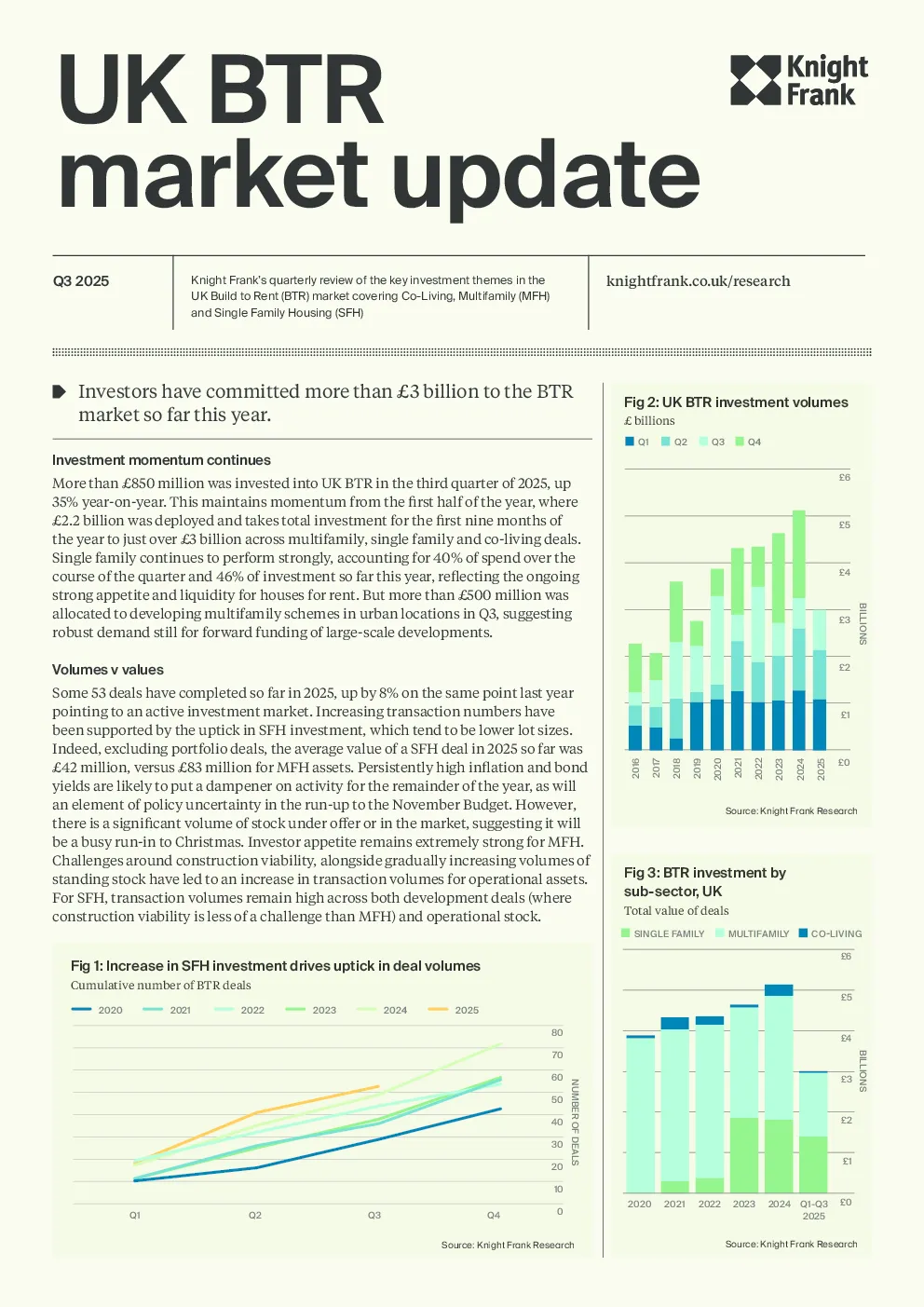
Knight Frank’s quarterly review of the key investment themes in theUK Build to Rent (BTR) market covering Co-Living, Multifamily (MFH)and Single Family Housing (SFH) Investors have committed more than £3 billion to the BTRmarket so far this year. Investment momentum continues More than £850 million was invested into UK BTR in the third quarter of 2025, up35% year-on-year. This maintains momentum from the first half of the year, where£2.2 billion was deployed and takes total investment for the first nine months ofthe year to just over £3 billion across multifamily, single family and co-living deals.Single family continues to perform strongly, accounting for 40% of spend over thecourse of the quarter and 46% of investment so far this year, reflecting the ongoingstrong appetite and liquidity for houses for rent. But more than £500 million wasallocated to developing multifamily schemes in urban locations in Q3, suggestingrobust demand still for forward funding of large-scale developments. Volumes v values Some 53 deals have completed so far in 2025, up by 8% on the same point last yearpointing to an active investment market. Increasing transaction numbers havebeen supported by the uptick in SFH investment, which tend to be lower lot sizes.Indeed, excluding portfolio deals, the average value of a SFH deal in 2025 so far was£42 million, versus £83 million for MFH assets. Persistently high inflation and bondyields are likely to put a dampener on activity for the remainder of the year, as willan element of policy uncertainty in the run-up to the November Budget. However,there is a significant volume of stock under offer or in the market, suggesting it willbe a busy run-in to Christmas. Investor appetite remains extremely strong for MFH.Challenges around construction viability, alongside gradually increasing volumes ofstanding stock have led to an increase in transaction volumes for operational assets.For SFH, transaction volumes remain high across both development deals (whereconstruction viability is less of a challenge than MFH) and operational stock. Cumulative number of BTR deals ‘Not out of the woods yet’ As expected, the Bank of England (BoE) kept interest rates at 4.00% during itsSeptember monetary policy committee meeting and announced the decision todial back its quantitative tightening bond-selling programme from £100 billionto £70 billion. The quantitative tightening target is in line with the BoE’s widermonetary policy plan to effectively reduce the banks’ balance sheet, while ensuringnot to impact the government’s wider gilt issuance strategy. Andrew Bailey, theBoE governor, suggested the UK economy was ‘not out of the woods yet’, and whileinflation stayed flat in August, unfavourable base rate effects will likely meaninflation will rise in the September reading, and any further rate cuts will need to bemade gradually and slowly. See the wood for the trees Despite an optimistic view amongst some forecasters that the BoE base rate couldfall up to 100bps to 3.00% by the end of 2026, lingering fiscal concerns and a softereconomic outlook suggest property yields will stay elevated relative to 10-yeargovernment gilts, at least in the medium term. However, the UK is not alone in thisscenario, with the spread between long-term government bond yields and propertyyields a global phenomenon for investors. But investors can see the wood for thetrees. For real estate, stable income growth, rather than yield spreads, is what willdrive capital growth returns in this cycle. For BTR investors, this means focusingon markets with favourable demand-supply imbalances, and assets with expectedvalue appreciation. Illustrating this is the UK’s growing proportional share ofEuropean BTR investment turnover. Despite a more favourable debt landscape inEurope, UK BTR has captured almost 30% of investor appetite across the continentsince 2023. Complete BTR stock surpasses 150k The UK’s BTR stock now stands at 153,367 complete homes, up by 25% compared toQ3 2024. There are a further 54,354 homes under construction meaning the sectorshould rise to more than 200,000 operational homes within the next few years. Thatwould mark a significant landmark for the sector, yet it remains a fraction of overalldemand. Challenges impacting the wider development market, however, mean thatoutside of the existing development pipeline the longer-term outlook for supply isless certain. So far this year, more than 20,000 BTR homes have completed, puttingthe sector just behind last year’s record delivery. SFH has accounted for just under afifth of completions so far this year, up from a tenth in 2021. Cumulative number of complete units by sub-sector Faltering at the start line As well as the c.207,000 BTR homes built or currently underway, there area further 111,422 with full planning granted. Turning these into new startsremains a challenge. The number of units under construction is 8% lowerthan a year ago, suggesting the market is caug