您的浏览器禁用了JavaScript(一种计算机语言,用以实现您与网页的交互),请解除该禁用,或者联系我们。 [巴克莱银行]:总结大型美丽法案的影响 - 发现报告

总结大型美丽法案的影响

2025-07-08 - 巴克莱银行 王泰华
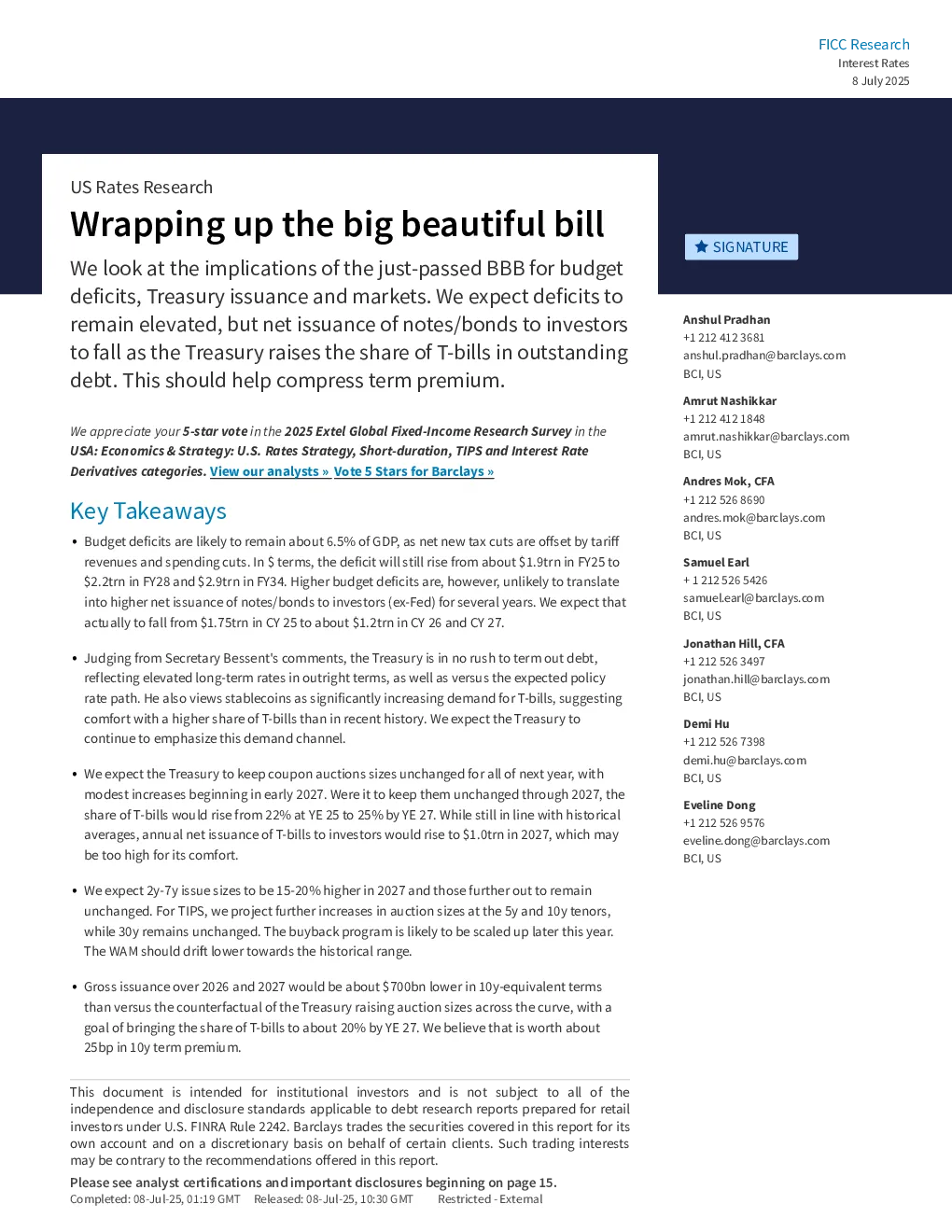
报告封面

Restricted - External Anshul Pradhan+1 212 412 3681anshul.pradhan@barclays.comBCI, USAmrut Nashikkar+1 212 412 1848amrut.nashikkar@barclays.comBCI, USAndres Mok, CFA+1 212 526 8690andres.mok@barclays.comBCI, USSamuel Earl+ 1 212 526 5426samuel.earl@barclays.comBCI, USJonathan Hill, CFA+1 212 526 3497jonathan.hill@barclays.comBCI, USDemi Hu+1 212 526 7398demi.hu@barclays.comBCI, USEveline Dong+1 212 526 9576eveline.dong@barclays.comBCI, US •At the refunding meeting, we expect the Treasury to reiterate that it "anticipates maintainingnominal coupon and FRN auction sizes for at least the next several quarters." With the debtlimit raised, it would rely heavily on T-bills to raise the cash balance quickly. We expect net T-bill issuance of $830bn in H2 25 and annual net issuance to average $700-800bn in CY 26-27.•Separately, the Fed has been shrinking its Treasury portfolio for some time now, by $475bn in2024 and $120bn in 2025. We expect QT to end by March 2026 and the Fed to become a buyerof USTs as it reinvests mortgage pay-downs into the Treasury market and eventually expandsthe balance sheet in 2027 to keep up with rising demand for reserves.Market implications•Duration: For a terminal fed funds rate pricing of 3-3.25%, we expect 10y and 30y yields todecline to 4.2% and 4.6% by year-end, respectively, 20-30bp below market pricing as termpremium compresses. For a more meaningful persistent move either way, the market needsto reassess the terminal rate.•Curve: The Treasury yield curve should remain steep as the Fed lowers the policy rate, butless than implied by forwards. The 1y forward 2s30s Treasury curve should be about 100bp,as opposed to the market-implied curve of 125bp.•Money markets:We expect T-bills to cheapen relative to OIS and SOFR to rise vs. fed fundsamid the rapid increase in net T-bill issuance over the coming months. However, given thecurrent and expected level of money market fund assets and starting share of T-bills, suchcheapening should be modest.•Inflation:A term premium compression should put more downward pressure on real yieldsthan breakevens, especially further out the curve, given that breakevens reflect only modestinflation risk premium.•Swap Spreads: Swap spreads should widen somewhat as markets digest the deficit andissuance implications of the reconciliation bill. The lowering of eSLR, along with potentialexclusion of Treasuries, should also support wider spreads.•Volatility:The passage of the bill is negative for short expiry/long tenor volatility. It shouldalso flatten payer skew in 30y tenors to make it more consistent with shorter tenors, whereskew is negative. But the rising US debt load supports a steeper forward vol surface.•In terms of trades,we maintain our recommendations to be long 5yf 5y USTs, 3y swapspread wideners, long 0.5 beta-weighted 30y breakevens and 3m expiry 2s30s 1:1 floorspreads.Budget Deficits: Where do we land?With the bill now having been made into law, we first look at its budget deficit implications.Figure 1 tabulates the annual budget deficit numbers, starting from the latest CBO baselineunder current law (which assumes TCJA tax cuts expire) and incorporating the initial score ofthe Senate plan (and assuming that expiring new tax provisions are made permanent). Thebudget deficit would rise from 6.6% in 2025 to about 7.1% of GDP in FY 26 and FY 27 and risefurther to about 7.6% in a decade's time. This is somewhat more expansionary than the currentpolicy baseline (of maintaining the current tax rates). On a 10y basis, tax provisions increaseprimary deficits about $5.3trn (assuming permanence, versus scored of $4.5trn). This is partlyoffsetby spending cuts of $1.2trn, resulting in a net primary deficit increase of $4.1trn; just theextension of TCJA would have cost $3.8trn.2 1https://www.cbo.gov/publication/61389FIGURE 1. Budget deficits are likely to stay in a 6-handle as a share of GDP2025202620272028202920302031203220332034-1,865-1,713-1,687-1,795-2,054-2,140-2,233-2,371-2,481-2,586-131-460-581-578-530-540-560-580-650-700-19-84288132176204206221-24-48-69-87-103-119-134-152-171-1,996-2,217-2,323-2,400-2,584-2,651-2,736-2,880-3,077-3,236-6.6%-7.1%-7.1%-7.1%-7.4%-7.3%-7.2%-7.3%-7.5%-7.6%-6.5%-6.2%-6.7%-6.7%-7.3%-7.3%-7.3%-7.5%-7.6%-7.6%-1,898-2,009-2,102-2,163-2,330-2,381-2,446-2,572-2,746-2,888-6.3%-6.4%-6.5%-6.4%-6.6%-6.5%-6.5%-6.6%-6.7%-6.8%98196201209217225235244255262These numbers, however, do not includetariffrevenues.Assuming an $200bn/year run-rate (at the weighted averagetariffrate of about 15%1) would result in a better profile. Figure 1shows that budget deficits as a share of GDP would remain about 6.5% and rise modestly in thesecond half. On a 10y basis, the cost would drop to about $2trn, but not as fiscally profligate asthe current policy. Needless to say, there is significant uncertainty abouttariffpolicy that farout, but over the next few years, there are likely to be significanttariffrevenues.Figure 2, Figure 3 and Figure 4 show reven