您的浏览器禁用了JavaScript(一种计算机语言,用以实现您与网页的交互),请解除该禁用,或者联系我们。[世界卫生组织]:hrp联盟在行动:通过在东地中海的伙伴关系适应未知 - 发现报告

hrp联盟在行动:通过在东地中海的伙伴关系适应未知

AI智能总结
查看更多
hrp联盟在行动:通过在东地中海的伙伴关系适应未知

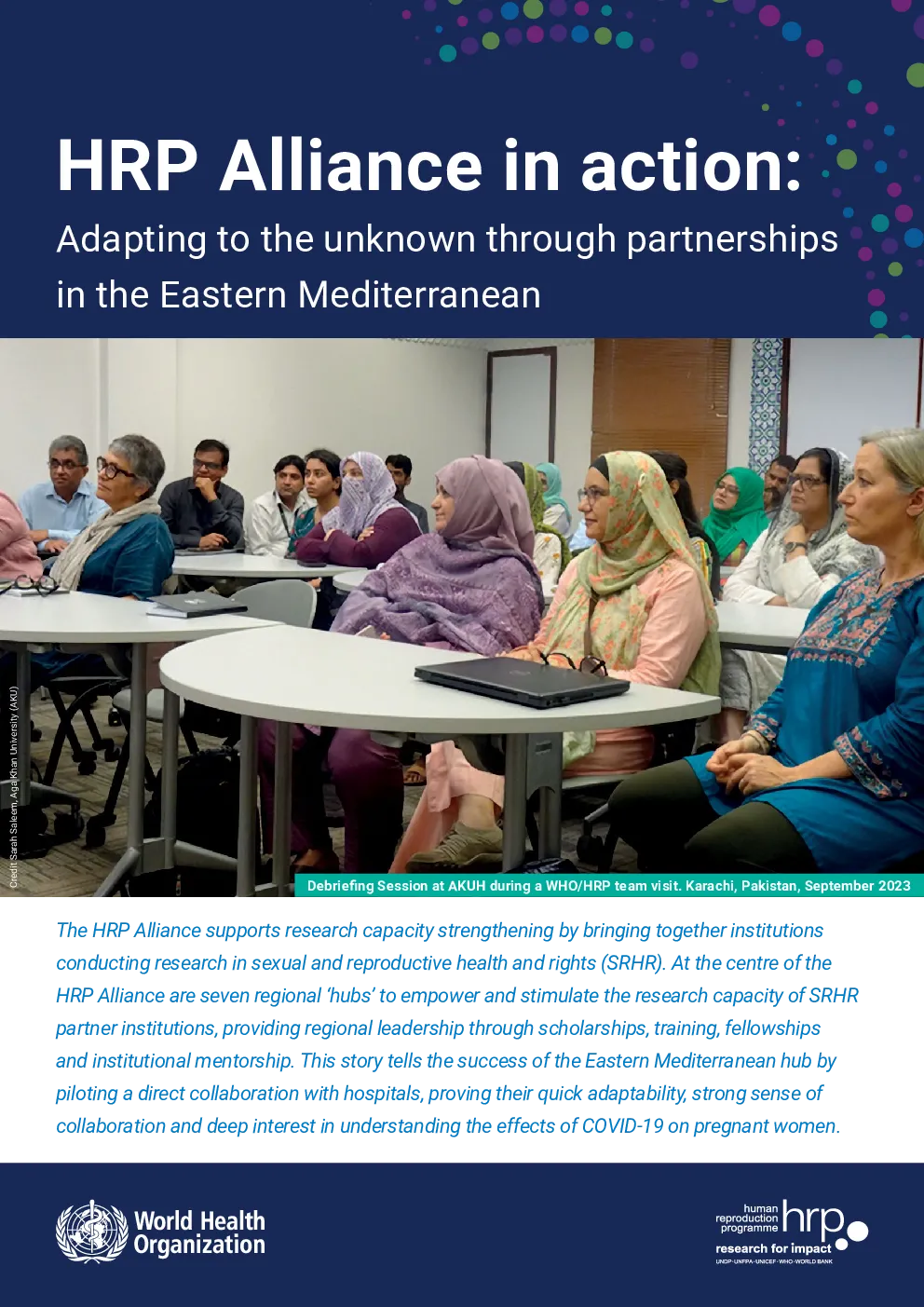
The Department of Community Health Sciences ofthe Aga Khan University (AKU) in Karachi, Pakistanserves as the Eastern Mediterranean regional hub forthe HRP Alliance, focusing on sexual and reproductivehealth and rights (SRHR) research capacity building.This hub, with support from the HRP Alliance, haspioneered a direct collaboration with hospitalsand training local researchers on SRHR matters,including groundbreaking research on the effects ofCOVID-19 on pregnancies. The hub’s success can beattributed to their rapid adaptation of strategy whenthe pandemic broke out. They quickly shifted theirattention both to operate under unknown and difficultcircumstances as well as understanding how thisvirus affects the health of pregnant women.“We started during COVID-19, and everything wasnew, so we quickly transitioned to online platformsto develop and deliver courses. I prepared andreviewed sessions, conducted literature searches,and collaborated with others to ensure we addressedcritical topics in research and reproductive healtheffectively,” said Sarah Saleem, Head of the Populationand Reproductive Health Section of the Department ofCommunity Health Sciences at AKU and HRP Alliancehub Principal Investigator (PI).Addressing challenges throughcollaborationSimultaneously, the initiative fostered directcollaboration between researchers and localhospitals. At that time, studies showed severechallenges to maternal health as lockdowns andI prepared and reviewed sessions, conducted literaturesearches, and collaborated with others to ensure weaddressed critical topics in research and reproductivehealth effectively.Sarah Saleem Page3prioritization of COVID-19 care led todeclines infacility-based births and postnatal visits in Pakistan.Financial barriers forced lower-income womentoward under-equipped private hospitals, while fearof infection and movement restrictions delayedcare-seeking. Hospitals thus faced two prominentchallenges: first, a lack of human and materialresources to provide adequate maternal health careand second, there was little to no knowledge of theimpact of COVID-19 on pregnant women.The hub addressed this gap by organizing targetedcapacity-building efforts, such as qualitative andquantitative research training, tailored to the needs ofhealthcare practitioners and emerging researchers.These courses equipped participants with theskills needed to undertake methodologically soundstudies, analyse data and translate these data intogroundbreaking publications which are the cornerstoneto improved policies.Learning and innovationsOne of the key learnings from the work of the hub wasthe value of leveraging digital platforms for trainingand collaboration. By offering online courses, includingmanuscript and research proposal writing, the hubensured inclusivity, enabling young researchersfrom remote areas and other Eastern Mediterraneancountries to participate. Furthermore, the emphasison mentorship allowed trainees to connect directlywith experienced researchers, facilitating knowledgetransfer and fostering a community of practice. Topicsusually marked as sensitive and taboo in the regionwere discussed and explained from an evidence-basedperspective. The concepts were introduced, followingWorld Health Organization (WHO) guidelines anddefinitions, and then they would go in depth on howto conduct research around these issues, includingtraining on ethical data collection.Another critical lesson was the need for culturalsensitivity when addressing topics such as abortionand contraception. Through careful stakeholderengagement and a focus on health outcomes, thehub was able to shift conversations and encourageunderstanding that all SRHR issues are vital for thehealth of their populations. A model for global adaptationThe impact of these efforts has been multi-fold.Over 100 researchers in the region have completedadvanced research training since the hub beganactivities. Among them was Sheikh Irfan: “In the firstyears of my PhD, it was extremely challenging tocommence and conduct field research in Pakistan dueto COVID-19 and related lockdowns, but I still madeprogress by writing and publishing the study protocols,including the one for a Cochrane review. The HRPAlliance collaboration led me to achieve somethingcompletely new in the context of my local setting,focusing on the feasibility ofFAST-M interventionfor early recognition and management of maternalsepsis in a low resource setting; something whichapparently had never before been done in Asia.” Dueto the close collaborations with the hospital, Irfan’swork was quickly taken up: “Consequently, the hospitaladministration decided to include FAST-M tools in thefiles of all maternal patients for early recognition andmanagement of maternal sepsis which is considered amajor achievement of our work,” he said.In the first yearsof my PhD, it wasextremely challenging tocommence and conductfield research in Pakistandue to COVID-19 andrelated lockdowns, butI still made progress byw