您的浏览器禁用了JavaScript(一种计算机语言,用以实现您与网页的交互),请解除该禁用,或者联系我们。[世界卫生组织]:HRP联盟在行动:通过非洲价值观澄清改变社会规范 - 发现报告

HRP联盟在行动:通过非洲价值观澄清改变社会规范

AI智能总结
查看更多
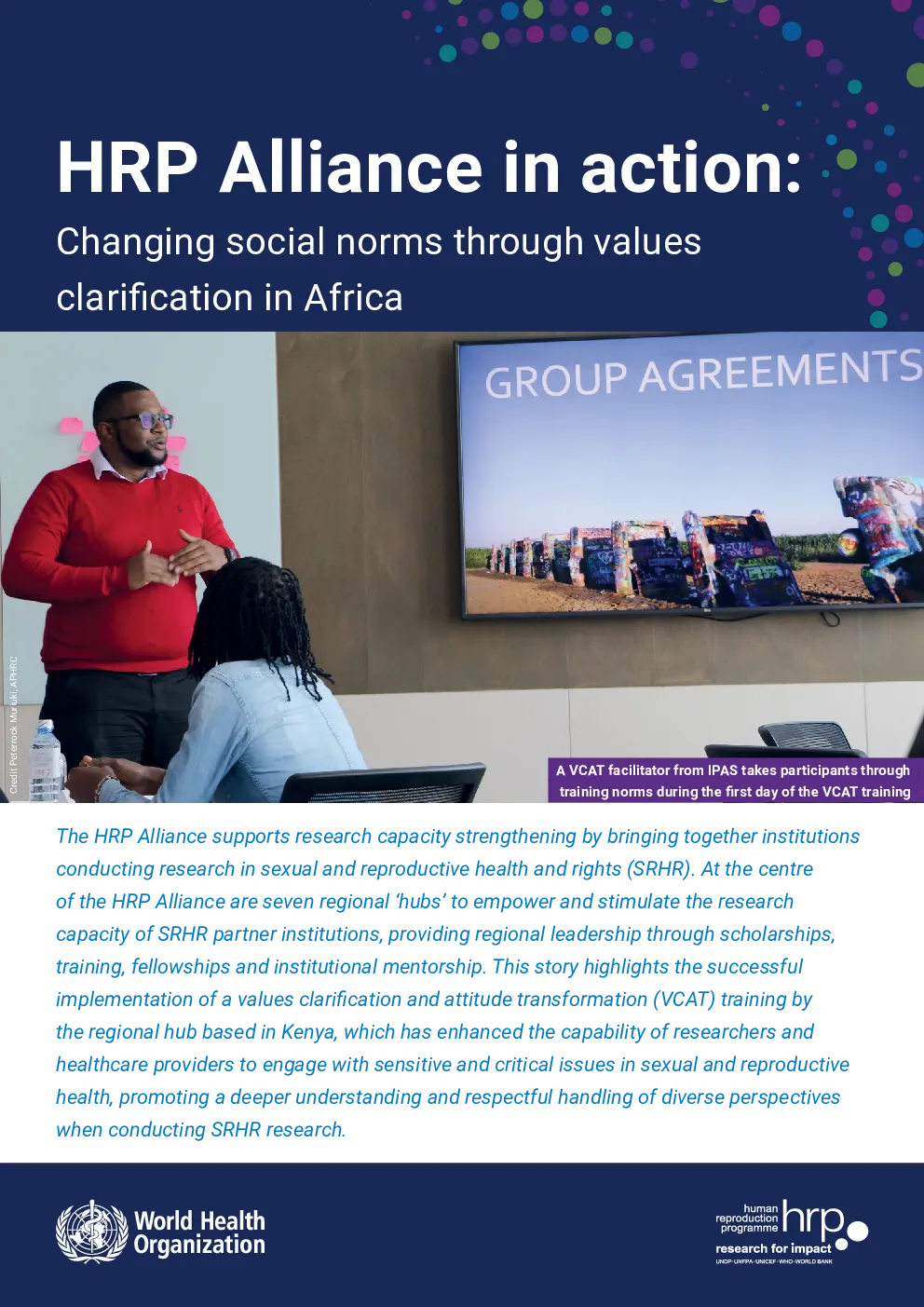
HRP联盟在行动:通过非洲价值观澄清改变社会规范

expectations, and power dynamics. When these normshealth and rights (SRHR) through the innovativeimplementation of a values clarification andattitude transformation (VCAT) training. Initiated inpartnership withIpas, this training was strategicallydeveloped to address capacity building bothinternally among APHRC staff and externally acrossHRP Alliance partners and beyond. Hesborn Wao,principal investigator at the hub, emphasizes, “VCATis essential for healthcare workers and researchers tocritically evaluate their own values, ensuring these donot interfere with their research or service delivery.”Scaling and impactPrior to offering this training, APHRC staff noticedseveral challenges hindering effective researchand service delivery in SRHR. One of the primaryconcerns was the presence of personal andsocial biases that influenced the way researchersand healthcare providers approached sensitiveSRHR topics, potentially affecting the objectivityof research. Cultural and ethical beliefs thatresearchers themselves might not even be awareof can lead to biased attitudes toward issues suchas contraception, abortion and sexual health.VCAT training participants sort through paper slips in an activityto match SRHR terms to their proper meaning during the training Sexual and reproductive health involves respect,safety, and freedom from discrimination and violence,and it iscritically influencedby gender norms, roles,are harmful, it can lead to unconscious biases andeven discriminatory actions. Addressing these normsis essential for improvinghealth and rights-basedoutcomesand requires research, services, and policiesthat actively confront and transform inequitablegender power relations. In East and Southern Africa,there are examples where gender inequalities canlead to practices such as child marriage and femalegenital mutilation, which adversely affect women’shealth and autonomy. Regional harmful socialnorms and practices, along with restrictive legalcontexts and inequalities,pose major challengesto achieving healthy SRHR outcomes. Additionally,social expectations can discourage open discussionsaboutcontraceptionand reproductive choices, limitingaccess to family planning services.The African Population & Health Research Center(APHRC) in Kenya, serving as the HRP Alliance hubfor the African Region, has significantly advancedresearch capacity in sexual and reproductive and people living with HIV. Hearing these stories,combined with interactive discussions, made mereflect on the impact of stigma, bias and restrictivepolicies on their access to healthcare. It reinforcedthe urgent need for safe spaces and nonjudgmentalservices for these individuals.”Moreover, VCAT promotes greater empathy andsensitivity among researchers. By exploring anddiscussing their values in an open environment,participants can better appreciate diverse perspectivesand the complex realities of the topics they work with.Broader implications and collaborationsThe success of VCAT at APHRC shows that thehub not only enhances individual capabilitiesbut also fosters partnerships for SRHR researchacross the region. A significant collaboration wasestablished with the HRP Alliance hub at IRSS inBurkina Faso, enabling the delivery of the VCATtraining in French for participants from BurkinaFaso, Guinea, and Côte d’Ivoire. Additionally, thehub partnered with two global VCAT consultantswho contributed their international expertise todevelop a structured curriculum for both in-personand virtual training. The training was then furtherintegrated into theAPHRC virtual academy, allowingit to be delivered as a blended course. For this, thefacilitators developed an online learning approachthat integrates interactive activities, self-pacedmodules, and live training sessions to enhance theaccessibility and scalability of the VCAT training.The VCAT training also played a crucial role insupporting research teams involved in theCognitiveTesting of a Survey Instrument to assess SexualPractices, Behaviours, and other Health-relatedThe training equipped me with the right tools tofacilitate safe, open conversations and advocate fordignified, inclusive SRHR services that recognise theunique struggles of different individuals.Maryben Omollo Recognizing these challenges, the hub at APHRCcreated a safe space for participants to criticallyreflect on their values, understand their biasesthat might hinder the research they engage in anddevelop the skills needed to navigate these complexissues with greater neutrality and sensitivity.Peter Muriuki, coordinator of activities for the hub,explains the process: “the first training was amongsenior leadership from APHRC. Then, this wascascaded to other staff and then we started offeringthis externally, including researchers participatingin a study led by HRP.” By engaging in thesetrainings, participants recognize how their valuesand attitudes might get in the way of producingevidence. They learn to recognise the basis for theirattitudes and appro