您的浏览器禁用了JavaScript(一种计算机语言,用以实现您与网页的交互),请解除该禁用,或者联系我们。[世界卫生组织]:hrp联盟在行动:通过西太平洋的专业培训加强研究 - 发现报告

hrp联盟在行动:通过西太平洋的专业培训加强研究

AI智能总结
查看更多
hrp联盟在行动:通过西太平洋的专业培训加强研究

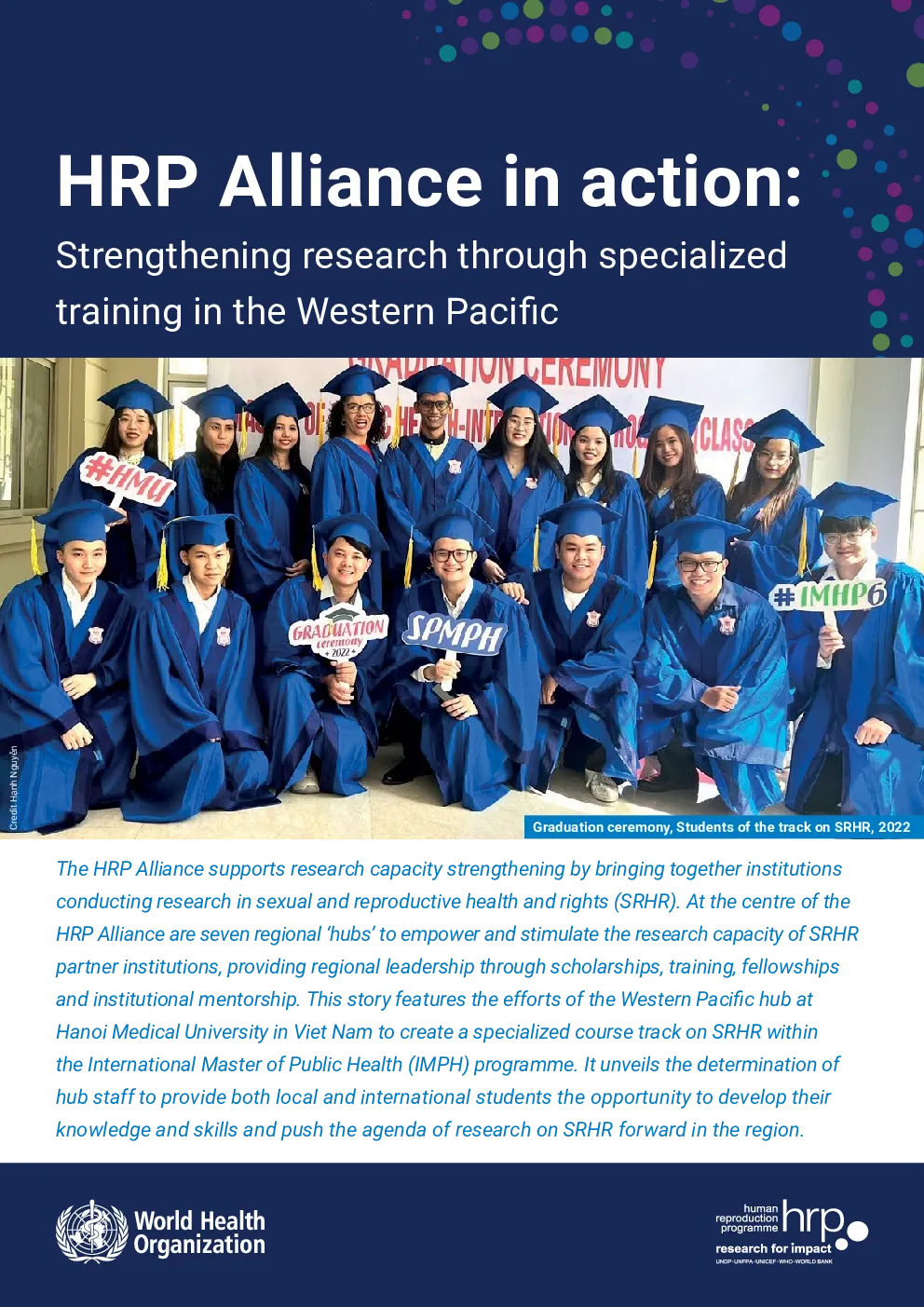
The Western Pacific region is facing significantchallengesin sexual and reproductive health andrights (SRHR). Notably, there are high rates ofsexually transmitted infections (STIs) and cervicalcancer, coupled with limited access to safe abortionservices. Despite these challenges, the countries inthe region have increasingly adoptedWorld HealthOrganization (WHO) recommendationsinto nationalhealth policies, strategies and guidelines focusingon reproductive, maternal, newborn, child andadolescent health.The regional hub of the HRP Alliance based in VietNam, hosted by Hanoi Medical University (HMU),has achieved notable success in advancing SRHRresearch capacity. Its unique contribution lies inthe development of a specialized track in SRHRwithin the International Master of Public Health(IMPH) programme. This track has the potential tosignificantly strengthen research capabilities in SRHRacross the Western Pacific region and even globally.The challengeThe Western Pacific region lacked structuredand specialised training programmes in SRHR.This absence created a critical gap in researchcapacity, as institutions and professionals in theregion were not adequately equipped to address SRHR challenges such as gender-based violence,adolescent health and contraceptive access.This is why HMU, with support from the HRPAlliance, developed a track focusing on SRHR as partof its IMPH programme. “At my university, we initiallyhad a general public health master’s programme.However, I noticed there was no specialisation inSRHR. With funding from the HRP Alliance, weproposed and developed the SRHR track, whichprovides scholarships for students from manycountries. This initiative was essential to addressthe lack of structured training in the region.” saidNguyễn Thị Thuý Hạnh, the principal investigator forthe Western Pacific hub. The track was designed toprovide students with advanced knowledge and skillsto conduct high-quality research specific to SRHR.The curriculum includes conceptual knowledge onissues around adolescent sexuality, maternal andperinatal health, gender-based violence, especiallyduring pregnancy and after birth, abortion andresearch methodologies and rigorous data analysistechniques, enabling students to design and conductin-depth research on pressing challenges andknowledge gaps related to SRHR.The development process involved collaborationwith local and international experts, includingfaculties at HMU (School of Preventive Medicine and Page3Public health), hub staff and representatives frominternational agencies such as the United NationsPopulation Fund and the International Organizationon for Migration. This collaborative effort ensuredthat the curriculum aligned with global standardswhile addressing regional needs. Pilot trainingsessions were conducted to refine the curriculumbased on student feedback.Regional effort, global expansionBetween 2019 and 2023, the programme supported17 master’s and one PhD students specializingin SRHR, with scholarships provided by the HRPAlliance. One of the Vietnamese students NguyệtMinh expressed gratitude: “Thanks to the invaluablesupport from the HRP Alliance and my supervisor,Dr Hanh, I successfully completedmy thesisonmental disorders among pregnant women beforeand during the COVID-19 pandemic. [The IMPH] hassignificantly enhanced my research capabilities,including literature review and synthesis, dataanalysis, teamwork and presentation skills. Thesecompetencies have allowed me to transitionsmoothly into my current role at the Department ofHealth Insurance under the Ministry of Health.”To further strengthen research capacity, the hubalso hosted workshops and seminars focused onSRHR topics. These included training on gender-based violence, sex and gender integrationinto health research, and advanced researchmethodologies for sensitive issues. The hub’sactivities emphasized equipping researchers fromthe regional network, including the IMPH students,with practical tools to conduct their researchrigorously and effectively.An ever-changing environmentThe implementation of the SRHR track revealed theimportance of flexibility and adaptation. The COVID-19pandemic necessitated the adoption of hybrid learningmodels and the reallocation of resources to ensureprogramme continuity. These adjustments not onlyallowed the programme to proceed but also madeit more accessible to students unable to attend inperson. Additionally, the collaborative development of the curriculum highlighted the value of engagingdiverse stakeholders, including academic faculty,international experts and policy makers. Accordingto Nguyen, “We collaborated extensively to designthe curriculum. For the SRHR track, we worked withthe School of Preventive medicine to shape theprogramme and invited lecturers at the University ofCopenhagen to provide input and join our assessmentboard. We also engaged international collaborators forspecific training courses to bring global expertise intothe programme.”The SRHR track has