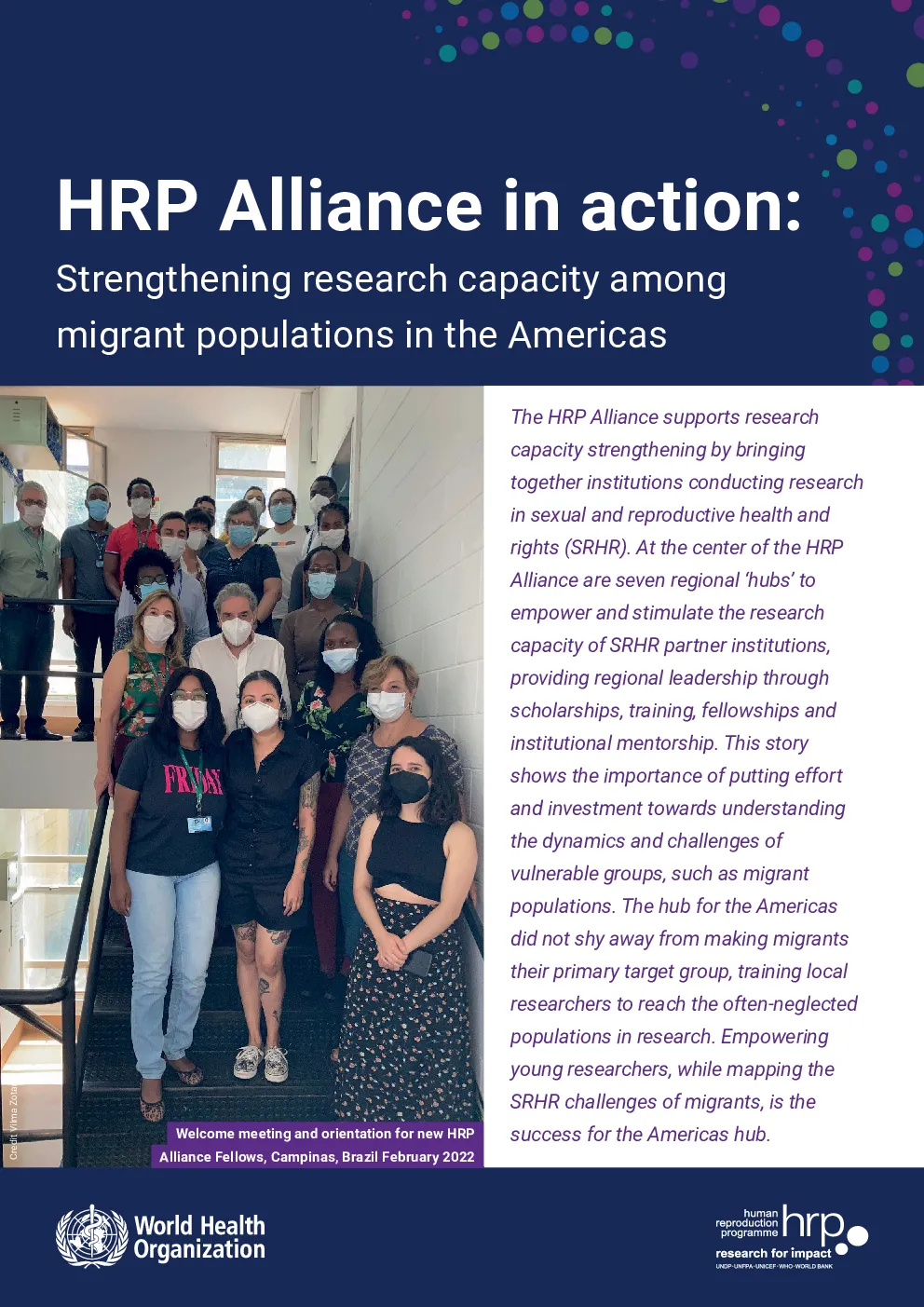
您的浏览器禁用了JavaScript(一种计算机语言,用以实现您与网页的交互),请解除该禁用,或者联系我们。[世界卫生组织]:hrp联盟在行动:加强美洲移民人口的研究能力 - 发现报告

hrp联盟在行动:加强美洲移民人口的研究能力

AI智能总结
查看更多
hrp联盟在行动:加强美洲移民人口的研究能力

Page2Throughout the Latin American Region,access tohealth care systemsand services can be fragmentedwith some vulnerable populations not being able toaccess healthcare. For example, many countries in theregion are dealing with fragmented and under-sourcedhealth systems which have beenshown to lead topoor outcomes and unequal access to SRHR services.These challenges are multiplied for migrants, facingadditional barriers such as language, legal status anddiscrimination. In 2018, The Pan American HealthOrganization (PAHO) establishedmass migration as aregional priority, in light of themillions of Venezuelansleaving their country as refugees and migrants. Thismigration crisis was, at the time, one of the largestmigratory movements in the world. This crisis, and thenear absence of locally generated knowledge on thesexual and reproductive health and rights of migrantsin the region prompted an innovative collaborationwith the HRP Alliance hub for the Americas at theCredit Leila Rocha Centro de Pesquisas em Saude Reprodutiva Campinas(CEMICAMP) in Brazil. CEMICAP played a crucialrole in supporting targeted research to uncover andaddress the barriers to SRHR services for migrantpopulations across the Americas.With HRP Alliance support, CEMICAMP combinedtechnical training with hands-on research support,through a small research impact grants programme,innovated to respond to the specific challenges facedby migrants in the region.Barriersto implement SRHR programmes in theregion can be attributed to insufficient and unstablefunding, strong regional differences and the absenceof high-quality data and quality indicators. Anotherissue is the unequal access to SRHR services,including a lack of trained personnel and adequateservices and availability for specific populationgroups such as adolescents, women in rural areas,indigenous communities, migrants and peopleidentifying as LGBTIQ +.Given their role as a hub, CEMICAMP leveraged itsstrategic partnerships with the University of Campinasto provide essential training for health professionals.These efforts ensured that researchers andpractitioners alike were equipped to address systemicgaps in SRHR services, particularly for migrantpopulations.Using the opportunity provided by the HRP Alliance’sresearch impact grants scheme, the hub at CEMICAMPwas able to lead this initiative focused on building localresearch capacity and generating evidence to informhealth system responses. Eleven projects across eightcountries, including Brazil, Colombia and Ecuador,were selected from 66 applications. These studiesinvestigated key SRHR barriers and facilitators formigrants, such as language barriers, discriminationand health system inadequacies, while also identifyingprotective factors like inclusive policies in specificcontexts.One notable outcome was the publication offindings in a specialPAHO Journal Issue. Thearticles presented findings from the diverse topicsexplored through the research projects, includingaccess to maternal health services, sexual andgender-based violence and abortion services for Venezuelan migrants. For example, researchconducted in Brazil highlighted how systemicbarriers like out-of-pocket costs hindered access toHIV/AIDS treatment among Venezuelan migrants,while universal health system policies acted asfacilitators. Similarly, studies in Guatemala andMexico revealed limited SRHR information andheightened vulnerability to sexual violence amongmigrant women and girls.CEMICAMP provided end-to-end support tograntees, from developing research protocolsto securing ethical approvals and preparingmanuscripts. This support was provided throughmandating participation in a comprehensive onlinetraining course covering research methodologiesand implementation.The feedback from participants wasoverwhelmingly positive. Many highlighted how thesupport from CEMICAMP allowed for bridging criticalknowledge gaps, empowering them to undertakeresearch projects with rigor and confidence. NellyAlvarado Ascencio, the principal investigator for theresearch team in El Salvador, even received a national I feel honored thatmy work is beingrecognized, this wouldnot have been possiblewithout HRP Alliance’ssupport. Their guidanceand provision of trainingand resources allowedme to explore thecritical issues migrantpopulations face interms of SRHR.Nelly Alvarado Ascencio Page4scientific research prize in 2024 in El Salvadorbecause of her research on migration and health. “Ifeel honored that my work is being recognized, thiswould not have been possible without HRP Alliance’ssupport. Their guidance and provision of training andresources allowed me to explore the critical issuesmigrant populations face in terms of SRHR.”The success of CEMICAMP’s model has significantimplications for other regions experiencing similarSRHR challenges. The publication of the PAHOJournal special series serves as a critical resource forpolicymakers and researchers, showcasing evidence-based interventions that can infor