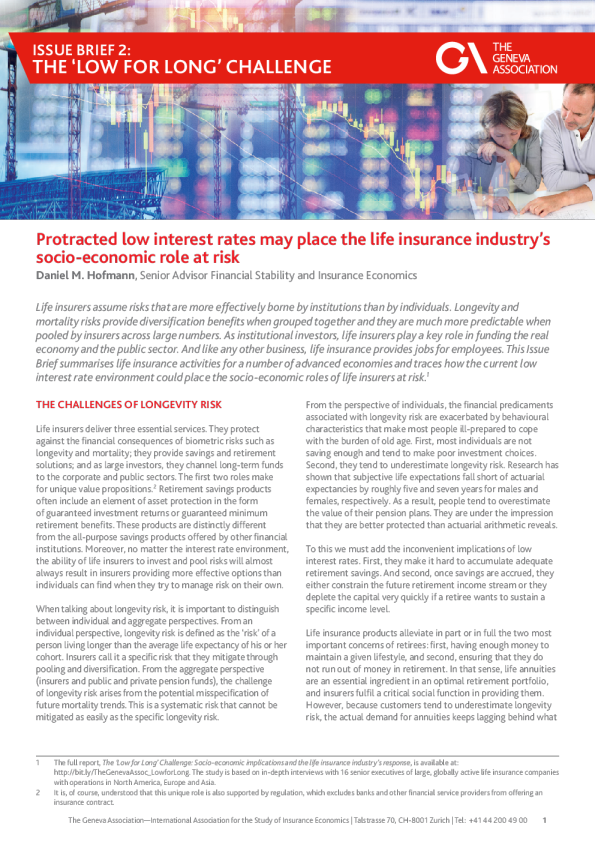
问题简报2:长期的低利率可能会使人寿保险业的社会经济作用面临风险
1The Geneva Association—International Association for the Study of Insurance Economics | Talstrasse 7 0 , CH-8001 Z urich | Tel:+41 44 200 49 0 01 www.genevassociation.org | @ TheGenevaAssocproducts relative to GDP. The record is mixed. In the U.K.penetration rates declined from a very high level, and therealso appears to be a decline in the U.S., which in fact startedmore than 30 years ago. In all other countries, protectionpenetration rates have increased, rising slightly in Germanyand Japan and nearly doubling in the case of France. Thereappears to be no detectable influence of interest rates on thesechanges over time.However, low interest rates seem to have had an adverseimpact on savings penetration rates in France and Germany(Figure 2). There are many reasons why this is the case. Eachcountry started out from different initial conditions, withproducts offered under different regulatory regimes and withdifferent tax incentives. And needless to say, low investmentyields make these products less attractive. From the morecomplete data presented in the background paper, one canderive these tentative conclusions:1.In the long run, life insurers did indeed gain a foothold inthe retirement solutions markets,2.The current low interest rate environment is likely to makefurther gains in this area a tough challenge,3.Continued low interest rate pressure could force lifeinsurers to move away from their unique role in the deliveryof retirement savings solutions with asset protection. Thiswould open a gap that cannot easily be filled.FUNDING THE ECONOMYTogether with mutual funds and pension funds, insurers arethe world’s largest institutional investors.3According to theOECD, in 2016 global insurers held USD 30.8 trillion in financialassets, of which more than USD 23 trillion were held by lifeinsurers. These amounts enable insurers to provide substantialfunding to governments and the corporate sector. Moreover,as a result of stable premium cash flows and their long-term,liability-driven investment approach, insurers are a stablesource of funding for the real economy. They play an importantrole in meeting long-term funding needs and, based on stablepremium in-flows, their steady portfolio allocations contributeto financial market stability.3Institutional investors are defined as non-bank institutions or individuals that trade financial securities in sufficiently large volumes to receive preferentialtreatment and lower commissions. As presumably knowledgeable investors, they are also not sheltered by consumer protection laws geared to smaller retail 2might be considered a societal optimum. It will be a noblechallenge for life insurers to help improve financial literacy andmake a contribution to mitigating the financial consequences oflongevity risk.Figure 1: Penetration of protection products(premiums in per cent of GDP)FRA (lhs)JPN (lhs)GER (lhs)USA (lhs)GBR (rhs)20062008201020122014201620182.0%1.8%1.6%1.4%1.2%1.0%0.8%0.6%0.4%0.2%0.0%10%9%8%7%6%5%4%3%2%1%0%Sources: ACLI, Axco, OECD and The Geneva Association.Figure 2: Penetration of savings products(premiums in per cent of GDP)10%8%6%4%2%0%GERGBR200620082010201220142016FRAUSAJPNSources: Axco, OECD, and The Geneva Association.Figure 1 provides an overview of life insurance penetrationrates for longevity and mortality protection products overthe past decade, i.e., how much policyholders spend on thoseinvestors. 3The Geneva Association—International Association for the Study of Insurance Economics | Talstrasse 7 0 , CH-8001 Z urich | Tel:+41 44 200 49 0 0Investments of insurers must meet future policyholder claims(liabilities), and it is in the nature of this liability-driveninvestment approach that the allocation of investmentportfolios is fairly stable over the medium term. This issupported by the observation that, on an industry-widelevel, the allocation to broad asset classes has not revealed adiscernible interest rate sensitivity in recent years.4The picture changes, however, when one looks further back inhistory, as illustrated by the portfolio reallocation of Japaneselife insurers in Figure 4. Between 1980 and 2015, the share ofloans in the portfolios shrank from 60 to 10 per cent. At thesame time, the share of government bonds expanded from 5 to45 per cent, a growth that picked up sharply after 2000 whenthe government incurred a swelling debt burden to stimulatethe economy. In insurers’ portfolios, government securitiesreplaced corporate bonds, which is another way of saying thatJapanese insurers withdrew from funding the real economy infavour of the government. Also striking is the growing shareallocated to foreign securities. This potentially increasedforeign exchange risk, although some or all of that risk mayhave been hedged or (as in the case of unit-linked products)passed on to policyholders.Similar developments were observed in Germany. The shareof government bonds held in investment portfolios more thandoubled after the year 2000 (Figure 3). This was i