问题简报1:人寿保险业如何应对“可控的逆风”
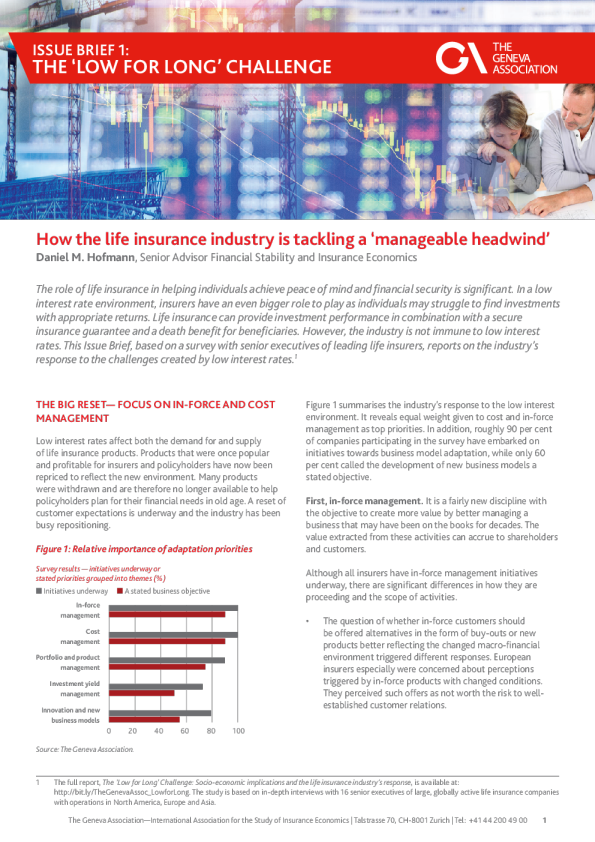
1The Geneva Association—International Association for the Study of Insurance Economics | Talstrasse 7 0 , CH-8001 Z urich | Tel:+41 44 200 49 0 0 2www.genevassociation.org | @ TheGenevaAssoc•Even more differing responses were received with respectto structural in-force actions which include selling legacybooks. Although a number of insurers did such transactions,many voiced strong objections to selling old books,wishing instead to retain in-force customers for the longterm. Transaction statistics reveal that the majority oflegacy book deals were performed in the U.S. and the U.K.,whereas numbers and size of such deals were considerablylower on the European continent.While in-force management activities are well established,more needs to be done. Slightly less than one-tenth of projectshave been completed. And more than half of the projectsare considered either underway or still in early stages. It isprobably fair to assume that in-force management will be firmlyinstitutionalised even after the current initiatives are done.Second, cost reduction.It ranks at the same priority level asin-force management, but the motives are different. For manyexecutives, cost management is common sense; they perceivethe sector as not being as efficient as it could be. Othersunderlined the importance of cost reductions to mitigate theadverse impact of lower investment returns in order to benefitinsurers and/or policyholders. And a third group called forinsurers to become more efficient in order to prepare for futurecompetition against InsurTech companies that are not saddledwith legacy burdens.However, achieving cost reductions can be difficult. The devilis in the details. One of the major challenges referred to arisesfrom complicated IT legacy systems built decades ago. They areoften not well integrated, creating barriers for speedy efficiencygains. Many executives saw a need for the corporate cultureto change towards an even more cost and customer-centricmind set. The survey also revealed that cost work is an ongoingprocess. Consequently, respondents believed that even morecould be done to improve the cost efficiency of life insurers, andparticularly so in light of technological progress.TOWARDS A NEW BUSINESS MIXUp to now, insurers have made significant progress withinitiatives rebalancing their new business mix towards moresustainable products that are, from both a policyholder andshareholder perspective, better adapted to the current lowinterest rate environment. Focus areas highlighted by surveyparticipants include: •Reducing the reliance on savings products (with highinterest rate guarantees) and replacing them with unit-linked and hybrid products that feature more sustainableguarantees or no guarantees at all,•Developing a stronger focus on biometric risk or termprotection products,•Focusing on wealth management for high net worthindividuals and, more broadly, on asset managementproducts,•Focusing on corporate customers by offering unit-linkedpensions and corporate protection business.As interest rates declined, many insurers sought additionalinvestment yield to fund the (high) guarantees promisedto policyholders on in-force policies or simply to maintainattractive pricing on new business. However, searching foryield does not seem to be as high a priority as often stated.This could be explained by regulatory considerations and/orsimply because the risk adjusted return fails to make the cut.Nearly half of respondents thought that a permanent reviewof investment management should be ‘business as usual’. Theymade clear that reviews cover a whole range of activities, suchas implementing sophisticated IT systems to better matchassets and liabilities, and outsourcing investment functions tothird party asset managers.When looking ahead, answers in response to questionsabout new, innovative business models were a bit reserved.Although executives saw the need to adapt business modelsto compete against potential high-tech competitors, it wasnot clear how exactly such business models would apply andhow new technologies could better support the business inthe future. A tentative conclusion could be that leaders needmore information about the potential of new technologies.They appear to believe that it is difficult to see how technology-enabled business models that disrupted competition in otherindustries could be transformed for insurance. There are alsomany hurdles that make market entry for non-insurancecompetitors difficult, rendering the need to face the challengeof new technology competitors less urgent than in otherindustries. But executives are aware that parts of the valuechain are being disrupted and that the potential for newtechnology challengers should not be neglected. 3The Geneva Association—International Association for the Study of Insurance Economics | Talstrasse 7 0 , CH-8001 Z urich | Tel:+41 44 200 49 0 0The extent to which life insurers will fulfil this role depends onhow successfully they can navigate the