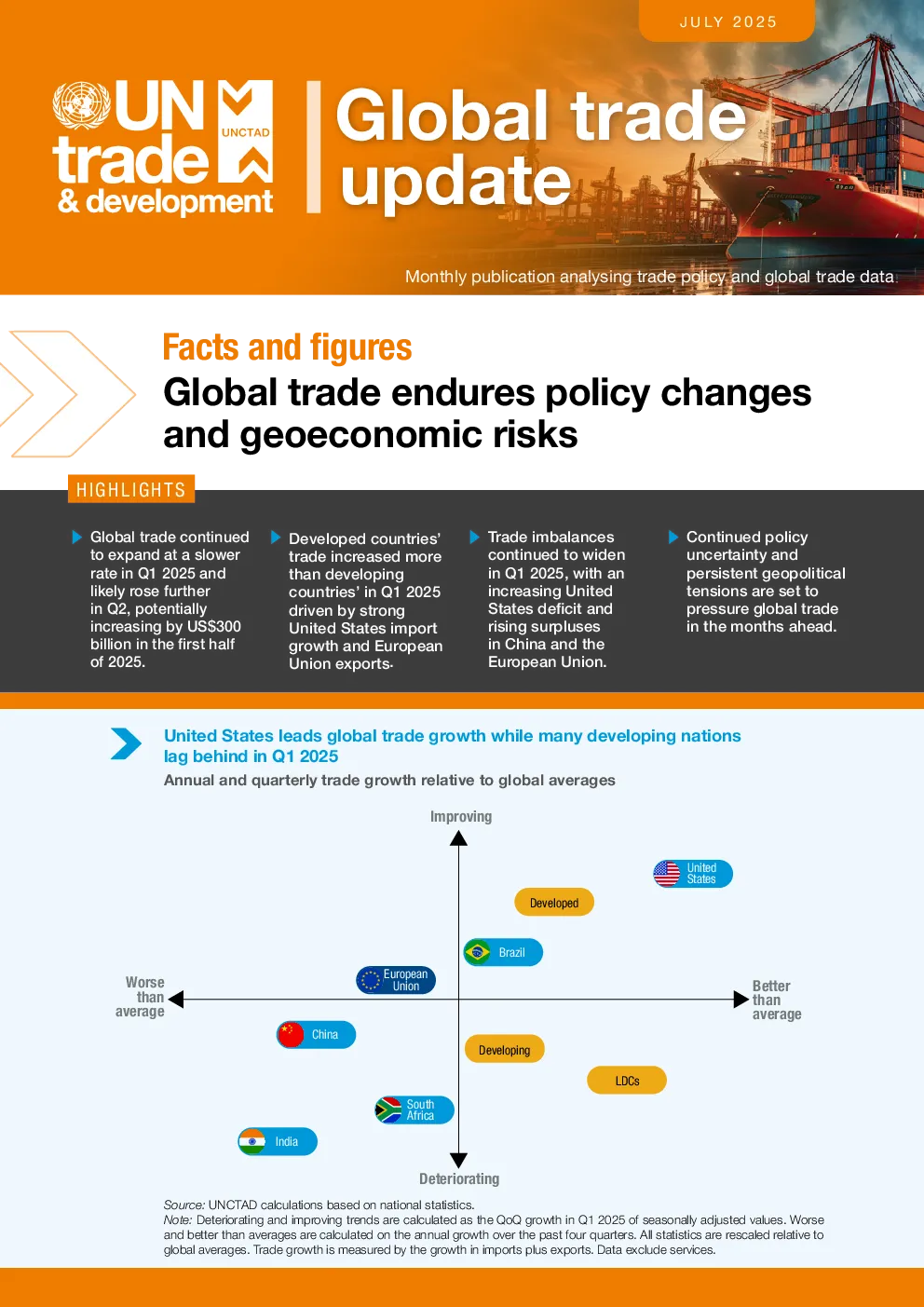
22019 Q12020 Q12021 Q12022 Q12023 Q12024 Q12025 Q1-30-20-10102030Quarterly servicesAnnual services Quarterly goods Annual goods2019 Q12020 Q12021 Q12022 Q12023 Q12024 Q12025 Q1-10-50510152025QuarterlyAnnualGlobal trade trends and nowcastGlobal trade in goods and services continued its positive trajectory during the first quarter of 2025(Q1 2025), with a quarter-over-quarter (quarterly) increase of about 1.5 per cent and a trailing fourquarters (annual) growth rate of 3.5 per cent. In Q1 2025, trade in goods and services grew at similarrates of approximately 1.5 and 1.7 per cent, respectively. However, services growth remains muchhigher on an annual basis, at around 9 per cent. The UNCTAD nowcast remains positive for Q22025, indicating a QoQ growth of about 2 per cent in both goods and services. According to theseestimates, global trade is set to expand by approximately US$300 billion in the first half of 2025, withgoods contributing about US$230 billion and services around US$70 billion.Global trade in goods and services remains strong in the first half of 2025Annual and quarterly growth in the value of trade in goods and servicesSources:UNCTADstat; UNCTAD calculations based on national statistics.Note:Quarterly growth is the quarter over quarter growth rate of seasonally adjusted values. Annual growth iscalculated using a trade-weighted moving average over the past four quarters. Figures for Q1 2025 are estimates.Q2 2025 is a nowcast as of 25 June 2025.Prices for traded goods registered a small upward tick in Q1 2025 and are expected to have increasedfurther in Q2 2025. This price increase partially explains the more significant growth in the value ofgoods trade during the first half of 2025, as volume growth was lower, at about 1 per cent.Trade inflation increased during 2025Annual and quarterly growth in the overall price of traded goodsSource:UNCTADstat; UNCTAD calculations based on national statistics.Note:Quarterly growth is the quarter over quarter growth rate of seasonally adjusted values. Annual growth iscalculated using a trade-weighted moving average over the past four quarters. Figures for Q1 2025 are estimates.Q2 2025 is a nowcast as of 25 June 2025. EstimatesNowcastEstimatesNowcast OutlookOverall, trade growth has been positive in the first half of 2025, despite increasing trade policyuncertainty, ongoing geopolitical tensions, and a challenging global economic environment. In thefirst quarter of 2025, global trade trends continued the gradual upward trajectory that began in thesecond half of 2023. Over recent quarters, both goods and services trade have shown consistentgrowth, largely driven by the strong performance of developing countries. However, in Q1 2025,developed economies outpaced developing ones in trade growth—primarily due to a surge inimports by the United States ahead of anticipated tariff increases, and robust export activity fromthe European Union. In contrast, South–South trade remained relatively subdued, although Africaregistered strong export growth. Nowcasts for Q2 2025 point to continued growth in both goodsand services trade. Preliminary data show that China’s exports remained resilient in April and May,driven by rising intra-regional trade and trade with Africa. United States’ exports also increasedin April. However, imports into the United States fell sharply QoQ, reflecting the impact of newlyimposed tariffs and the unusually high volume of imports in Q1, as businesses rushed to bring ingoods ahead of the tariff increases.Looking ahead to the second half of 2025 continued resilience in trade will depend heavily on policyclarity, geoeconomic developments, and supply chain adaptability. On the negative side, globaleconomic growth is expected to slow down in many regions, suggesting that international trade mayface slower growth. Moreover, the potential imposition of higher tariffs in the United States—and therisk of broader trade conflicts—pose significant downside risks. A negative signal also comes from thelatest reading of China’s Purchasing Managers’ Index, which often reflects weakening manufacturingactivity and can signal reduced demand for imports and softening export orders. However, growingregional integration may provide some support to global trade. Moreover, leading indicators such asthe Shanghai Containerized Freight Index and the Baltic Dry Index have rebounded from early 2025lows, although remain below 2024 averages.The most important factors contributing to heightened uncertainty in global trade for the second halfof 2025 are:Persisting trade policy uncertainty in the United StatesThe United States adopted a 10 per cent baseline tariff, with additional tariffs on specific countriescurrently on hold. Moreover, it imposed additional import duties on steel and aluminum. While the10 per cent rate is expected to remain, uncertainty is growing over potential pauses, exemptions,new broad-based tariffs targeting specific countries, and additional product-spec