您的浏览器禁用了JavaScript(一种计算机语言,用以实现您与网页的交互),请解除该禁用,或者联系我们。 [世界银行]:评估社会保护的适应性,提高蒙古牧民应对气候冲击的能力2025 - 发现报告

评估社会保护的适应性,提高蒙古牧民应对气候冲击的能力2025

农林牧渔 2025-06-23 世界银行 LIHUYUN
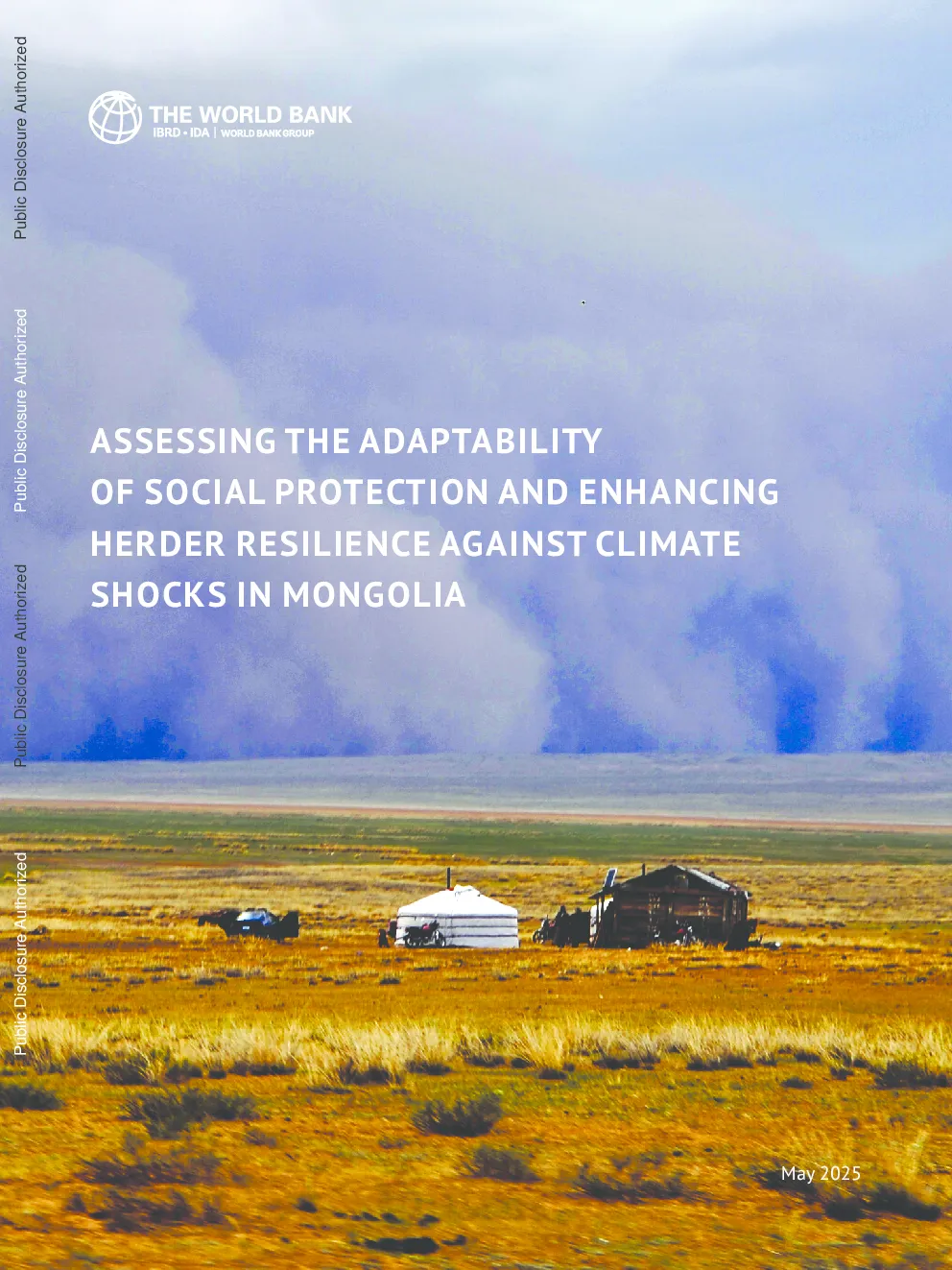
报告封面

ASSESSING THEADAPTABILITY OF SOCIALPROTECTION AND ENHANCINGHERDER RESILIENCEAGAINST CLIMATE SHOCKS INMONGOLIA May 2025 © 2025 International Bank for Reconstruction and Development / The World Bank1818 H Street NW, Washington, DC 20433Telephone: 202-473-1000; Internet: www.worldbank.org Some rights reserved This work is a product of the staff of The World Bank with external contributions.Thefindings,interpretations,and conclusions expressed in this work do notnecessarily reflect the views of The World Bank, its Board of Executive Directors, orthe governments they represent. The World Bank does not guarantee the accuracy ofthe data included in this work. Nothing herein shall constitute or be considered to bea limitation upon or waiver of the privileges and immunities of The World Bank, all ofwhich are specifically reserved. CONTENTS ForewordivAcknowledgementsvAcronyms and AbbreviationsviExecutive Summaryviii 1.1Poverty, vulnerability, and climate shocks11.2The role of adaptive social protection inresponding to covariate shocks41.3Purpose of this report51.4Conceptual and analytical framework for theASP assessment61.5Methodology71.6Report Structure7 REFERENCES56 2 ASSESSMENT OF THE ADAPTABILITY OF THESOCIAL PROTECTION SYSTEM IN MONGOLIA ANNEXES60 2.1 Institutional arrangements and partnerships102.1.1Government leadership and coordination112.1.2Laws and strategies152.2 Programs and delivery systems182.2.1Analysis of social assistance programswith regard to ASP192.2.2Government social protection responseto COVID-19 shocks and subsequent highinflation192.2.3 Emergency (humanitarian) assistance212.2.4 Delivery systems222.3 Data and information management systems242.3.1 Appraisal of existing information systemsfor the purposes of ASP242.3.2 Access by non-government actors toinformation28 Annex A.Selection of Mongolia’s social assistanceresponses to the COVID-19 pandemic60Annex B.Disaster protection institutional framework inMongolia62Annex C. NEMA organizational chart63Annex D. Examples of Adaptive Social Protection64 BOXES Box 1.Collaboration between national and subnationalactors in responding to the 2023 floods14Box 2.Integrated Household Administrative Database(IHAD)26Box 3.Social Protection and Climate Change inMongolia36Box 4. Overview of Local Development Fund54 3 ASP FOR POOR AND VULNERABLE DZUD-AFFECTED HERDERS33 FIGURES Figure 1.Percentage of poor under different scenarios,April-September 202020Figure 2.Disaster Risk Financing instruments inMongolia in 202330Figure 3.Purchases made by herders to prepare forwinter, 2018-201939Figure 4.Collection of items by herders to prepare forwinter, 2018-201942 3.1 Programs and delivery systems343.1.1 Government schemes353.1.2 Non-government schemes373.1.3 Delivery systems393.2Information Systems and Data403.2.1Data and systems that are relevant fordzud response403.2.2 Early warning systems413.3Other challenges faced by herders433.3.1 Index-based livestock insurance433.3.2 Other challenges not directly related tosocial protection45 TABLES Table 1.Coverage of index-based livestock insurance,2016-202144 FOREWORD Climate shocks, particularly dzud, have a profound and far-reaching impact on thelivelihoods of Mongolians, especially herders. Increasingly frequent due to climate change,these extreme weather events not only threaten the immediate survival of livestock butalso undermine the long-term resilience and sustainability of herding communities. At thesame time, other extreme weather events such as urban floods are also becoming morecommon. In this context, effective social protection measures are crucial to mitigatingthe adverse effects and supporting the recovery and adaptation of households. This report presents the results of extensive research and collaborative efforts toimprove Mongolia’s social protection system’s ability to adapt to covariate shocks andenhance herder resilience to climate shocks. It analyzes the existing social protectionmechanisms, with specific attention to social assistance, and emphasizes the system’spotential for adaptive social protection, as demonstrated by the government’s swiftresponse to the COVID-19 crisis. Nonetheless, the report also identifies gaps and offerspractical recommendations to enhance effectiveness across the four pillars of adaptivesocial protection: (i) Institutional arrangements and partnerships; (ii) Programs anddelivery systems; (iii) Data and information; and (iv) Finance. Furthermore, by assessingthe system’s responsiveness to the needs of the most vulnerable herders, it aims tofoster a more resilient community capable of withstanding and adapting to the inevitableclimate shocks. I extend my gratitude to all those who made this report possible, including keystakeholders consulted to assess the current state of Mongolia’s adaptive socialprotection system, including addressing challenges faced by herding communities. Theirinsights and experiences were invaluable in shaping the findings and reco