AI智能总结
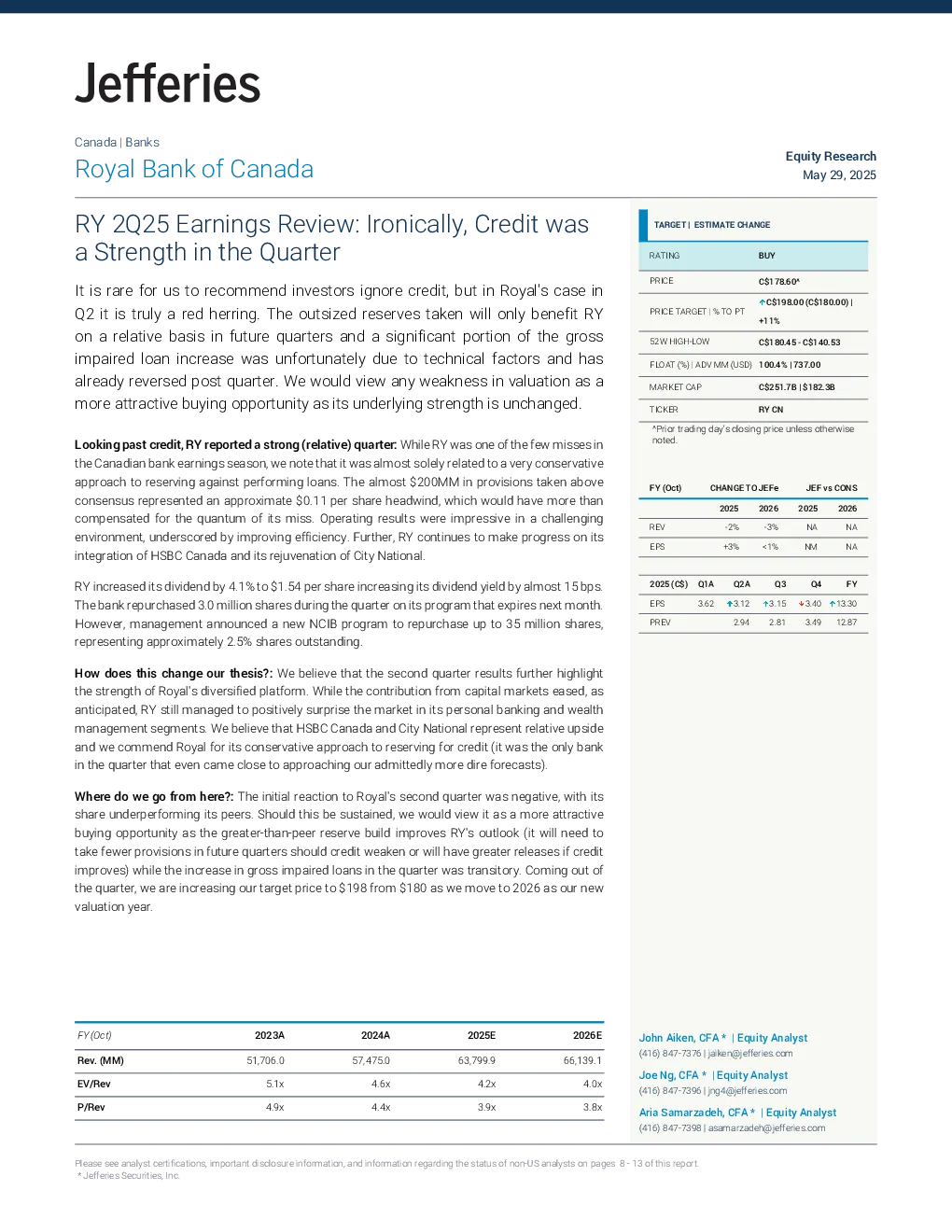
2024A2025E2026E57,475.063,799.966,139.14.6x4.2x4.0x4.4x3.9x3.8x John Aiken, CFA * | Equity Analyst(416) 847-7376 | jaiken@jefferies.comJoe Ng, CFA * | Equity Analyst(416) 847-7396 | jng4@jefferies.comAria Samarzadeh, CFA * | Equity Analyst(416) 847-7398 | asamarzadeh@jefferies.com The Long View: Royal Bank of CanadaInvestment Thesis / Where We DifferPost acquisition of HSBC Canada extends RY's dominance in Canadian retailand commercial banking. Further, with expense run-rate savings from itsrecent restructuring charges expected to hit the bottom line, we see a scenariowhere Royal will generate strong earnings growth and, on a relative basis,outperform the group.Base Case,C$198, +11%Our base-case price target of $198 for RY is basedon a 13.5x forward P/E against FY26E EPS of$14.63.Sustainability MattersTop Material Issues1)Product Design and Lifecycle Management:contributing to environmental and social impacts throughtheir lending practices and considering ESG factors and risk exposure when underwriting loans.2)Employee Diversity & Inclusion:fostering a diverse and inclusive workplace to attract top talent andbuild long-term value.Company Targets1) Commitment to provide $500 billion in sustainable finance by 2025.2) Total GHG emissions, market based (tonnes of CO23) Multiyear goal to have 50% women executives.Questions to Management1) What is the strategy for carbon-intensive lending portfolios; what are the near-term & long-term plansfor lending?2) What actions is the company taking to achieve its diversity & inclusion goals?Please see important disclosure information on pages 8 - 13 of this report.This report is intended for Jefferies clients only. Unauthorized distribution is prohibited. Risk/Reward - 12 Month ViewUpside Scenario,C$217, +22%Driven by a stronger-than-expected contributionfrom its HSBC Canada acquisition, our upsidescenario of $217 for RY is based on a 10% increaseto FY26E EPS against a forward P/E of 13.5x.e) — 70% reduction by 2025 vs 2018. Downside Scenario,C$158, -12%Weighed by a weaker domestic economy andprolongedslowdown,synergies from HSBCCanada fall short of expectations, resulting in ourdownside scenario of $158 for RY, based on a 10%decline to its FY26E EPS against a forward P/E of12.0x.CatalystsAgainst the backdrop of a soft landing, fuelingimprovedconsumer spending and strongerbusinesssentiment,RY's diversified businessmodel should garner solid top line growth, whilethe bank's restructuring of its cost base in 2023could result in a further boost to operating leverageand earnings. 2 Earning Through a Strong Reserve BuildSecond Quarter Results:PositiveOutlook:NeutralEarnings quality:With the spike in provisions and decline in capital markets related revenues, thequality of Royal's earnings was quite high in the second quarter.Operating leverage/performance:The decline in RY's core expenses was outpaced by its revenues,incurring negative sequential operating leverage in the second quarter.Risk:As integration risk associated with HSBC Canada eases, Royal's relative risk profile improves,with its strong capital ratio and diversified platform.Figure 1 - RY - EPS Summary.Q2-25 EARNINGS PER SHARE OVERVIEW(in C$ millions)ReportedAdjustments:Adjusting items, netAdjusted Core Earningsvs. JEF - Above/(Below)vs. Consensus - Above/(Below)Source: Company reports, JefferiesRY reported adjusted earnings per share of $3.12 below consensus expectations of $3.16 but aboveour estimate of $2.94. While Royal technically missed expectations, we note that the higher thanforecast provisions (against consensus) resulted in a roughly $0.11 per share headwind.On the credit front, RY posted a sizeable level of provisions in the quarter, coming in at $1,424 millionvs. consensus estimate of $1,227 million, with the bulk of the increase related to increasing reserveson performing loans, as provisions on impaired loans declined sequentially. That said, there was asignificant lift in impaired loans in the quarter (up over $1 billion or 14%) as commercial impairmentsremain elevated. Juxtaposed against the weaker credit performance, Royal's regulatory capital ratiowas stable, coming in at 13.2%, while it increased its dividend by 4.1% to $1.54 per share. Thisincreases RY's dividend yield by almost 15bps to 3.45%.By segment, Personal Banking net interest margins were up 6 bps while average loans were up 0.1%sequentially and 8.5% from a year ago. Revenues held in while efficiency improved in the quarter,with earnings down solely because of higher provisions on performing (impaired provisions weredown sequentially). On the Commercial Banking side, margins were down 7 bps while average loanswere up 1.5% against the first quarter and 22% (HSBC assisted) year-over-year. Revenues saw adecline, largely related to fewer days in the quarter while the overall decline in earnings was largelyattributable to a spike in provisions on performing loans. In Wealth Management, net interest marginfor the segment was down 6 bps