AI智能总结
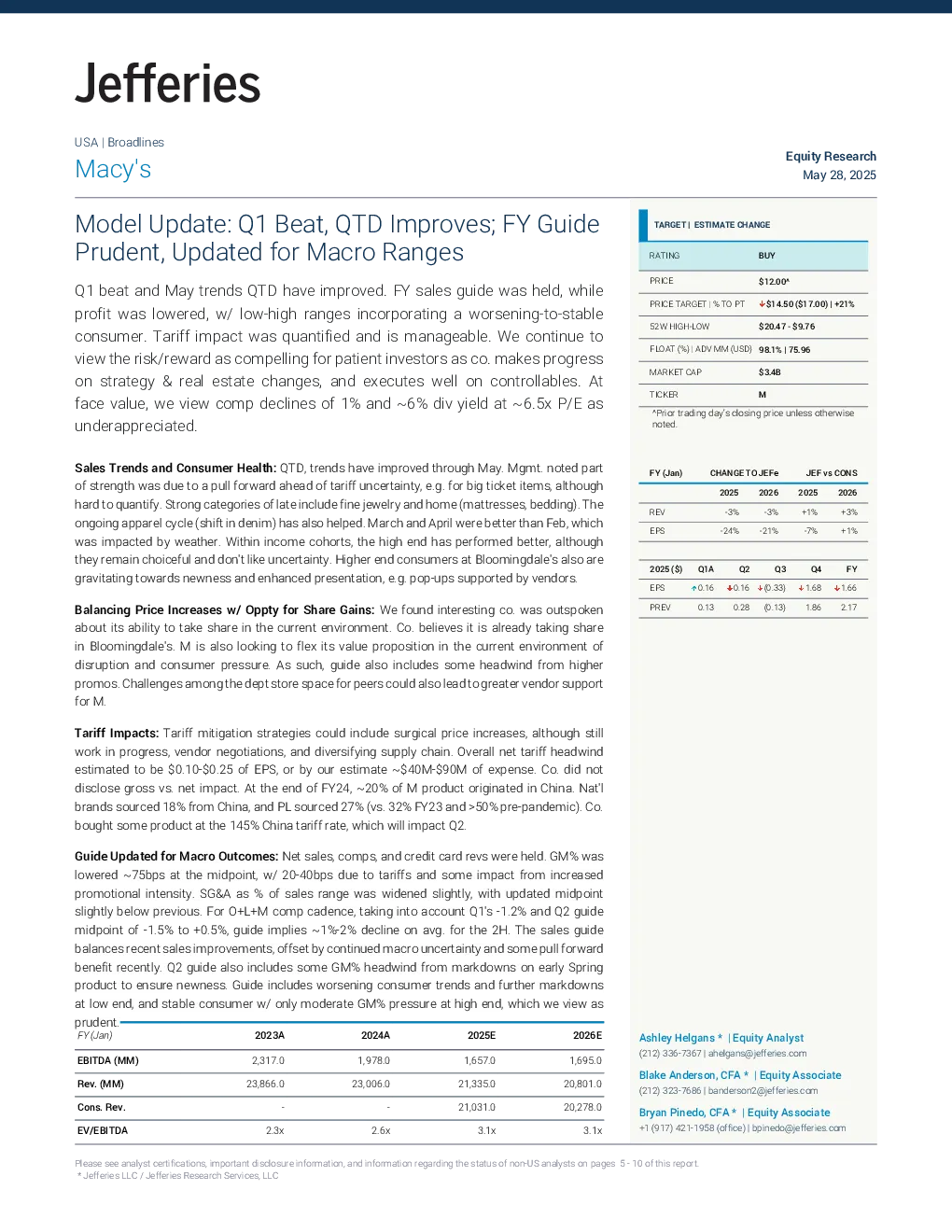
Model Update: Q1 Beat, QTD Improves; FY GuidePrudent, Updated for Macro Ranges Q1 beat and May trends QTD have improved. FY sales guide was held, whileprofit was lowered, w/ low-high ranges incorporating a worsening-to-stableconsumer. Tariff impact was quantified and is manageable. We continue toview the risk/reward as compelling for patient investors as co. makes progresson strategy & real estate changes, and executes well on controllables. Atface value, we view comp declines of 1% and ~6% div yield at ~6.5x P/E asunderappreciated. Sales Trends and Consumer Health:QTD, trends have improved through May. Mgmt. noted partof strength was due to a pull forward ahead of tariff uncertainty, e.g. for big ticket items, althoughhard to quantify. Strong categories of late include fine jewelry and home (mattresses, bedding). Theongoing apparel cycle (shift in denim) has also helped. March and April were better than Feb, whichwas impacted by weather. Within income cohorts, the high end has performed better, althoughthey remain choiceful and don't like uncertainty. Higher end consumers at Bloomingdale's also aregravitating towards newness and enhanced presentation, e.g. pop-ups supported by vendors. Balancing Price Increases w/ Oppty for Share Gains:We found interesting co. was outspokenabout its ability to take share in the current environment. Co. believes it is already taking sharein Bloomingdale's. M is also looking to flex its value proposition in the current environment ofdisruption and consumer pressure. As such, guide also includes some headwind from higherpromos. Challenges among the dept store space for peers could also lead to greater vendor supportfor M. Tariff Impacts:Tariff mitigation strategies could include surgical price increases, although stillwork in progress, vendor negotiations, and diversifying supply chain. Overall net tariff headwindestimated to be $0.10-$0.25 of EPS, or by our estimate ~$40M-$90M of expense. Co. did notdisclose gross vs. net impact. At the end of FY24, ~20% of M product originated in China. Nat'lbrands sourced 18% from China, and PL sourced 27% (vs. 32% FY23 and >50% pre-pandemic). Co.bought some product at the 145% China tariff rate, which will impact Q2. Guide Updated for Macro Outcomes:Net sales, comps, and credit card revs were held. GM% waslowered ~75bps at the midpoint, w/ 20-40bps due to tariffs and some impact from increasedpromotional intensity. SG&A as % of sales range was widened slightly, with updated midpointslightly below previous. For O+L+M comp cadence, taking into account Q1's -1.2% and Q2 guidemidpoint of -1.5% to +0.5%, guide implies ~1%-2% decline on avg. for the 2H. The sales guidebalances recent sales improvements, offset by continued macro uncertainty and some pull forwardbenefit recently. Q2 guide also includes some GM% headwind from markdowns on early Springproduct to ensure newness. Guide includes worsening consumer trends and further markdownsat low end, and stable consumer w/ only moderate GM% pressure at high end, which we view as Ashley Helgans * | Equity Analyst(212) 336-7367 | ahelgans@jefferies.comBlake Anderson, CFA * | Equity Associate(212) 323-7686 | banderson2@jefferies.comBryan Pinedo, CFA * | Equity Associate+1 (917) 421-1958 (office) | bpinedo@jefferies.com The Long View: Macy's Investment Thesis / Where We Differ •We believe the new "normal" assumed by consensus is overly negative•While we acknowledge the secular challenges to the dept. store channel,we see a slower decline and note potential optionality for M in new storeformats and brand partnerships•M has its work cut out to reinvigorate traffic, but sentiment remains lowand resilience during the pandemic suggests the MT steady state could bebetter than the market expects. Store closures are a positive step on thepath to returning to growth and expanding margins. Upside Scenario,$21, +75% Downside Scenario,$8, -33% Base Case,$14.5, +21% •Sales decline -4% in FY25 and -3% in FY26•GM% decreases 50bps in FY25 due to tariffsand promos and is flattish in FY26•SG&A % of sales increases ~130bps in FY25due to cost inflation and deleverage•Adj. EBITDA margin declines to ~7.5% in FY25from 8.6% in FY24, below 2019; FY26 margin is+30bps Y/Y driven by closing dilutive stores•PT of $14.50 = 8x EPS of $1.82. •Sales decline 3% FY25 and are flat in FY26despite store closures as discretionary spendimpacts are muted and co's strategic initiativescontribute to upside•GM% declines due to promos are mitigated bypricing science, marketplace, and lower digital,while tariff impacts are mitigated•SG&A% sees upside on incremental expensesavings and lapping cost inflation•EBITDA margins increase to 8.5%•PT of $21 = 9x EPS of $2.38. •Sales declines worsen to-7%as consumepressure increases, mall traffic worsens, andAUR benefits reverse on higher promos•M reinvests the majority of SG&A cuts into newinitiatives, which fail to drive traffic•More store closures are needed beyond theoriginal 150, pressur