AI智能总结
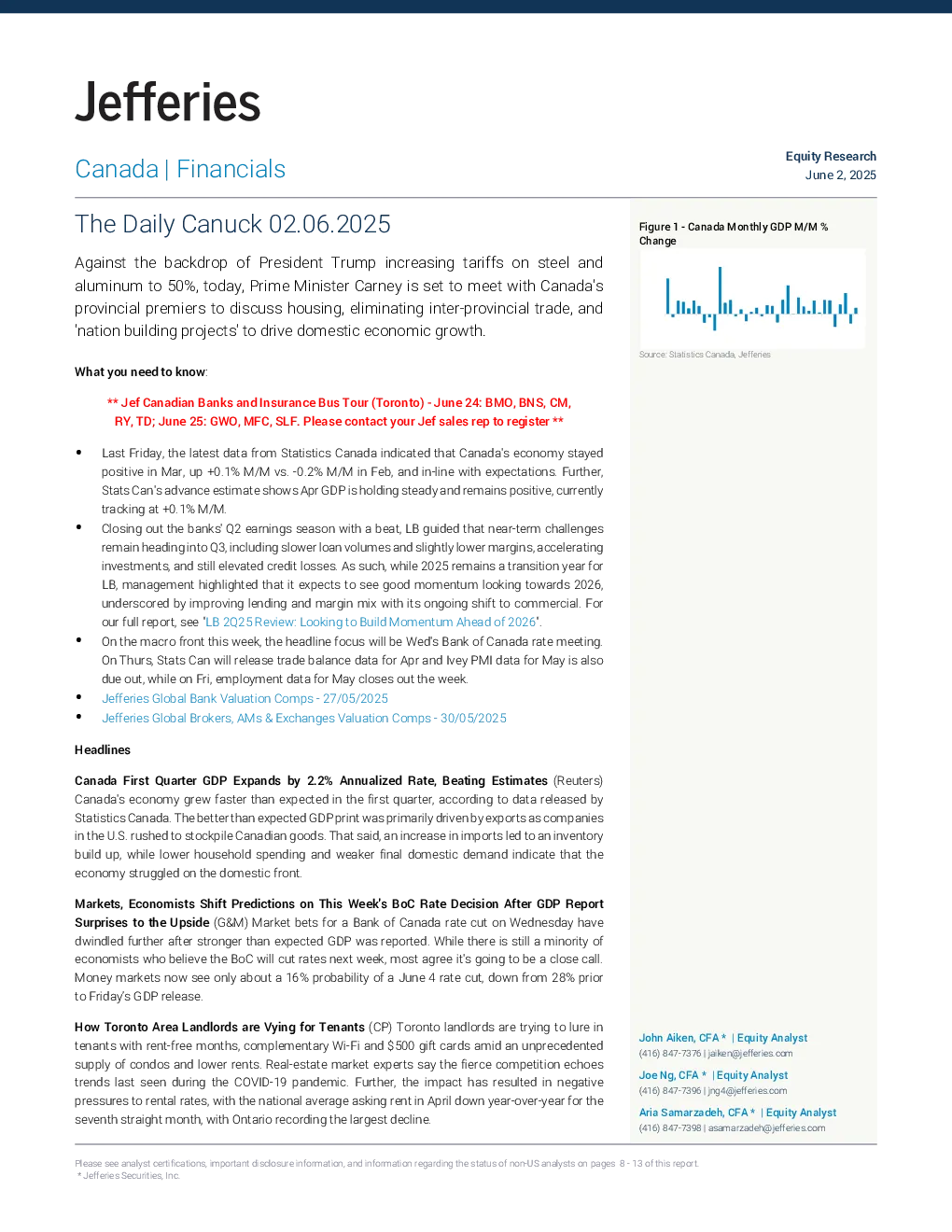
John Aiken, CFA * | Equity Analyst(416) 847-7376 | jaiken@jefferies.comJoe Ng, CFA * | Equity Analyst(416) 847-7396 | jng4@jefferies.comAria Samarzadeh, CFA * | Equity Analyst(416) 847-7398 | asamarzadeh@jefferies.com.Source: Statistics Canada, Jefferies Trump's New Steel Tariffs Will Cause 'Mass Disruption', Canadian Industry Warns(Global News)Canada's steel industry warns that President Trump's doubling of tariffs on steel and aluminumimports to 50% will "create mass disruption and negative consequences". Catherine Cobden,president and CEO of the Canadian Steel Producers Association, said the steel industry in Canadaand the U.S. were highly integrated and tariffs would hit steel producers on both sides.Please see important disclosure information on pages 8 - 13 of this report.This report is intended for Jefferies clients only. Unauthorized distribution is prohibited. Macroeconomic/GlobalCanada First Quarter GDP Expands by 2.2% Annualized Rate, Beating Estimates(Reuters) LastFriday, Reuters reported that Canada's economy grew faster than expected in the first quarter,according to data released by Statistics Canada. The article notes that the better than expectedGDP print was primarily driven by exports as companies in the U.S. rushed to stockpile Canadiangoods. That said, an increase in imports led to an inventory build up, while lower household spendingand weaker final domestic demand indicate that the economy struggled on the domestic front.Economists warn that as U.S. tariffs on Canada continue, this trend will continue to persist. Thegross domestic product in the first quarter grew by 2.2% on an annualized basis compared with thedownwardly revised 2.1% growth posted in the previous quarter, Statistics Canada said. This is thefinal economic indicator before the Bank of Canada's rates decision on Wednesday and will helpdetermine whether the central bank will cut or stand pat on rates. Currency swap markets increasedtheir bets for a pause in rates to 82% after the data was released from 75% earlier. Analysts polledby Reuters had expected first-quarter GDP to expand by 1.7%.Markets, Economists Shift Predictions on This Week's BoC Rate Decision After GDP ReportSurprises to the Upside(G&M) On Friday, the Globe and Mail highlighted that market bets for aBank of Canada rate cut on Wednesday have dwindled further after stronger than expected GDP wasreported. While there is still a minority of economists who believe the BoC will cut rates next week,most agree it's going to be a close call. Money markets now see only about a 16% probability of aJune 4 rate cut, down from 28% prior to Friday’s GDP release. Nevertheless, markets are still pricingin between one and two quarter-point rate cuts by the end of this year. While the Canadian economysurprised to the upside in the first quarter, the fourth quarter was revised to the downside, bluntingsome of the positive impact. Further, the stronger Q1 was aided by a sharp uptick in exports asCanadian firms moved to ship goods ahead of the U.S. tariffs, while consumption growth, businessinvestments, and government spending all seemingly slowed.How Toronto Area Landlords are Vying for Tenants(CP) Last Friday, the Canadian Press reportedthat Toronto landlords are trying to lure in tenants with rent-free months, complementary Wi-Fiand $500 gift cards amid an unprecedented supply of condos and lower rents. According to thearticle, real-estate market experts say the fierce competition, which extends beyond the GreaterToronto Area, is giving renters more negotiating power, echoing trends last seen during the COVID-19pandemic. Further, while such incentives are increasing in Toronto, landlords in other city centres,such as the Hamilton area, are also locked in a tight contest that benefits renters. Real estateresearch firm Urbanation said a record 29,000 condo units were completed in the Greater Torontoand Hamilton Area in 2024, and 40% of that new supply has since entered the rental market. As such,there were 6,549 condo units available for lease in the Greater Toronto and Hamilton Area at the endof this year’s first quarter, a 29% increase from a year ago and 160% higher than two years ago, lastmonth’s Urbanation report shows. The report also found that 63% of buildings offered incentivesto renters, more than double from a year ago. As such, the vacancy rate for purpose-built rentalscompleted since 2000 in the Toronto and Hamilton areas was 3.5% in the first quarter this year, thehighest level since nearly four years ago. This has resulted in negative pressures to rental rates asrecent data from Rentals.ca and Urbanation show the national average asking rent in April was downyear-over-year for the seventh straight month, with Ontario recording the largest decline. Asking rentsin the province fell 2.7% to an average of $2,338. On an annual basis, rents for one-bedroom and two-bedroom apartments in Toronto had declined 8.4% and 10.6%, respectively, compared to the samemonth the