您的浏览器禁用了JavaScript(一种计算机语言,用以实现您与网页的交互),请解除该禁用,或者联系我们。[韩国央行&国际货币基金组织]:改变未来:人工智能在韩国的影响 - 发现报告

改变未来:人工智能在韩国的影响

AI智能总结
查看更多
改变未来:人工智能在韩国的影响

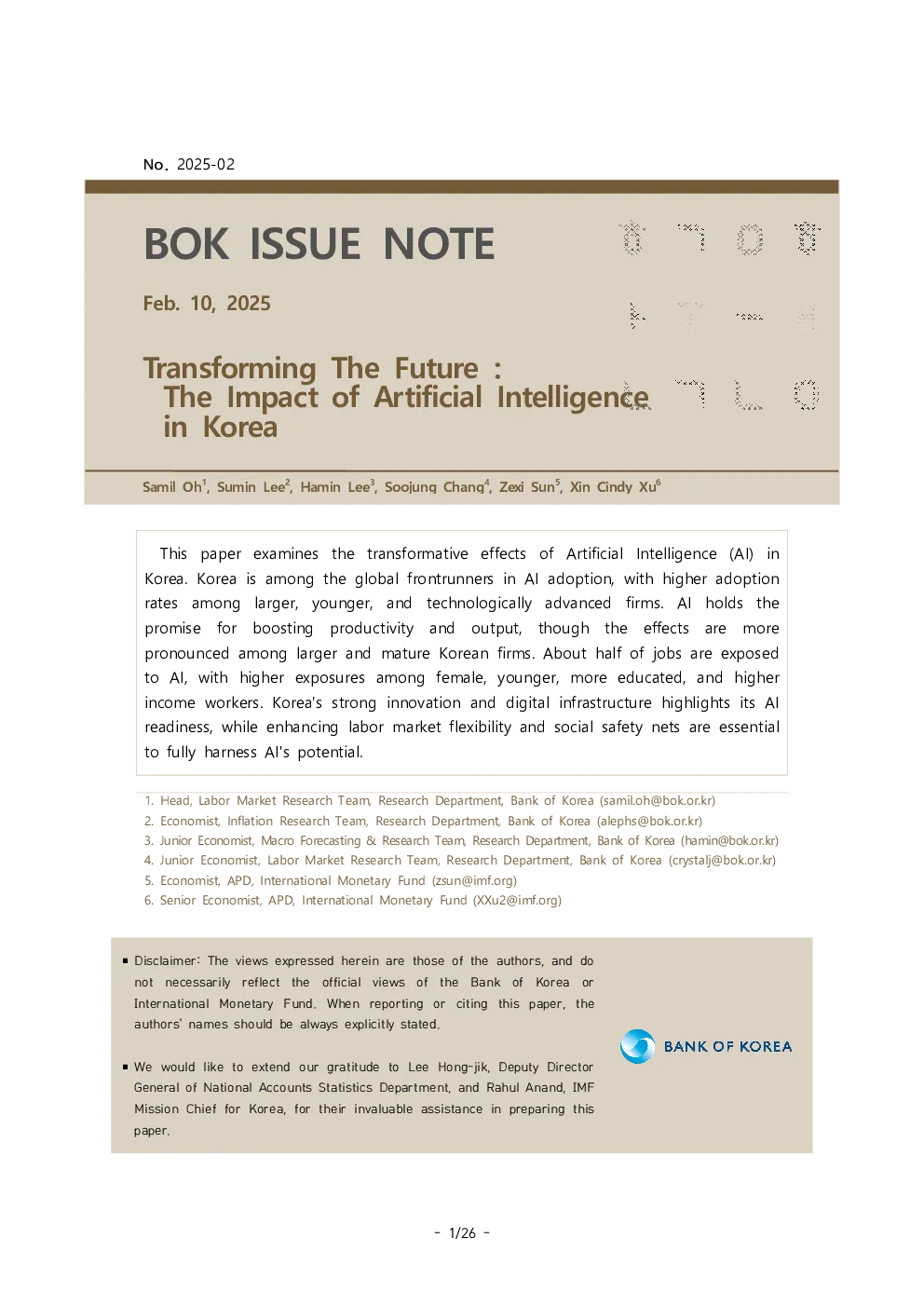
BOKISSUENOTE Feb.10,2025 TransformingTheFuture:TheImpactofArtificialIntelligenceinKorea SamilOh1,SuminLee2,HaminLee3,SoojungChang4,ZexiSun5,XinCindyXu6 ThispaperexaminesthetransformativeeffectsofArtificialIntelligence(AI)inKorea.KoreaisamongtheglobalfrontrunnersinAIadoption,withhigheradoptionratesamonglarger,younger,andtechnologicallyadvancedfirms.AIholdsthepromiseforboostingproductivityandoutput,thoughtheeffectsaremorepronouncedamonglargerandmatureKoreanfirms.AbouthalfofjobsareexposedtoAI,withhigherexposuresamongfemale,younger,moreeducated,andhigherincomeworkers.Korea'sstronginnovationanddigitalinfrastructurehighlightsitsAIreadiness,whileenhancinglabormarketflexibilityandsocialsafetynetsareessentialtofullyharnessAI'spotential. 1.Head,LaborMarketResearchTeam,ResearchDepartment,BankofKorea(samil.oh@bok.or.kr)2.Economist,InflationResearchTeam,ResearchDepartment,BankofKorea(alephs@bok.or.kr)3.JuniorEconomist,MacroForecasting&ResearchTeam,ResearchDepartment,BankofKorea(hamin@bok.or.kr)4.JuniorEconomist,LaborMarketResearchTeam,ResearchDepartment,BankofKorea(crystalj@bok.or.kr)5.Economist,APD,InternationalMonetaryFund(zsun@imf.org)6.SeniorEconomist,APD,InternationalMonetaryFund(XXu2@imf.org) ▪Disclaimer:Theviewsexpressedhereinarethoseoftheauthors,anddonotnecessarilyreflecttheofficialviewsoftheBankofKoreaorInternationalMonetaryFund.Whenreportingorcitingthispaper,theauthors'namesshouldbealwaysexplicitlystated. ▪WewouldliketoextendourgratitudetoLeeHong-jik,DeputyDirectorGeneralofNationalAccountsStatisticsDepartment,andRahulAnand,IMFMissionChiefforKorea,fortheirinvaluableassistanceinpreparingthispaper. Ⅰ.Introduction ArtificialIntelligence(AI)hasemergedasatransformativeforceglobally(Figure1).AIrepresentsawiderangeoftechnologiesdesignedtoenablemachinestomimichumancognitiveabilities(Cazzanigaetal.,2024).RecentadvancesinAI,notablytheemergenceofgenerativeAI(GenAI)thatincludessystemssuchaslargelanguagemodelsandgenerativepretrainedtransformers,havemarkedaleapintheabilityoftechnologytooutperformhumansinseveralcognitiveareas(IMFWEO,April2024).AccordingtotheIBM2023survey,asignificantshareoflargeenterprises(over1,000employees)globallyhasadoptedAI,with42percentofsurveyedITProfessionalsdeployingAIandanadditional40percentreportingactiveexplorationinNovember20231). Sources:Kielaandothers2021;OpenAI;IMFWEO,April2024;andIBMGlobalAIAdoptionIndex,2023. Note:LeftfigureisbasedonanumberoftestsinwhichhumanandAIperformancewereevaluatedinfivedifferentdomains,fromhandwritingrecognitiontolanguageunderstanding.FortheGREmathematicstest,thehumanbenchmarkissetatthemedianpercentile,with-100in2017reflectingthepublicationoftheseminalpaperonGPTs.AI=artificialintelligence;GRE=GraduateRecordExamination;GPTs=generativepretrainedtransformers.RightfigureisfromtheIBMGlobalAIAdoptionIndex,2023. InarapidlyagingeconomylikeKorea,AIadoptioncouldhaveaprofoundimpact.AIoffersbothopportunitiesandchallengesforagingeconomies.Aspopulationsage,economiesfacepotentiallaborshortages,slowdownsinproductivityandincreasedpressuresonhealthcareandpensionsystems.AIcanplayapivotalroleinaddressingtheseissuesbycomplementinghumanlabor,enhancingproductivity,improvinghealthcare,andprovidinginnovativesolutionsforelderly care.Meanwhile,AIcouldalsocausejobdisplacement,reduceworkerincomes,andincreaseinequality,especiallyfortheelderlygroupastheytendtofacemorechallengesadaptingtotechnologychanges.Asduringtheintroductionofpastgeneral-purposetechnologies,theimpactofAIoneconomicoutcomes,remainshighlyuncertain. chipsexports(Figure2).WhiletheglobalAIboompresentssignificantopportunities,challengesalsoexistfortheKoreanchipindustry,includingfromintenseglobalcompetition,technologicalcomplexities,geopoliticaltensionsandtradedisputes,andtheneedforcontinuousinnovation. Asaleadinginnovatorandsemiconductorproducer,KoreaishighlyexposedtoAI.Koreaiswidelyrecognizedasaleadingtechnologyinnovatorandconsistentlyrankshighonvariousglobalinnovationindexes(Figure2).Notably,Koreaishomecountrytosomeoftheworld'stoptechnologycompaniesandsemiconductormanufacturers.AItechnologiesrequireadvancedprocessingcapabilities,leadingtoincreaseddemandforhigh-performancecomputingchips,suchasGPUs(GraphicsProcessingUnits)andspecializedAIprocessors.Koreancompanieshavebeeninvestinginthedevelopmentandproductionofthesechips,cateringtotheneedsofAIsystems.In2024H1,Koreansemiconductorexportshavesignificantlyexpanded,benefitingfromtheglobalAIboom,accountingforabout23percentofglobal LiteratureontheeconomicimpactofAIhasbeengrowing,butcomprehensivestudiesonKorearemainlimited.Alargebodyofexistingresearchhasfocusedonpotentiallabormarketeffectsinadvancedeconomies,includingthejobdisplacementimpact(e.g.Felten,etal.,2021and2023)andcomplementaryrolesofAI(Pizzinelli,etal.2023).Somestudies havealsoassessedtheaggregateproductivityandoutputgainsfromtheAIadoption,withawiderangeofestimates(e.g.Acemoglu,2024;BriggsandKodnani,2023;McKinsey,2023).AfewstudieshaveinvestigatedtherelationshipbetweenAIuseandfirmperformance(e.g.OECD,2023).TherecentIM