您的浏览器禁用了JavaScript(一种计算机语言,用以实现您与网页的交互),请解除该禁用,或者联系我们。 [国际能源署]:光伏电动汽车充电站:要求、障碍、解决方案和社会接受度 - 发现报告

光伏电动汽车充电站:要求、障碍、解决方案和社会接受度

电气设备 2025-01-15 国际能源署 测试专用号1普通版
报告封面

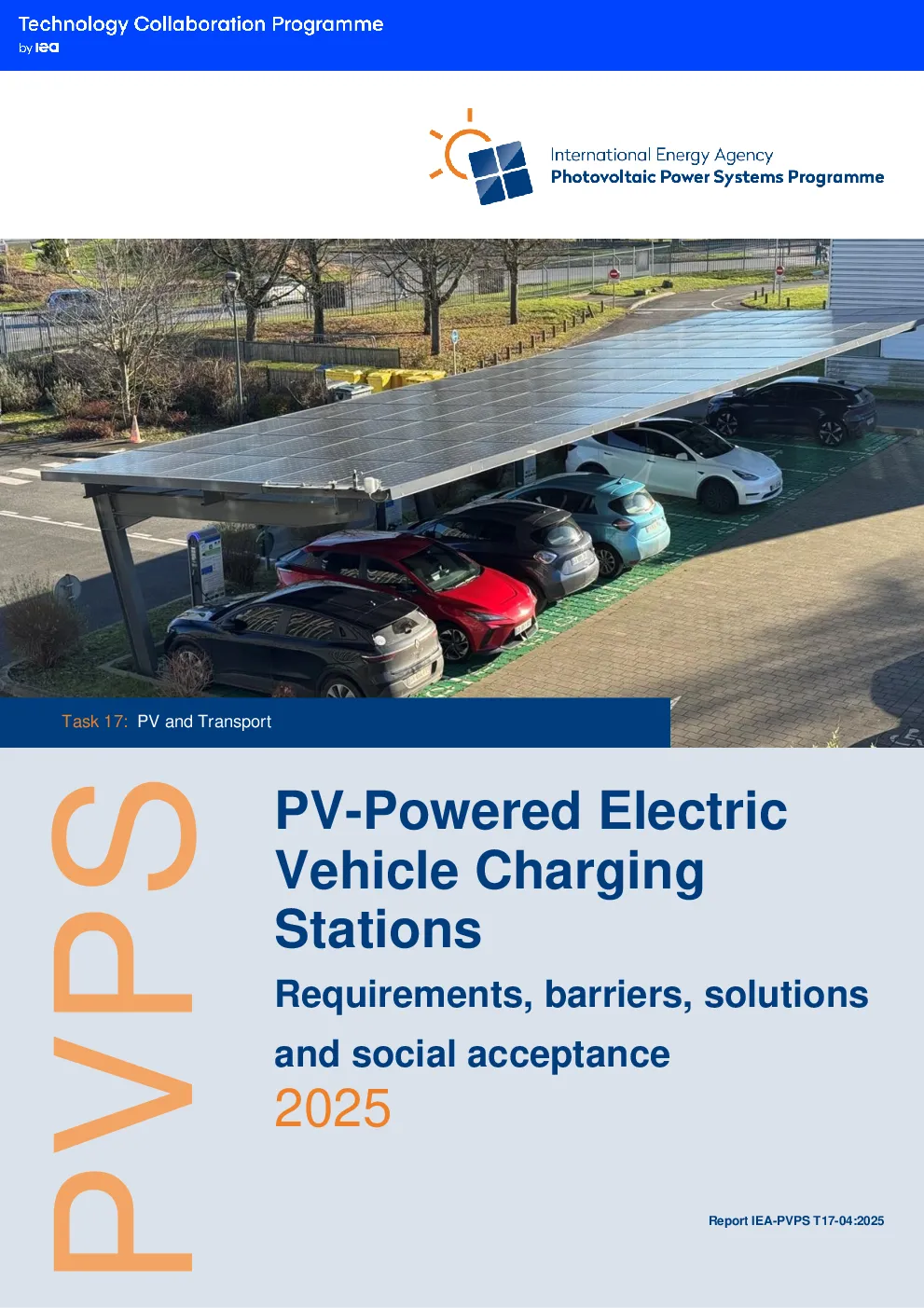
Task17:PVand Transport PV-PoweredElectricVehicleChargingStations Requirements, barriers, solutions and social acceptance2025PVPS What is IEA PVPS TCP? The International Energy Agency (IEA), founded in 1974, is an autonomous body within the framework of the Organizationfor Economic Cooperation and Development (OECD). The Technology Collaboration Programme (TCP) was created witha belief that the future of energy security and sustainability starts with global collaboration. The programme is made up of6.000 experts across government, academia, and industry dedicated to advancing common research and the applicationof specific energy technologies. The IEA Photovoltaic Power Systems Programme (IEA PVPS) is one of the TCP’s within the IEA and was established in1993. The mission of the programme is to “enhance the international collaborative efforts which facilitate the role ofphotovoltaic solar energy as a cornerstone in the transition to sustainable energy systems.” In order to achieve this, theProgramme’s participants have undertaken a variety of joint research projects in PV power systems applications. Theoverall programme is headed by an Executive Committee, comprised of one delegate from each country or organisationmember, which designates distinct ‘Tasks,’ that may be research projects or activity areas. The30IEA PVPSmembersAustralia, Austria, Belgium, Canada, China, Denmark, Enercity SA, European Union, Finland,France, Germany, India, Israel, Italy, Japan, Korea, Malaysia, Morocco, the Netherlands, Norway, Portugal, Solar EnergyResearch Institute of Singapore (SERIS), SolarPower Europe, South Africa, Spain, Sweden, Switzerland, Thailand,Turkey, United States. Visit us at:www.iea-pvps.org What is IEA PVPSTask17? The objective of Task 17 of the IEA Photovoltaic Power Systems Programme is to deploy PV in the transport, which willcontribute to reducing CO2emissions of the transport and enhancing PV market expansions. The results contribute toclarifying the potential of utilization of PV in transport and to proposal on how to proceed toward realising the concepts. Task 17’s scope includes PV-powered vehicles such as PLDVs (passenger light duty vehicles), LCVs (light commercialvehicles),HDVs(heavy duty vehicles) and othervehicles, aswell asPVapplications forelectricsystems andinfrastructures, such as charging infrastructure with PV, battery and other power management systems. Authors Main Content:M. Sechilariu (France), A. Alchami (France), S. Cheikh-Mohamad (France), B. Robisson(France), M.C Brito (Portugal) Editor:Manuela Sechilariu(Task17 Subtask 2 Leader), A. Alchami (France) DISCLAIMER TheIEAPVPSTCPisorganisedundertheauspicesoftheInternationalEnergyAgency(IEA)butisfunctionallyandlegallyautonomous.Views, findings and publications of the IEA PVPS TCP donot necessarily represent the views or policies of the IEA Secretariat or itsindividualmembercountries COVER PICTURE Living Lab and ExperimentalPlatform-PV-powered charging station, Innovation Center of Université de Technologie de Compiègne,France PV-PoweredElectricVehicleChargingStations Requirements, barriers, solutions and social acceptance IEA PVPSTask 17PV and Transport Report IEA-PVPS T17-04:2025January-2025 Acknowledgements...........................................................................................................6List of abbreviations..........................................................................................................7Executive summary...........................................................................................................91Requirements,BarriersandSolutionsForPV-PoweredChargingInfrastructure for EV Charging...............................................................................121.1Public grid and distribution system operator point of view: EV chargingcontrol and power management with demand response........................................141.2Human-System Interfaces for PV-Powered Electric Vehicles ChargingStation..................................................................................................................231.3Real-Time Power Management Including an Optimization Problem forPV-Powered Electric Vehicle Charging Stations....................................................361.4Case study: experimental results of solar charging of electric vehiclesat CEA Cadarache.................................................................................................691.5Solar park-ride parking for electric vehicles: case study in Lisbon..............861.6Global Cost and Carbon Impact Assessment Methodology for ElectricVehicles’ PV-Powered Charging Station...............................................................952Societal Impact and Social Acceptance of PVCS and New Services.....................1212.1Case study in France: new survey on the social acceptance of PVCSand associated new services...................................................................