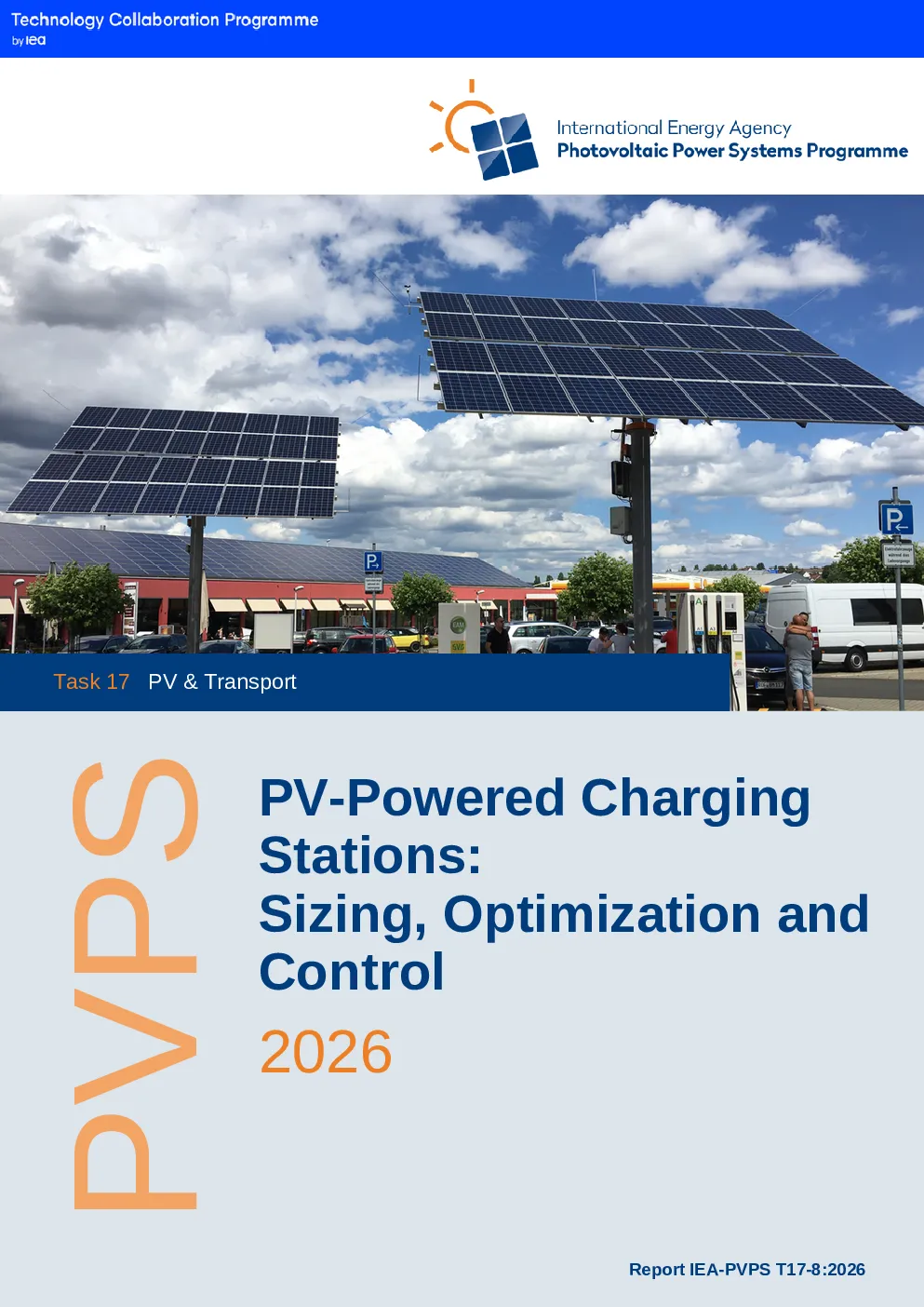
PV-Powered ChargingStations:Sizing, Optimization andControl PVPS2026 What is IEA PVPS TCP? The International Energy Agency (IEA), founded in 1974, is an autonomous body within the framework of the Organizationfor Economic Cooperation and Development (OECD). The Technology Collaboration Programme (TCP) was created witha belief that the future of energy security and sustainability starts with global collaboration. The programme is made up of6.000 experts across government, academia, and industry dedicated to advancing common research and the applicationof specific energy technologies. The IEA Photovoltaic Power Systems Programme (IEA PVPS) is one of the TCP’s within the IEA and was established in1993. The mission of the programme is to “enhance the international collaborative efforts which facilitate the role ofphotovoltaic solar energy as a cornerstone in the transition to sustainable energy systems.” In order to achieve this, theProgramme’s participants have undertaken a variety of joint research projects in PV power systems applications. Theoverall programme is headed by an Executive Committee, comprised of one delegate from each country or organisationmember, which designates distinct ‘Tasks,’ that may be research projects or activity areas. The 28 IEA PVPS participating countries are Australia, Austria, Belgium, Canada, China, Denmark, Finland, France,Germany, India, Israel, Italy, Japan, Korea, Lithuania, Malaysia, Morocco, the Netherlands, Norway, Portugal, SouthAfrica, Spain, Sweden, Switzerland, Thailand, Türkiye, the United Kingdom and the United States of America. TheEuropean Commission, Solar Power Europe and the Solar Energy Research Institute of Singapore are also members. Visit us at:www.iea-pvps.org What is IEA PVPSTask17? The objective of Task 17 of the IEA Photovoltaic Power Systems Programme is to deploy PV in the transport, which willcontribute to reducing CO2emissions of the transport and enhancing PV market expansions. The results contribute toclarifying the potential of utilization of PV in transport and to proposal on how to proceed toward realising the concepts. Task 17’s scope includes PV-powered vehicles such as PLDVs (passenger light duty vehicles), LCVs (light commercialvehicles),HDVs(heavy duty vehicles) and other vehicles, as well as PV applications for electric systems andinfrastructures, such as charging infrastructure with PV, battery and other power management systems. Authors ➢Main Content:Bruno Robisson, Fadi Agha Kassab, Miguel C. Brito, Nathanael Dougier, Saleh Cheikh-Mohamad ➢Editors:Amalie Alchami, Manuela Sechilariu DISCLAIMER TheIEAPVPSTCPisorganisedundertheauspicesoftheInternationalEnergyAgency(IEA)butisfunctionallyandlegallyautonomous.Views, findings and publications of the IEA PVPS TCP do not necessarily represent the views or policies of the IEA Secretariat or itsindividualmembercountries COPYRIGHT STATEMENT Thiscontent may be freely used, copied and redistributed, providedappropriate credit is given(please refer to the ‘Suggested Citation’).The exception is that some licensed images may not becopied, as specified in the individual image captions. SUGGESTED CITATION SechilariuM.(2025, Ed.), CelikB.(2025), RobissonB. (2023), Ngo V.L. (2023), KassabF. A. (2024), Cheikh-Mohamad S. (2023), BritoM.C (2024), Locment F. (2025),DougierN. (2023)and Alchami A. (Ed.)PV-Powered Charging Stations: Sizing, Optimization and Control(Report No. T17-8:2026). IEA PVPS Task17.https://iea-pvps.org/key-topics/pv-charging-stations-2026// COVER PICTURE STELLA, Smart Transport and Energy Living LAb, Innovation Center of Université de Technologie de Compiègne, France PV-Powered Charging Stations:Sizing, Optimization and Control IEA PVPSTask17PV and Transport Report IEA-PVPS T17-8:2026January-2026 ISBN978-1-7642902-5-8DOI10.69766/HEJY2778 Main Authors Bruno Robisson, CEA Cadarache, FranceFadi Agha Kassab, Avenues, Université de Technologie de Compiègne,FranceMiguel C. Brito, Faculdade de Ciências da Universidade de Lisboa, PortugalNathanael Dougier, Avenues, Université de Technologie de Compiègne, FranceSaleh Cheikh-Mohamad, Avenues, Université de Technologie de Compiègne, France Contributing Author Antonio Vallera, Faculdade de Ciências da Universidade de Lisboa, PortugalBerk Celik, Avenues, Université de Technologie de Compiègne,FranceFabrice Locment, Avenues, Université de Technologie de Compiègne, FranceManuela Sechilariu, Avenues, Université de Technologie de Compiègne, FranceVan-Lap Ngo, CEA Cadarache, France Editors Amalie Alchami,Avenues, Université de Technologie de Compiègne, FranceManuela Sechilariu, Avenues, Université de Technologie de Compiègne, France Acknowledgements...........................................................................................................6List of abbreviations..........................................................................................................7Executive summary.............................