您的浏览器禁用了JavaScript(一种计算机语言,用以实现您与网页的交互),请解除该禁用,或者联系我们。[欧洲航空安全局(EASA)]:2021欧洲城市空中交通(UAM)社会接受度研究报告 - 发现报告

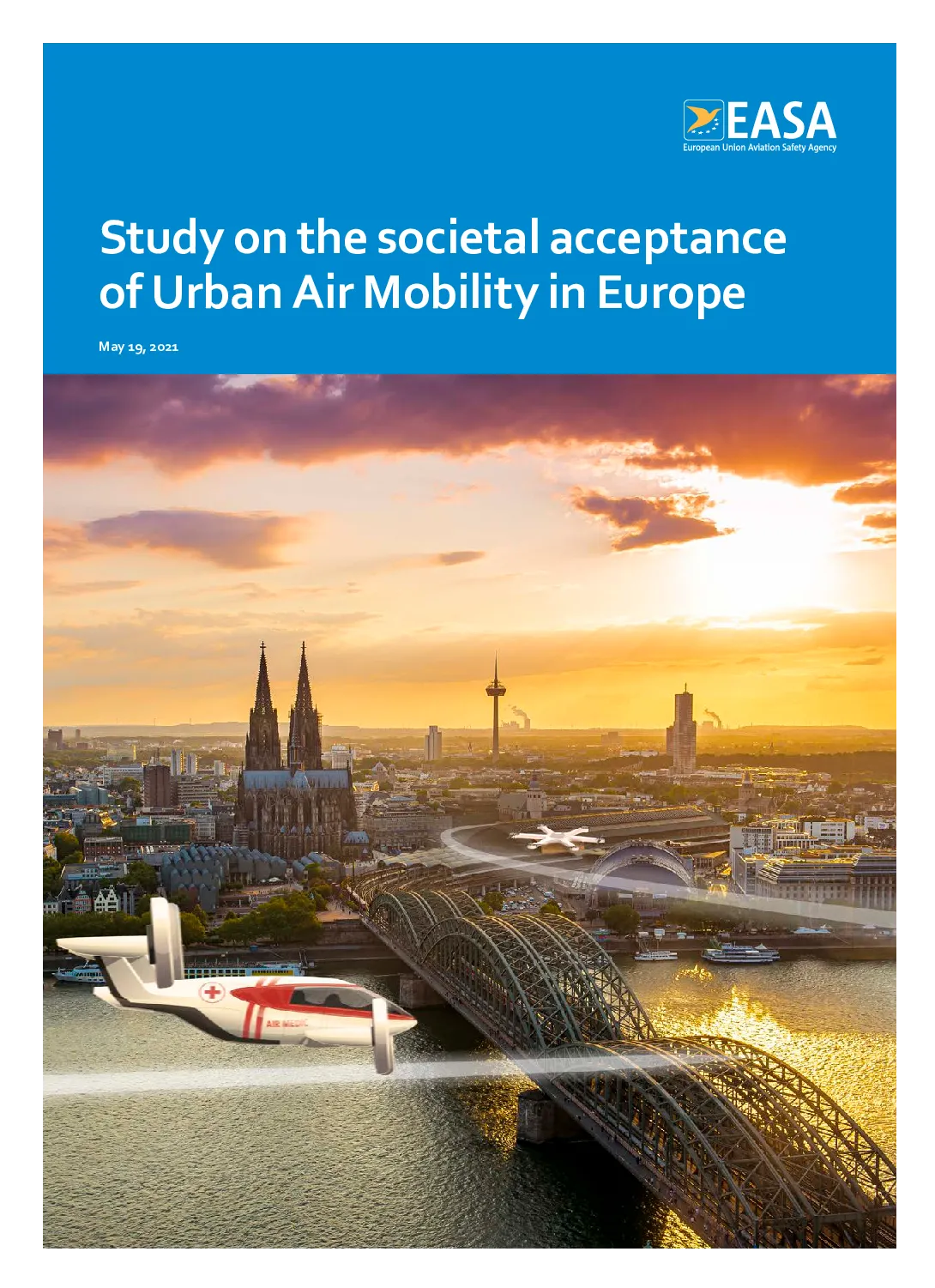
2021欧洲城市空中交通(UAM)社会接受度研究报告

AI智能总结
查看更多
2021欧洲城市空中交通(UAM)社会接受度研究报告

May 19, 2021 Further information and the full survey insights are available at easa.europa.eu/UAM This study has been carried out for EASA by McKinsey & Company upon award of a specific contract implementing arunning multiple framework contract for the provision of consultancy services. Consequently, it does not necessarilyexpress the views of EASA itself, nor should it be relied upon as a statement, as any form of warranty, representation,undertaking, contractual, or other binding commitment upon EASA. Ownership of all copyright and other IPR in thismaterial including any documentation, data and technical information, remains vested to EASA. All logo, copyrights,trademarks, that may be contained within, are the property of their respective owners. Reproduction of this study,in whole or in part, is permitted under the condition that this Disclaimer remains clearly and visibly affixed in full at alltimes with such reproduced part. This study has measured the attitude of the EU society towards UAM early 2021, wellin advance of future deployment in EU cities foreseen around 2024-2025. The results have been generated with besteffort at this point in time, however public perception may change over time once citizens are exposed to actual UAMoperations. Executive Summary New technologies such as the enhancement of battery technologies and electric propulsion as well as major investmentsmade into start-ups are enabling the development of new vertical take-off and landing Urban Air Mobility (UAM)aircraft. Thus, Urban Air Mobility – defined as an air transportation system for passengers and cargo in and around urbanenvironments – may be deployed in Europe within three to five years, offering the potential for greener and faster mobilitysolutions. As several projects and demonstrations are under way, it is time for the European Union, and for national and localauthorities to prepare the framework that will enable this new mode of transport and give Europe the chance ofestablishing itself as one of the first movers in this field at a global level. Citizens’ and future UAM users’ confidence and acceptance will be critical to success. As part of the preparation ofan adequate regulatory framework, the European Union Aviation Safety Agency (EASA) therefore conducted thiscomprehensive study on the societal acceptance of UAM operations across the European Union. The study was carried outtogether with the consulting firm McKinsey & Company between November 2020 and April 2021. Full details of the reportcan be found on the EASA website. Based on thorough research, literature review, local market analysis, surveys and interviews, the study examinedthe attitudes, expectations and concerns of EU citizens with respect to UAM and revealed interesting insights, someunexpected. The survey results were very homogeneous among all those surveyed across the EU and in all socio-economiccategories. They can be clustered into 10 key take-aways: 1.EU citizens initially and spontaneously express a positive attitude toward and interest in UAM; it is seen as a new andattractive means of mobility and a majority is ready to try it out;2.The notion of general/public interest is a determining factor for acceptance: use cases for the benefit of thecommunity, such as medical or emergency transport or those connecting remote areas, are better supported thanuse cases satisfying individual/private needs;3.The main benefits expected from UAM are faster, cleaner and extended connectivity;4.However, when encouraged to reflect upon the concrete consequences of potential UAM operations in theircity, EU citizens want to limit their own exposure to risks, in particular when related to safety, noise, security andenvironmental impact;5.Safety concerns come first, but the study also shows that citizens seem to trust the current aviation safety levels andwould be reassured if these levels were applied for UAM;6.Noise is the second main concern expressed; the study indicates that the level of annoyance varies with thefamiliarity of the sound, with familiar city sounds at the same decibel levels being better accepted; it also confirmsthat the distance, duration and repetition of the sound impacts its acceptance;7.UAM is seen as a good option to improve the local environmental footprint, through reduced urban trafficcongestion and better local air quality; but at the same time citizens express major concerns about UAM’s impact onwildlife;8.The results also demonstrate a limited trust in the security and cyber security of UAM, requiring threat-preventionmeasures;9.The integration of UAM into the existing air and ground infrastructure must respect residents’ quality of life and thecultural heritage of old European cities;10.Finally, local residents and authorities feel directly affected by the deployment of UAM and want to engage and playan active role in its implementation. The study results show that EU citizens are calling for active and pre-emptive measur