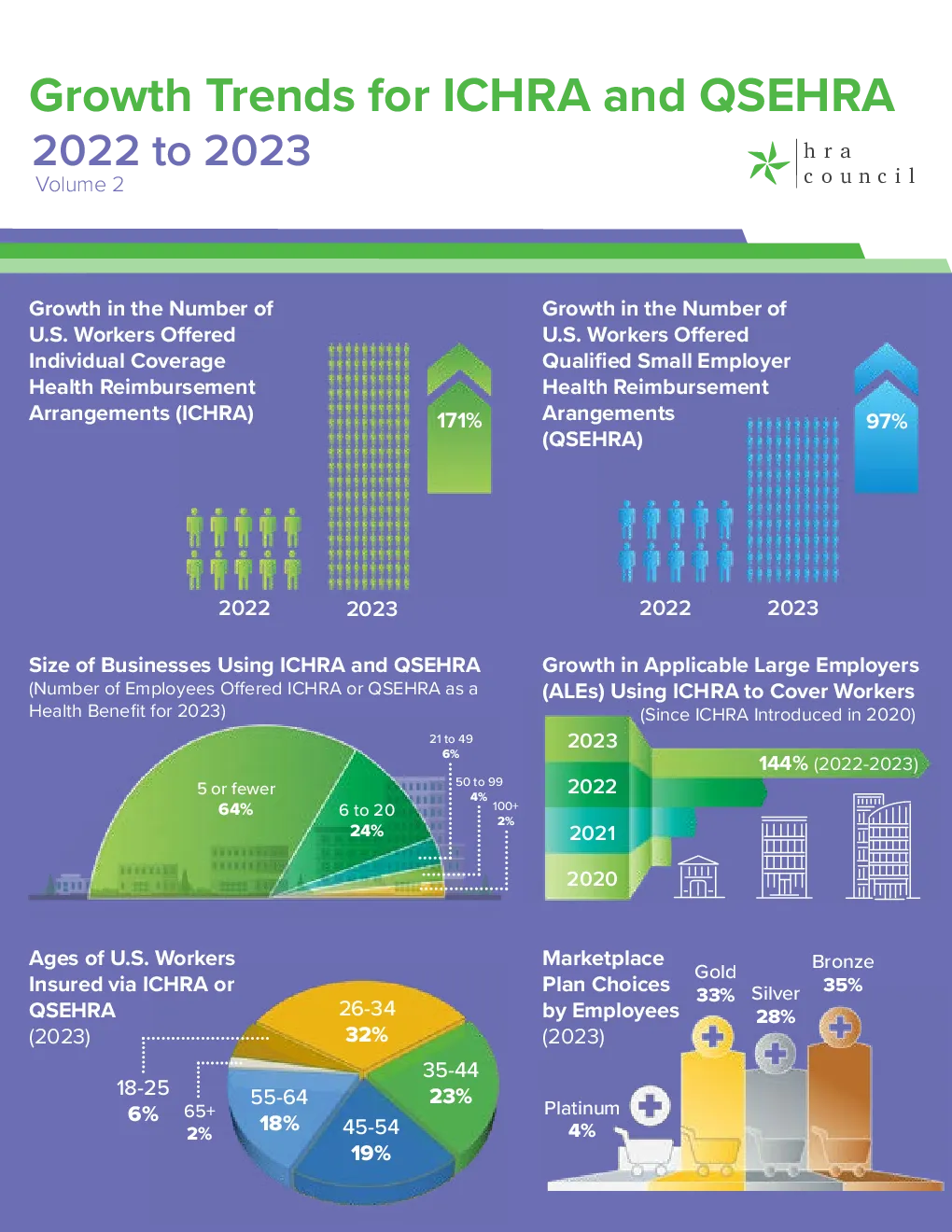
This new report—compiled by a data team from HRA Council Members—builds on the inaugural 2022 findings withenrollment data through January 2023 and underscores national adoption trends for Individual Coverage Health Reim-bursement Arrangements (ICHRAs) and Qualified Small Employer Health Reimbursement Arrangements (QSEHRAs).New Findings for 2023 Build on the Strong Growth Reportedfor 2020-2022:The rapid growth — 144%—in larger businesses adopting ICHRAis a significant employer trend in this year’s report. For ApplicableLarge Employers (ALEs), ICHRA is a fast-growing coverage solu-tion offering ACA-mandated health benefits.Additional highlights include:•The number of employers reported to have adopted ICHRAgrew 64% between 2022 and 2023.•ICHRA and QSEHRA continue to be an on-ramp for business-es offering health benefits for the first time.•Small businesses with fewer than 50 employees were healthbenefits pioneers with QSEHRA and continue to show steadyexpansion of 8% growth as a more mature market.•The number of American workers offered either ICHRA orQSEHRA as a health benefit more than doubled between2022-2023.•ICHRA and QSEHRA bring younger workers into the ACAMarketplaces, stabilizing risk and keeping premiums and costs lower.How was the data in this HRA Council report sourced, compiled, and reported?HRA Council Members who are administrators and/or enrollment platforms entered a data-sharing agreement to reportout anonymized, HIPAA-compliant data for U.S. employers and their workers who have adopted ICHRA or QSEHRA. TheCouncil then aggregated the data to identify trends in the growth of these two health reimbursement arrangements.How do I learn more about the HRA Council?The HRA Council is a non-profit, non-partisan advocacy organization of HRA administrators, carriers, enrollment firms,brokers, and practitioners representing clients in all 50 states and D.C. The Council educates members, employers andpolicy-makers; works towards industry standards; shares collective industry research; and advocates for HRA solutions.To learn more, seewww.hracouncil.org/reportor emailinfo@hracouncil.org.20232022202120202023202220212020Read more at: hracouncil.org/reportThank you to our Data Leader Members:The Year in ICHRA & QSEHRA Growth in Number of US EmployersOffering ICHRA for Health Benefits64%(2022-2023)Growth in Number of US EmployersOffering QSEHRA for Health Benefits8%(2022-2023)2021 The number of American workers offeredeither ICHRA or QSEHRA as a health benefitmore than doubled between 2022-2023.ICHRA offers to employees grew by 171% between 2022 and 2023.As larger businesses in-cluding Applicable LargeEmployers (ALEs) adoptICHRAs, the number ofAmerican workersoffered customizable,quality health benefitshas nearly tripled in thelast year.ICHRAGrowth(Number ofEmployeesOffered ICHRA)20222023QSEHRA offers to employees grew by 97% between 2022 and 2023.QSEHRAGrowth(Number ofEmployeesOffered QSEHRA)20222023The number of U.S.employees offered aQSEHRA has doubledbetween 2022-2023.QSEHRAs, now in theirseventh year, continue to bea strong, stable on-ramp tobenefits for small businesseswho want to provide employ-ees with customizablehealth insurance options.2016Qualified Small EmployerHRAs (QSEHRAs) intro-duced through bipartisan21st Century CURES Act.2017Executive Order directsagencies to expandusability of HRAs.2002HRAs first recognized byIRS Notices and Rulings.Who ICHRA & QSEHRA Cover in 2023HRA Council 2022-2023 Growth Trends for ICHRA & QSEHRA ICHRA & QSEHRAare tax-advantagedarrangements employersselect to reimburse theiremployees for purchas-ing ACA-compliant,quality health insurance.171%97%Qualified SmallEmployer HRAs(QSEHRAs) are for busi-nesses with fewer than50 full time employees.Individual CoverageHRAs (ICHRAs) can beimplemented by busi-nesses of any size.2020Individual providers launchIndividual Coverage HRAs(ICHRAs). ICHRA and QSEHRA bring younger workersinto the ACA Marketplaces, stabilizing riskand keeping premiums and costs lower.Employees enrolled in a Marketplace plan via ICHRA or QSEHRAshowed nearly equal choice among Gold, Silver, and Bronze plans.Marketplace PlanSelections byEmployees(2023)Platinum4%MYTH: Employees don’tunderstand health insuranceand prefer their employers to selecttheir plans.TRUTH: Employees know whatthey need. The nearly evendistribution between the metal tiershighlights how employees becomewise health consumers evaluating thechoices offered by ICHRA andQSEHRA in the context of theirpersonal health needs.Ages of U.S.Workers Insuredvia ICHRA orQSEHRA(2023)61% of employees enrolled in a Marketplace plan via ICHRA orQSEHRA for the 2023 benefit year are 44 or younger.MYTH: Employers useICHRA and QSEHRA tomove older employees withhealth risks into the Marketplace.TRUTH: Not only is discrimination by age or healthstatus prohibited, employee data shows ICHRA andQSEHRA bring younger workers into the individual market.The increased participation of younger workers in Marketplace p