家庭和个人护理领域的自然积极行动
 AI智能总结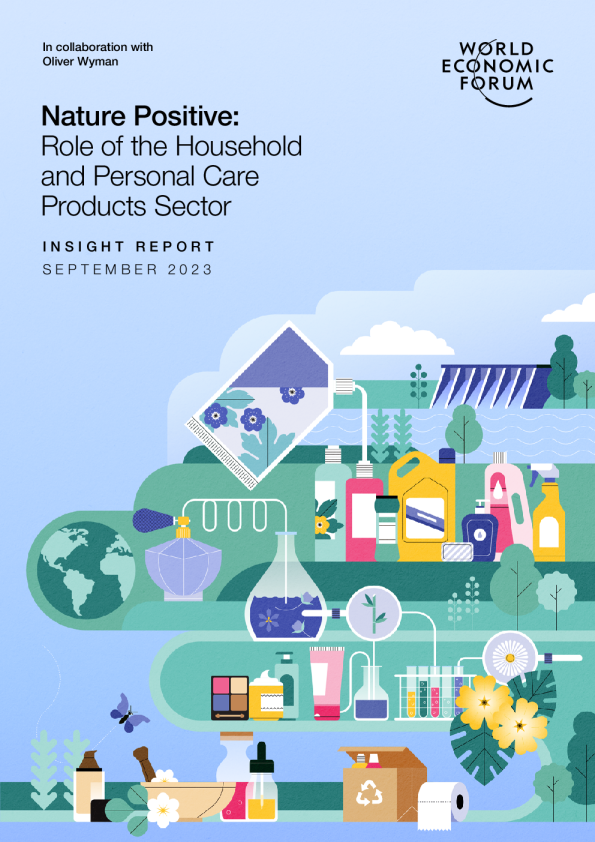
© 2023 World Economic Forum. All rightsreserved. No part of this publication maybe reproduced or transmitted in any formor by any means, including photocopyingand recording, or by any informationstorage and retrieval system.DisclaimerThis document is published by theWorld Economic Forum as a contributionto a project, insight area or interaction.The findings, interpretations andconclusions expressed herein are a resultof a collaborative process facilitated andendorsed by the World Economic Forumbut whose results do not necessarilyrepresent the views of the World EconomicForum, nor the entirety of its Members,Partners or other stakeholders.Part of the World Economic Forum’sSector Transitions to Nature Positivereport series, 2023Nature Positive:Role of the ChemicalSectorNature Positive:Role of the Cement andConcrete SectorSelect the reportto discover moreNature Positive:Role of the Household and Personal Care Products Sector ContentsForewordsExecutive summary1 Introduction1.1 Why nature matters for businesses1.2 The current approach to nature and biodiversity1.3 The road ahead2 Where the sector is today2.1 Sector overview2.2 Progress is promising but needs to accelerate3 Nature-related impacts and dependencies3.1 Double materiality3.2 Water and other resource use3.3 Land-use change3.4 Pollution3.5 Greenhouse gas emissions4 Five priority actionsPriority action #1 Improve water stewardshipPriority action #2 Source responsiblyPriority action #3 Influence customer behaviour on product useand disposalPriority action #4 Support nature conservation and restorationPriority action #5 Expand circularity, product innovation andcollaboration5 Get started5.1 Align strategy with organizational maturity5.2 A deeper look at metrics to support decision-making5.3 Map the transition onto business functions6 ConclusionAppendixContributorsEndnotes 4681012141516171920212223242528303132333637394244454851Nature Positive:Role of the Household and Personal Care Products Sector ForewordsThe consequences of the twin crises of climatechange and nature collapse have never beenmore evident, with temperatures soaring, wildfiresraging, food supplies at risk and freshwater suppliesdwindling. Household and personal care productsplay an important role in protecting the health andwell-being of individuals, families and communities,but we know that our sector contributes to thedrivers of nature loss through land conversion,water extraction, greenhouse gas emissions andpollution. The sector is also heavily dependenton nature, especially when it comes to the rawmaterials in our products.Our customers and investors expect us to adoptsustainable practices and develop products that dono harm. They also want us to be transparent andaccountable for any nature- and biodiversity-relatedimpacts throughout our supply chains. However,many companies find the issue very complex. Theystruggle to understand the implications of natureand biodiversity collapse on their business. Theyfind it hard to set meaningful targets and identifytangible actions to stop doing harm or turn towardsregeneration.Best practices and leadership are now emergingas frameworks and guidance for materialityassessments and prioritization become available.Businesses in the household and personal careproducts sector are making commitments toprotect nature, such as reducing emissions anddecreasing downstream discharges, waste ortoxicity. We are also starting to see sector-widecollaboration to address common barriers or toNature Positive:Role of the Household andPersonal Care ProductsSector Ulrike SapiroChief Sustainability Officer,HenkelNature Positive:Role of the Household and Personal Care Products Sector scale up solutions and accelerate transformationcollectively. But there is far more that can andmust be done to keep up with the ambition of theKunming-Montreal Global Biodiversity Framework.This report sets out our sector’s reliance on andrelationship with nature and gives us a clearpathway to reduce our individual business andsector impacts on nature. In the coming years, wemust continue to reduce freshwater withdrawal,source responsibly, address plastic pollution andbecome more circular. This starts by assessingand prioritizing all of the material impacts that ourbusiness has on nature, from the supply chain toproduction, downstream use and end of life.We need to encourage our consumers to join us onthis journey. As a sector that focuses on householdand personal care products, we are uniquelyplaced to help shift consumer behaviour in supportof a nature-positive future. Through our productsand brands, we can inspire individuals to makeinformed decisions and opt for greener products,while repurposing and recycling wherever relevant.Between us, we can drive demand for nature-positive innovations.And we need to act together. Collaboration andcooperation are essential if we are to preventcatastrophic ecosystem collapse. Each of ourorganizations must prioritize the actions outlinedin this