释放政策连贯性以实现可持续发展目标:治理机制评估
 AI智能总结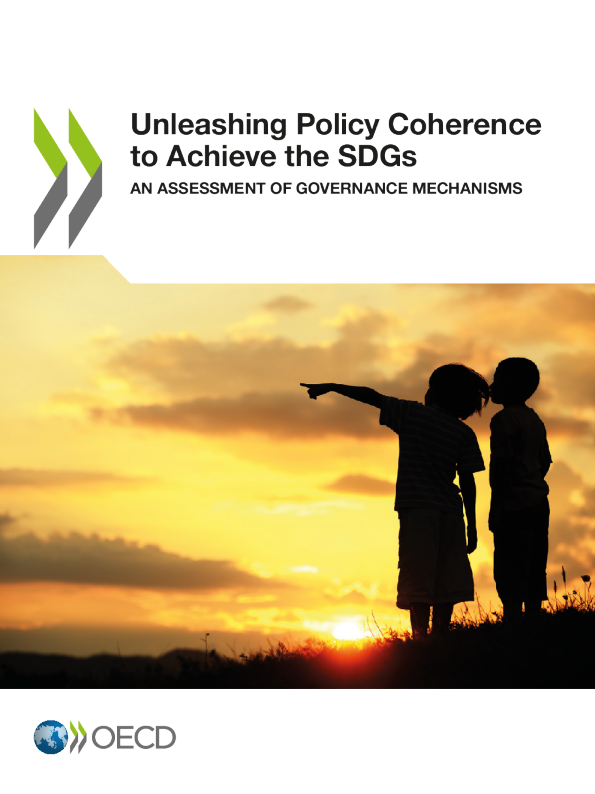
Unleashing PolicyCoherence to Achievethe SDGsAN ASSESSMENT OF GOVERNANCE MECHANISMS This document, as well as any data and map included herein, are without prejudice to the status of or sovereignty overany territory, to the delimitation of international frontiers and boundaries and to the name of any territory, city or area.The statistical data for Israel are supplied by and under the responsibility of the relevant Israeli authorities. The use ofsuch data by the OECD is without prejudice to the status of the Golan Heights, East Jerusalem and Israeli settlements inthe West Bank under the terms of international law.Please cite this publication as:OECD (2024),Unleashing Policy Coherence to Achieve the SDGs: An Assessment of Governance Mechanisms, OECDPublishing, Paris, https://doi.org/10.1787/a1c8dbf8-en.ISBN 978-92-64-73032-8 (print)ISBN 978-92-64-84629-6 (PDF)ISBN 978-92-64-34904-9 (HTML)ISBN 978-92-64-41051-0 (epub)Photo credits:Cover illustration © ESB Professional/Shutterstock.com.Corrigenda to OECD publications may be found on line at: www.oecd.org/about/publishing/corrigenda.htm.© OECD 2024Attribution 4.0 International (CC BY 4.0)This work is made available under the Creative Commons Attribution 4.0 International licence. By using this work, you accept to be bound by the terms of this licence(https://creativecommons.org/licenses/by/4.0/).Attribution– you must cite the work.Translations– you must cite the original work, identify changes to the original and add the following text:In the event of any discrepancy between the original work and thetranslation, only the text of original work should be considered valid.Adaptations– you must cite the original work and add the following text:This is an adaptation of an original work by the OECD. The opinions expressed and arguments employed inthis adaptation should not be reported as representing the official views of the OECD or of its Member countries.Third-party material– the licence does not apply to third-party material in the work. If using such material, you are responsible for obtaining permission from the third party and forany claims of infringement.You must not use the OECD logo, visual identity or cover image without express permission or suggest the OECD endorses your use of the work.Any dispute arising under this licence shall be settled by arbitration in accordance with the Permanent Court of Arbitration (PCA) Arbitration Rules 2012. The seat of arbitration shallbe Paris (France). The number of arbitrators shall be one. UNLEASHING POLICY COHERENCE TO ACHIEVE THE SDGS © OECD 2024ForewordThe implementation of the 2030 Agenda andits interconnected Sustainable Development Goals (SDGs)represents a major challenge for all countries. As the 2030 deadline draws closer, it is clear that the worldis not on track to achieve the SDGs.This situation is being exacerbated by a wave ofinterconnected globalchallenges: the triple planetary crises of climate change, biodiversity loss and pollution, pandemics, foodand energy shortages and growing poverty and inequality, worsened by large-scale conflicts. At this pivotalpoint, mere incremental and fragmented change will not suffice.Policy coherence for sustainable development (PCSD) is a key enabler to accelerate progress towardachieving the SDGs. Byenabling the systematic integration of the economic, social and environmentaldimensionsof sustainable development at all stages of policymaking, it can reduce policy fragmentation;ensure that policies across sectors and levels of government are mutually reinforcing in pursuingsustainable development; address the negative impacts of domestic policies on other countries; andenable the evaluation and consideration of the long-term impacts of policies.The OECD Recommendation on Policy Coherence for Sustainable Development [OECD/LEGAL/0381],was adopted by the OECD Council in 2019, revisingthe previous Recommendation on Good InstitutionalPractices in Promoting Policy Coherence for Development of 2010. This revision was in response to thedemand by OECD Members and non-Members to address how to coherently implement the 2030 Agenda.The Recommendation focuses on the mechanisms that governments need to develop and implementcoherent policies in all areas–that is, the processes, systems, structures and tools for managing andco-ordinating policies at different levels of government. Today, the Recommendation remains the onlyinternationally recognised standard guiding countries in formulating strategies and plans for PCSD.This report provides the first, systematicassessment of the current state of implementation of PCSD byAdherents to the OECD Council Recommendation, based on consultations and analysis conducted over2023-24. While most Adherents have established a foundation of political commitment to PCSD backedby strategies for sustainable development up to 2030, significant gaps persist. These gaps are particularlyvisible in the area of assessing and addressing the transboundary impac