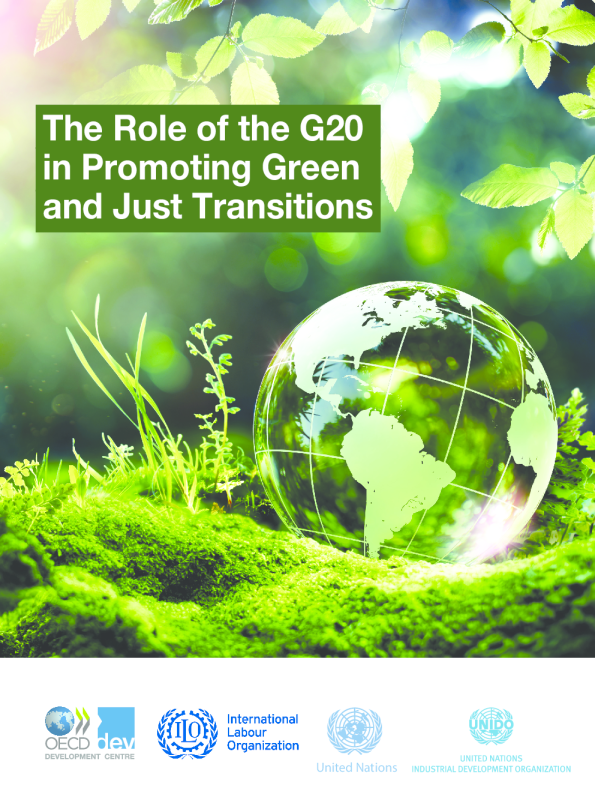
G20在促进绿色和公正转型中的作用
 AI智能总结
TheRole of the G20 inPromotingGreen andJustTransitions This work is published under the responsibility of the Secretary-General of the OECD, theDirector Generalof UNIDO, the Secretary-General of the United Nations and the Director-General of the ILO. The opinionsexpressed and arguments employed herein do not necessarily reflect the official views of the Membercountries of the OECD or its Development Centre, or the Member States of UNIDO, United Nations or ILO. The names and representation of countries and territories used in this joint publication follow the practiceof the OECD, in consultation and agreement with ILO, UNIDO and the United Nations. This document, as well as any data and map included herein are without prejudice to the status of orsovereignty over any territory, to the delimitation of international frontiers and boundaries and to the nameof any territory, city or area. ILO ISBN: 9789220409503 (pdf Web) Photo credits:Cover design by Aida Buendia using an image of Miha Creative © Shutterstock.com Corrigenda to OECD publications may be found online at:www.oecd.org/about/publishing/corrigenda.htm. © OECD/ILO/United Nations/UNIDO 2024 Attribution 3.0 IGO (CC BY 3.0 IGO) This workismade available under the Creative Commons Attribution 3.0 IGO licence. By using this work, you accept to be bound bythe terms of this licence (https://creativecommons.org/licenses/by/3.0/igo/).Attribution–you must cite the work.Translations–you must cite the original work, identify changes to the original and add the following text:In the event of any Adaptations–you must cite the original work and add the following text:This is an adaptation of an original work by the OECD, ILO,United Nations and UNIDO. The opinions expressed and arguments employed in this adaptation should not be reported asrepresenting the official views of the OECD or of its Member countries,or the Member States of UNIDO, United Nations or ILO.Third-party material–the licence does not apply to third-party material in the work. If using such material, you are responsible for obtaining permission from the third party and for any claims of infringement.You must not use the OECD’s, ILO’s, United Nations’ or UNIDO’s respective logo, visual identity or cover image without express permission or suggest the OECD, ILO, United Nations or UNIDOendorse your use of the work.Any dispute arising under this licence shall be settled by arbitration in accordance with the Permanent Court of Arbitration(PCA) Arbitration Rules 2012. The seat of arbitration shall be Paris (France). The number of arbitrators shall be one. Background and context Group of Twenty (G20) development ministers unanimously adopted theG20 2023 Action Plan onAccelerating Progress on the SDGs(henceforth “Action Plan”)andG20 High Level Principles (HLPs) onLifestyles for Sustainable Development (LiFE)in June 2023 under the Indian presidency. The new ActionPlan, which builds on theG20 Action Plan on the 2030 Agenda(2016), recognises the unprecedentedurgency of the need for the G20 to take co-ordinated action and ensure policy coherence toexpedite advancements in achieving the Sustainable Development Goals (SDGs). In Section 3 of theAction Plan, the G20 underlined its commitment to implementing “sustainable, inclusive and justtransitions globally, while leaving no one behind”(G20 Development Ministerial, 2023[1]). In this regard, the G20 encouraged international organisations to conduct studies to “analyse the gaps,opportunities and synergies in following anintegrated and collective approach to these transitions” soas to promote improved institutional and policy frameworks across levels and ensure that “globaltransition efforts will maximise synergies andminimise trade-offsas we [the G20] make progress oninternationally agreed agendas and the various transitions they entail”(G20 Development Ministerial,2023[1]). In accordance with this mandate,the International Labour Organization (ILO),the Organisation forEconomicCo-operation and Development(OECD),the United Nations Conference on Trade andDevelopment(UNCTAD) andtheUnited Nations Industrial Development Organization (UNIDO) have co-authored this report, leveraging their respective areas of expertise asknowledge partners of the G20Development Working Group.1 Global agendas on climate and sustainable development have been developed over time through parallelinternational processes.Guided by the preamble of the Paris Agreement, this report focuses onpromotingpolicy coherence, at the domestic and international level,toenhance co-operationandenablean international architecture that is well suited for the implementation of green and justtransitions. For the purposes of this report,green and just transitionsareunderstood asglobal andnational effortstowards achieving worldwide carbon neutrality by or around the mid-centuryglobally, inan inclusive manner andadapted toeach national context. This involvesactive co-operation amongall,developed and