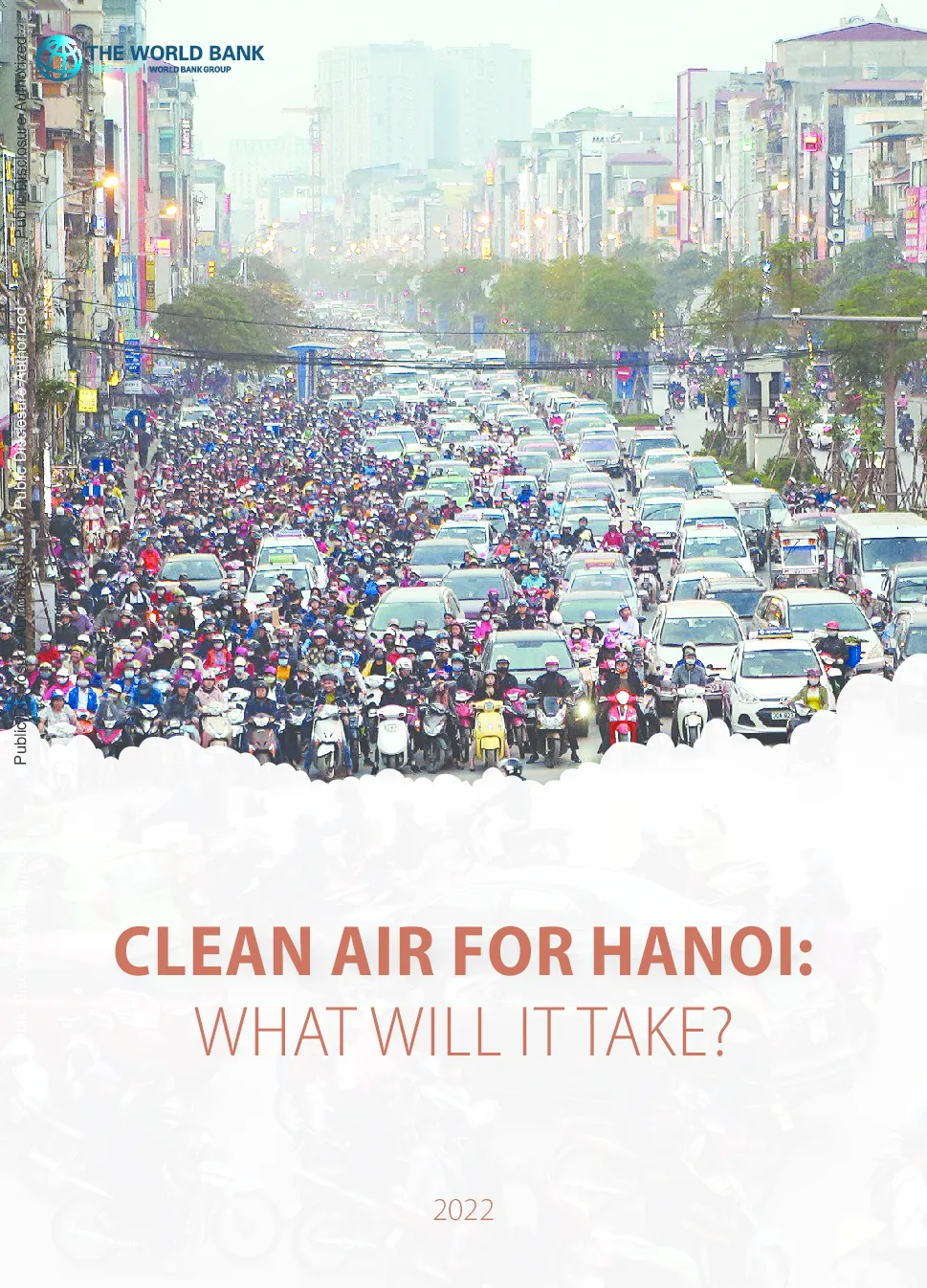
您的浏览器禁用了JavaScript(一种计算机语言,用以实现您与网页的交互),请解除该禁用,或者联系我们。[世界银行]:河内的清洁空气:需要什么?(英)2025 - 发现报告

河内的清洁空气:需要什么?(英)2025

公用事业2025-05-06世界银行何***
AI智能总结
查看更多
河内的清洁空气:需要什么?(英)2025

CLEAN AIR FOR HANOI:WHAT WILL IT TAKE? © 2022 International Bank for Reconstruction and Development / The World Bank1818 H Street NWWashington DC 20433Telephone: 202-473-1000Internet: www.worldbank.org This work is a product of the staff of The World Bank with external contributions. The findings,interpretations, and conclusions expressed in this work do not necessarily reflect the views ofThe World Bank, its Board of Executive Directors, or the governments they represent. TheWorldBankdoesnotguaranteetheaccuracy,completeness,orcurrencyofthedataincludedin this work and does not assume responsibility for any errors, omissions, or discrepanciesin the information, or liability with respect to the use of or failure to use the information,methods, processes, or conclusions set forth. The boundaries, colors, denominations, and otherinformation shown on any map in this work do not imply any judgment on the part of TheWorld Bank concerning the legal status of any territory or the endorsement or acceptance ofsuch boundaries. Nothing herein shall constitute or be construed or considered to be a limitation upon or waiverof the privileges and immunities of The World Bank, all of which are specifically reserved. Rights and Permissions The material in this work is subject to copyright. Because The World Bank encouragesdissemination of its knowledge, this work may be reproduced, in whole or in part, fornoncommercial purposes as long as full attribution to this work is given. Any queries on rights and licenses, including subsidiary rights, should be addressed to WorldBank Publications, The World Bank Group, 1818 H Street NW, Washington, DC 20433, USA; fax:202-522- 2625; e-mail: pubrights@worldbank.org. Cover photo: Huy Hùng – TTXVN Cover design and layout: Hong Nguyen – Vuong Hoang Table of Contents Acknowledgements Abbreviationsxi Executive Summaryxii 1.1Air Quality in Hanoi and the Surrounding Areas31.2Air Pollution Control Policy in Hanoi, Bac Ninh, and Hung Yen and Linkwith Climate Change Mitigation71.3The Draft Power Development Plan 8 and Vietnam’s Nationally DeterminedContribution 2020 and Air Quality Co-benefits of Climate Actions8 2.1The GAINS Model122.2Data Sources and Cost Calculations132.3Stakeholder Consultations and Data Validations142.4Scenario Design14 Chapter 3:Understanding How Air Quality Improvements Can be Made17 3.1Understanding the Current Situation173.1.1Emissions of PM2.5Precursor Substances183.1.2Validation213.1.3PM2.5Source Contributions for Hanoi, Bac Ninh, and Hung Yenin the GAINS Model21 3.2Future Air Quality233.2.1Socioeconomic Development Trends233.2.2The Policies before 2020 Scenario233.2.3The New Policies in Effect from 2021 Along with NDC 2020 Scenarios263.2.4The Cost-effective Scenario to Reach the NAAQS PM2.5Target31 3.4Determining Cost Effectiveness through Marginal Abatement Cost Curvesfor Selected Key Air Quality Measures35 Chapter 4:Clean Air for Hanoi by 2030: What Will it Take?39 4.1Key Sector Interventions404.2A Coordinated Regional and National Mechanism is Neededfor Air Quality Management404.3Enforcement is Key414.4Monitoring, Reporting, and Validation of Emissions Reductionsand Climate Finance Mobilization44 Appendix A: A Note on Data Collection45 References51 List of Boxes Box 1.1World Bank’s Country Climate and Development Report (CCDR) for Vietnam8Box 3.1The Maximum Technically Feasible Reduction Scenario29Box 4.1Examples of air quality actions around the world42 List of Figures Figure ES.1Annual mean concentrations of PM2.5in Hanoi since 2015ixFigure ES.2Ambient concentrations and population exposure to PM2.5modelled for 2015xiFigure ES.3Population-weighted annual mean source contributions of PM2.5concentrationsin Hanoi, 2015xiiFigure ES.4Impact of polices on air quality standards by 2020 in Hanoi, Bac Ninh,and Hung YenxivFigure 1.1Explanation of Air Quality Index3Figure 1.2Annual mean concentrations of PM2.5in Hanoi since 20154Figure 1.3Daily PM2.5concentrations measured at the NCEM urban traffic stationand at the urban background station in Hanoi in 2019-20206 Figure 1.472-hour backward trajectories estimating air pollution in Hanoion November 19, 20197Figure 3.1PM2.5emission inventory for 201518Figure 3.2Emissions of PM2.5precursors in Hanoi, Bac Ninh, and Hung Yen, estimatedin this study for 201519Figure 3.3Ambient concentrations and population exposure to PM2.5modelled for 201520Figure 3.4GAINS estimate of source apportionment for Hanoi, 2015-201921Figure 3.5Population-weighted annual mean source contributions of PM2.5concentrationsin Hanoi, 201522Figure 3.6Population-weighted annual mean source contributions of PM2.5concentrationsin Bac Ninh and Hung Yen provinces, 201522Figure 3.7Ambient concentrations and population exposure to PM2.5in the policiesbefore 2020 case in 2030 for Hanoi, Bac Ninh, and Hung Yen24Figure 3.8Source attributions to population-weighted PM2.5concentrations in the policiesbefore 2020 projection in 203025Figure 3.9Ambi