您的浏览器禁用了JavaScript(一种计算机语言,用以实现您与网页的交互),请解除该禁用,或者联系我们。 [国际劳工组织(ILO)]:2024乌干达咖啡产业价值链研究报告 - 发现报告

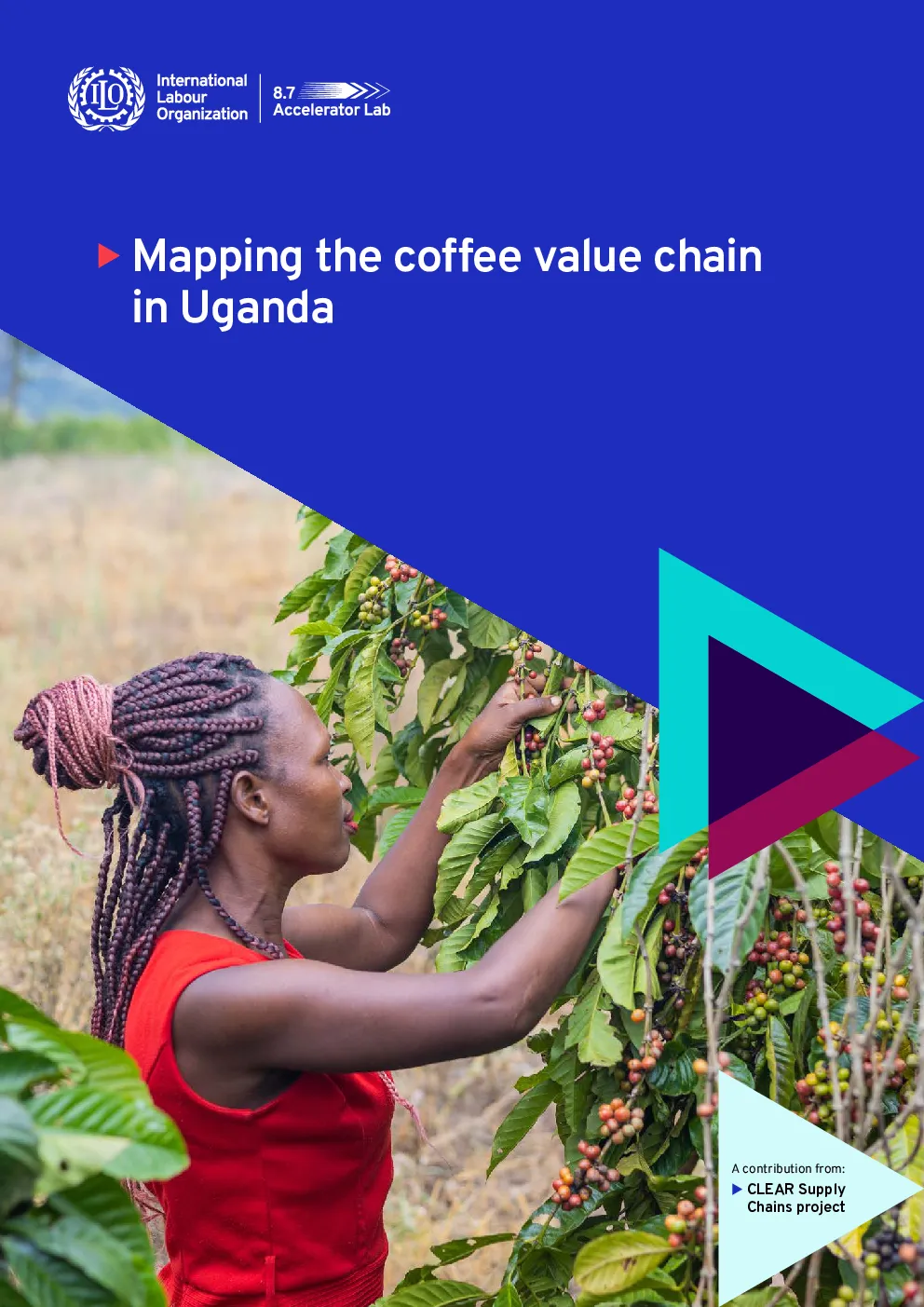
2024乌干达咖啡产业价值链研究报告

报告封面

Mapping the coffee value chainin Uganda Mapping the coffee valuechain in Uganda Attribution 4.0 International (CC BY 4.0) This work is licensed under the Creative Commons Attribution 4.0 International. To view a copy of thislicence, please visit https://creativecommons.org/licences/by/4.0/. The user is allowed to reuse, share (copyand redistribute), adapt (remix, transform and build upon the original work) as detailed in the licence.The user must clearly credit the ILO as the source of the material and indicate if changes were made tothe original content. Use of the emblem, name and logo of the ILO is not permitted in connection withtranslations, adaptations or other derivative works. Attribution– The user must indicate if changes were made and must cite the work as follows: ILO,Mappingthe coffee value chain in Uganda, Geneva: International Labour Office, 2024. © ILO. Translations– In case of a translation of this work, the following disclaimer must be added along with theattribution:This is a translation of a copyrighted work of the International Labour Organization (ILO). Thistranslation has not been prepared, reviewed or endorsed by the ILO and should not be considered an officialILO translation. The ILO disclaims all responsibility for its content and accuracy. Responsibility rests solelywith the author(s) of the translation. Adaptations – In case of an adaptation of this work, the following disclaimer must be added along with theattribution:This is an adaptation of a copyrighted work of the International Labour Organization (ILO). Thisadaptation has not been prepared, reviewed or endorsed by the ILO and should not be considered an officialILO adaptation. The ILO disclaims all responsibility for its content and accuracy. Responsibility rests solelywith the author(s) of the adaptation. Third-party materials– This Creative Commons licence does not apply to non-ILO copyright materialsincluded in this publication. If the material is attributed to a third party, the user of such material is solelyresponsible for clearing the rights with the rights holder and for any claims of infringement. Any dispute arising under this licence that cannot be settled amicably shall be referred to arbitrationin accordance with the Arbitration Rules of the United Nations Commission on International Trade Law(UNCITRAL). The parties shall be bound by any arbitration award rendered as a result of such arbitration asthe final adjudication of such a dispute. Queries on rights and licensing should be addressed to the ILO Publishing Unit (Rights and Licensing) atrights@ilo.org. Information on ILO publications and digital products can be found at: www.ilo.org/publns. 978-92-2-040805-6 (print)978-92-2-040806-3 (web PDF) The designations employed in ILO publications and databases, which are in conformity with United Nationspractice, and the presentation of material therein do not imply the expression of any opinion whatsoeveron the part of the ILO concerning the legal status of any country, area or territory or of its authorities, orconcerning the delimitation of its frontiers or boundaries. The opinions and views expressed in this publication are those of the author(s) and do not necessarily reflectthe opinions, views or policies of the ILO. Reference to names of firms and commercial products and processes does not imply their endorsementby the ILO, and any failure to mention a particular firm, commercial product or process is not a sign ofdisapproval. Executive summary This report presents a value chain mapping and analysis of coffee in Ugandain support of the project“Ending Child Labour in Supply Chains: Addressing the Root Causes of Child Labour in Supply Chainsthrough an Area-based Approach”, co-funded by the European Union and jointly implemented by theInternational Labour Organization (ILO), as the leading agency, the Food and Agriculture Organization(FAO), the International Trade Centre (ITC) and the United Nation Children’s Fund (UNICEF). The projectis also supported by 11 leading international coffee brands, roasters and traders who are members ofthe ILO Child Labour Platform (CLP), eight of whom source actively from Uganda. The report is a synthesis of key takeaways from relevant initiatives and research as well as consultationwith key stakeholders in the Ugandan coffee industry. The main aims of the report are to: XUnderstand thesteps of the coffee value chain(upstream, midstream and downstream), thestructure of the coffee sector, trading practices, and factors which impact on value additionXIdentifykey actors along the coffee supply chainand identify opportunities to cooperate,involve or align with key global, national, regional, and local actorsXUnderstand the current landscape of projects and interventions(UN agencies, publicsector, private actors, etc.) working to achieve decent work in coffee-growing areas and identifypotential synergies and opportunities for collaboration with key actors as well as geo