AI智能总结
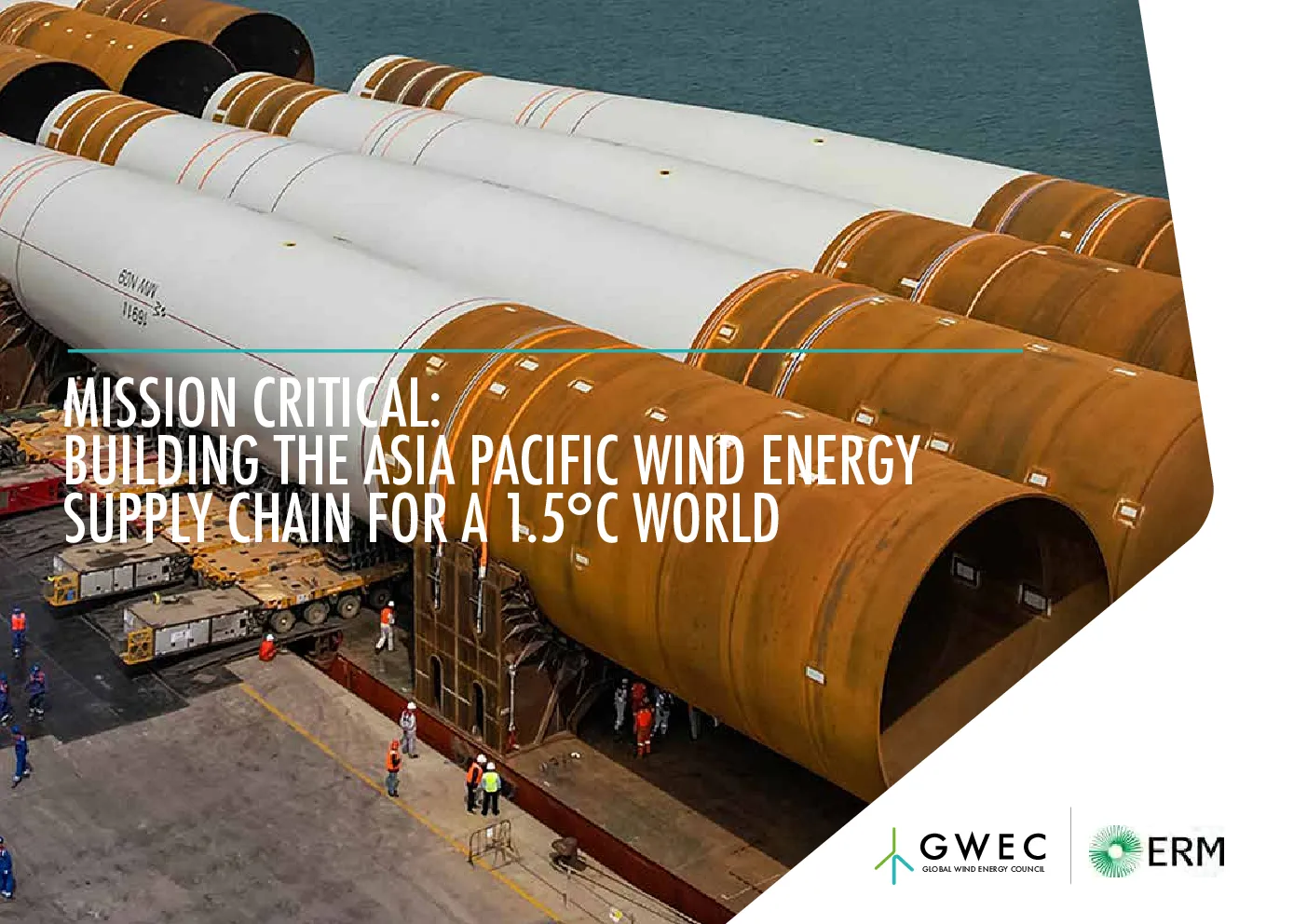
This work is subject to copyright. Its content,including text and graphics, may bereproduced in part for non-commercialpurposes, with full attribution. Unless otherwisestated, material in this publication may be freelyused, shared, copied, reproduced, printed, and/or stored, provided that appropriateacknowledgement is given to the authororganisations as the source(s) and copyrightholders. Material in this publication that isattributed to third parties may be subject toseparate terms of use and restrictions, andappropriate permissions from these thirdparties may need to be secured before any useof such material. Local content contributors were Stewart Mullin(Australia), Akihiko Kurashina and Esther FangWen (Japan), Ann Margret Francisco and MarkHutchinson (Philippines), Janice Cheong (SouthKorea), Nguyen Van Trang and Thang Vinh Bui(Vietnam), Wanliang Liang (China), KshitijMadan (India), and Erick Lu (central Asia) fromthe GWEC team as well as Mike Ottaviano andRichard Clarkson (Australia), RandiRamadhansjah and Arryati Ramadhani(Indonesia), Takayuki Shibata (Japan), JosephPark and Jaemin Pyeon (South Korea), and MarkWatson and Tu Dang (Vietnam) from the ERMteam. Published Disclaimer This publication and the material herein areprovided “as is.” All reasonable precautionshave been taken by the copyright holders toverify the reliability of the material in thispublication. However, neither GWEC and ERM,nor any of their officials, agents, data, or otherthird-party content providers provides awarranty of any kind, either expressed orimplied, and they accept no responsibility orliability for any consequence of use of thepublication or material herein. The informationcontained herein does not necessarilyrepresent the views of all Members of GWECand its constituent associations. Thedesignations employed and the presentation ofmaterial herein do not imply the expression ofany opinion on the part of GWEC or ERMconcerning the legal status of any region,country, territory, city, or area or of itsauthorities, or concerning the delimitation offrontiers or boundaries. 25 November 2024 Front cover imageCourtesy of Dajin Heavy Industry DesignLemonbox www.lemonbox.co.uk The authors wish to thank Atty. Josefina PatriciaMagpale-Asirit as well as Carsten Brinck, andDeepak Chinnapa (Brinckmann) for providingadditional content for their selected areas ofexpertise. AcknowledgmentsThis report was produced by the Global Wind Energy Council and co-authored by ERM. The lead authors of this report were Feng Zhao,Liming Qiao, Weng Han Tan (GWEC), BreanneGellatly, Gareth Lewis, Jan Galceran, RaimondDasalla, Roberta Donkin, Sean Peedle, andTugce Sahin (ERM). © Global Wind Energy Council and ERM Table of Contents Foreword2 Executive Summary3 Chapter 1: APAC Market Status and Wind Supply Chain Outlook11Introduction and APAC Market Outlook12APAC Findings on the Wind Supply Chain Through to 203014Looking Beyond a 2030 APAC Wind Supply Chain17 Chapter 2: Deep Dive into the APAC Wind Supply Chain19Turbine Nacelle Assembly21Key Components26Critical Materials46Offshore Wind Balance of Plant54Offshore Wind Enablers63 Chapter 3: Country Case Studies71Australia72Indonesia80Japan87Philippines95South Korea104Vietnam111Snapshot on Singapore121 Clarification Notes to Reader Definition of the regionAsia Pacific Region includes East Asia, Central Asia, South Asia, Southeast Asia, and Oceania. Definition of the target marketsAlthough supply chain evaluations and stakeholder consultations were conducted across each APACmarket for this study, dedicated case studies weredeveloped for six target countries includingAustralia, Indonesia, Japan, Philippines, South Korea,and Vietnam. Chapter 4: Recommendations to Secure APAC’s Wind Supply Chain Appendix129Definitions and Terminology130About GWEC/ERM131 The inclusion of a global goal totriple renewable energy by 2030 inthe final text at COP28 Dubai was ahistoric landmark for wind andother renewable technologies.However, despite record-breakinggrowth the global effort to triplerenewable energy by 2030 isfalling short. The latest trackingreport co-released by IRENA, theCOP29 Presidency and the GlobalRenewable Alliance reveals asignificant gap in progress to meetthe goals set out in the UAEConsensus and keep the 1.5°Ctarget within reach. manufacturing, can scale up thesupply chain, and maintain – andenhance – wind’s competitivenessversus other technologies, all whilebuilding strong political and socialsupport for our mission. on supply chain investment andallows cooperation on sharedchallenges including grid systems,ports, vessels and associated skills. This report, delivered in partnershipwith ERM, is GWEC’s first regionalwind energy supply chain report.Not only does it take a deep diveacross the wind energy supplychain, from nacelles to componentsto materials to offshore windbalance of plant, but also identifieskey industrial strengths andopportunities across six case studymarkets which