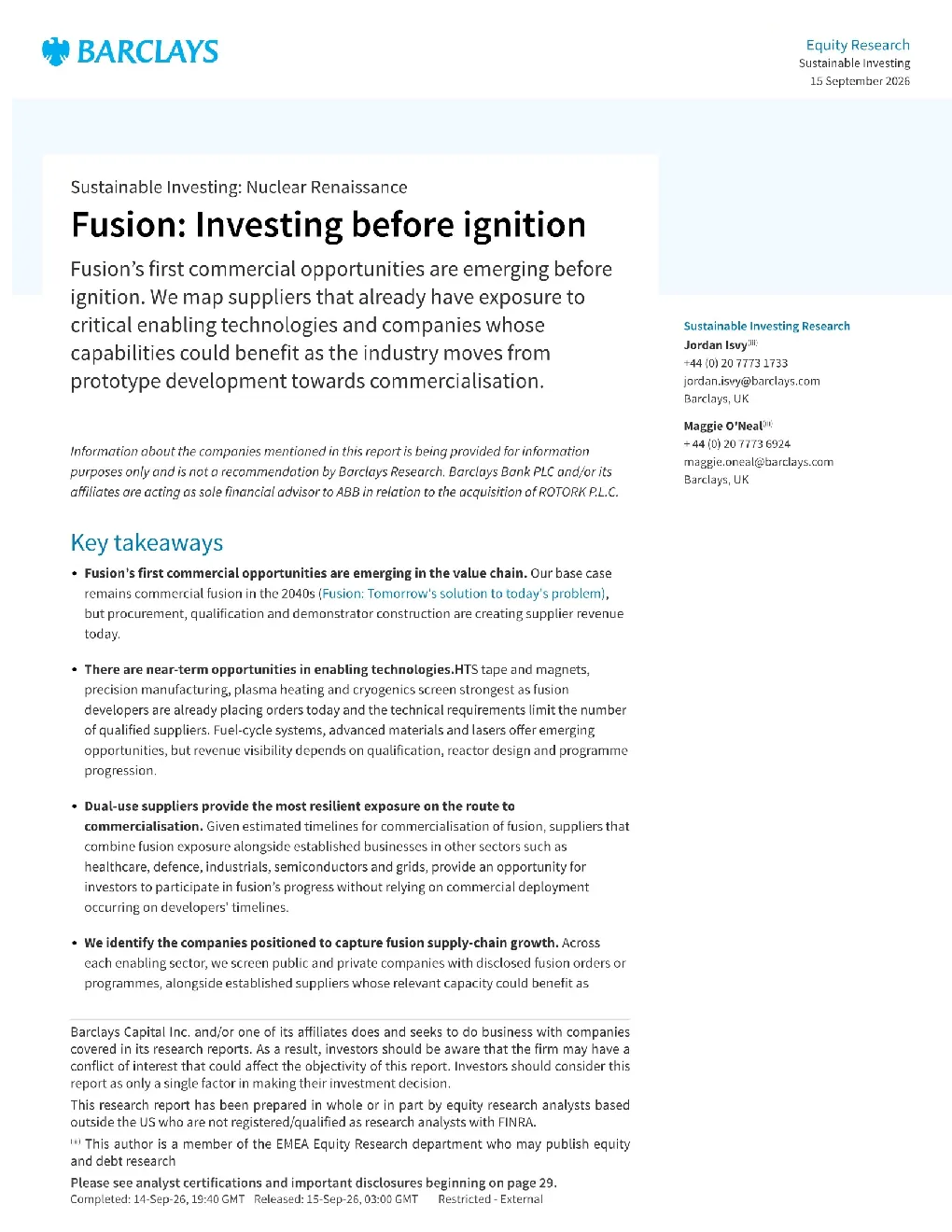
Fusion's first commercial opportunities are emerging in the value chain, with procurement, qualification, and demonstrator construction creating supplier revenue today. The base case remains commercial fusion in the 2040s, but near-term opportunities exist in enabling technologies such as HTS tape and magnets, precision manufacturing, plasma heating, and cryogenics. Revenue visibility for fuel-cycle systems, advanced materials, and lasers depends on qualification, reactor design, and program progression.
Dual-use suppliers provide the most resilient exposure on the route to commercialization. Companies combining fusion exposure with established businesses in sectors like healthcare, defense, industrials, semiconductors, and grids offer investors a way to participate in fusion's progress without relying on developers' timelines.
The report identifies companies positioned to capture fusion supply-chain growth across enabling sectors. HTS tape and magnet systems are already generating revenue today, with suppliers including Fujikura, Faraday, SuNam, Sumitomo Electric, and American Superconductor. Precision engineering, vacuum systems, and high-spec components are also generating revenue through demonstration projects and qualification work. Key companies in this space include Freemelt, Vinci, Mitsubishi Heavy Industries, and 2Vinci.
Power electronics and plasma heating technologies are critical to fusion but have applications across various sectors, including industrial, power, defense, and healthcare. Suppliers like Thales, American Superconductor, and Ampelion have exposure to these markets. Kyoto Fusioneering is a pure-play fusion company focused on power electronics and plasma heating.
Cryogenics and industrial gases are another area with near-term revenue opportunities. Suppliers like Air Liquide and Linde already serve multiple industries, and cryogenics companies such as cPC-Cryolab and Cryomagnetics provide specialized components for fusion facilities. The report highlights the attractiveness of cryogenics for investors due to early revenue generation, scarce capabilities, and diverse customer bases.
Fuel-cycle systems, advanced materials, and lasers offer emerging opportunities but have lower revenue visibility. Suppliers like Eni, BWX Technologies, SHINE Technologies, Materion, and Guardian Metal Resources are involved in these areas. Material development and component qualification are ongoing areas of spending.
Thermal management and blanket systems are essential for fusion reactors, with companies like Kyoto Fusioneering and Mitsubishi Heavy Industries involved in this space. Plasma-facing and advanced materials, including tungsten, ceramics, and composites, are critical for reactor performance and are being developed by companies like Freemelt, MiREsso, and CoorsTek.
Diagnostics, simulation, and digital control systems are used throughout the development cycle, with companies like Cosylab, Siemens AG, and Amentum providing these services. These activities generate revenue from research, testing, and operation stages, with adjacent demand from accelerators, healthcare, and defense.
Engineering, construction, and regulatory services are front-loaded and paid on long-dated contracts. Vinci, Asystem, Atkins Realis, and Amentum are examples of companies involved in this area. The report highlights the importance of nuclear licensing expertise in this segment.
Lasers and optics are core enabling technologies for inertial fusion, with suppliers like Thales, Hamamatsu Photonics, and Amplitude involved in this market. Revenue currently comes from the design and delivery of experimental laser infrastructure and components for research facilities.
Operations, robotics, remote handling, and lifecycle services are critical for fusion plant operation and maintenance. Companies like Amentum, Bilfinger, Assystem, and Atkins Realis are involved in this area. Remote handling expertise is increasingly being integrated into reactor design.
Power conversion and grid infrastructure are less fusion-specific and are driven by broader trends like grid modernization and data center demand. Companies like GE Vernova, Siemens Energy, ABB, and Hitachi Energy are involved in this market.