2026年福利洞察基准报告
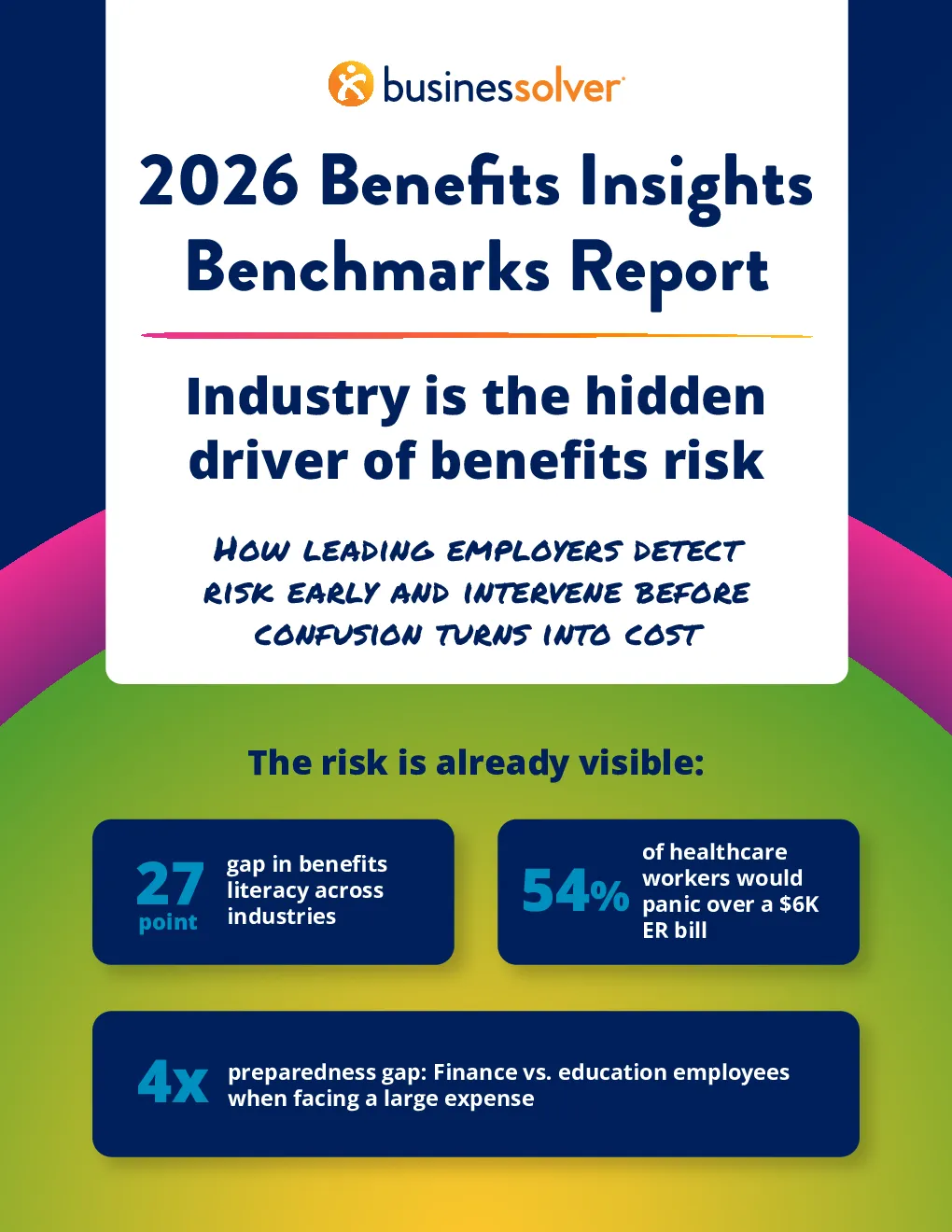
2026 Benefits InsightsBenchmarks Report Industry is the hiddendriver of benefits risk How leading employers detectrisk early and intervene beforeconfusion turns into cost The risk is already visible: of healthcareworkers wouldpanic over a $6KER bill54% gap in benefitsliteracy acrossindustries preparedness gap: Finance vs. education employeeswhen facing a large expense Table of contents Finance9 Healthcare and hospitals/clinics12 Hospitality and retail15 Manufacturing18 Conclusion21 HR is ready to shift gears with their benefits administration technology Businessolver’s 2025 survey of 1,500+ HR leaders and executives across competitor solutionsshows they’re prioritizing engagement and simplification over the next 5 years: want a singleaccess point for allbenefits programs76% aren’t satisfiedwith their currentenrollment tools ordecision support34% 74% 43% want clear andeasy-to-understandomnichannel benefitscommunications are neutral ordissatisfied withtheir current benefitsadministration solution Industry and benefits literacy rates areclosely linked. Here’s what that means. Today’s HR leaders face uncompromising mandates:Control costs, drive AI transformation, and maximizebenefits impact. And often on leaner budgets and withouta clear definition of what success looks like. Businessolver has allowed us to sliceand dice [the data] for our entirepopulation and figure out how wecan best communicate and deliver toour employees. We’ve been using theBenefitsolver platform and I’m at thepoint where I can push as a partner tocreate a one-stop-shop for all thingsbenefits and wellbeing. In this report, we break down the top insights, riskindicators, and engagement trends across five keyindustries within the Benefitsolver platform, highlightinghow anticipatory data and insights enable organizationsto detect risk early and intervene before confusion, cost,and poor decisions occur. -Barbara Fick, Director, Total Rewards at PanasonicNorth America Read Panasonic’s case study 8 industry trends redefining the benefits playing field Cost containment gets creative with reference-based pricingAI governance is a crucial differentiator as security reviews spike 25%Multi-year benefits planning is a mustHR AI spend hits $1.6M annuallyAgent-to-agent experiences are the futureData fluency is the new HR competency“Quiet” is HR’s best marker of successDemand for custom communications soars 43%12345678 View the full trends in our 2026 Benefits Insights report Industry and income are linked to benefitsliteracy and financial stress Industry and income are strong predictors of benefitsrisk—even more than age:93,000+ employee healthliteracy benchmark responses show a 27-pointdivide between the highest- and lowest-literacyscoring industries.Comparatively, the largest gapbetween generations is 16 percentage points. Our annual Benefits Insights study likewise continuesto show the strong interplay between income, literacy,and financial panic: •Benefits knowledge varies sharply by incomeand industry: Software employees score 59%compared to just 32% in retail—a27-pointliteracy gap •Feelings of “panic” about a $6,000 ER bill arehighest in education (66%) versus finance(29%)—a37-point gap Businessolver clients have accessto 7+ dashboards populated withemployee data and insights fromthe Benefits Literacy and BenefitsPreferences Benchmarks andmore. Together, these insightsreveal what employees want,where they’re confused, and howHR can take action. •Lower-income employees prioritize2X as manyaffordability-driven benefitsas higher earners 2025 AI-driven outcomes forBusinessolver’s 850+ clients Employers who use Sofia, Businessolver’santicipatory AI, achieve measurable outcomes: •91% overall instant chat resolution rate;85% of all chats stay resolved after 7 days•2.6 million unique employee interactionsacross phone and chat•263 million minutes savedwith self-servicetools, anticipatory insights, and AI-supportedprocess automation Learn more aboutthe dashboards A closer look at Businessolver’sBenefits Insights Dashboards Businessolver’s Benefits Insights Dashboards unify benchmarking data, engagement signals,and enrollment trends into a single, real-time view for admin teams and theirbrokers/advisors. By connecting what employees value, understand, and choose, thesedashboards pinpoint where risk is forming—before it shows up in costs, claims, or poordecisions. More importantly, they don’t just report on benefits, they surface early risksignals and trigger targeted actions. Why these dashboards matter Benefits costs continue to rise, but many organizations lack clear visibility into what’s drivingspend and how to control it. These dashboards provide key missing links by: •Identifying where risk is building—and enabling early intervention before it impacts cost•Spotting misalignment between benefits offered versus usage and actual employee needs•Pinpointing where confusion or underuse will likely lead to higher d