经常账户缺口21%不等同于人民币被低估21%
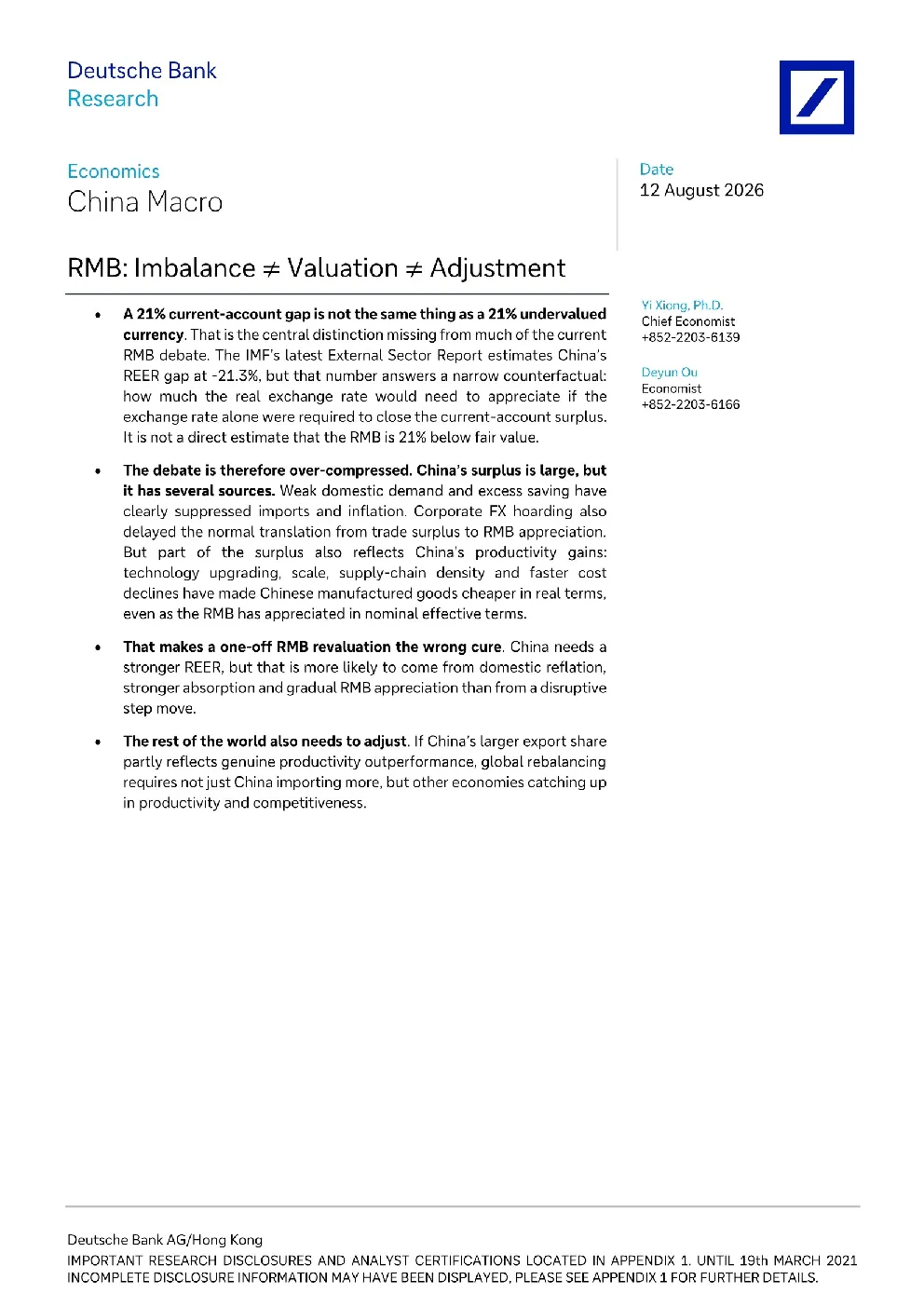
RMB: Imbalance ± Valuation ± Adjustment ChiefEconomist+852-2203-6139 currency.ThatisthecentraldistinctionmissingfrommuchofthecurrentRMBdebate.The IMF'slatest External Sector Report estimates China'sREERgap at-21.3%,but thatnumberanswers a narrowcounterfactual:how much the real exchange rate would need to appreciate if theexchange rate alone were required to close the current-account surplus.It is nota directestimate that the RMB is 21% belowfairvalue. Economist+852-2203-6166 The debate is therefore over-compressed. China's surplus is large, butit has several sources. Weak domestic demand and excess saving haveclearly suppressed imports and inflation. Corporate FX hoarding alsodelayed the normal translation from trade surplus to RMB appreciation.But part of the surplus also reflects China's productivity gains:technology upgrading, scale, supply-chain density and faster costdeclines have made Chinese manufactured goods cheaper in real terms,even as the RMB has appreciated in nominal effective terms. That makes a one-off RMB revaluation the wrong cure. China needs astronger REER, but that is more likely to come from domestic reflation,stronger absorption and gradual RMB appreciation than from a disruptivestepmove. The rest of the world also needs to adjust. If China's larger export sharepartly reflects genuine productivity outperformance, global rebalancingrequires not just China importing more, but other economies catching upin productivity and competitiveness. China Macro latest2026ExternalSectorReportpublishedonJuly31,IMFstaff assessedChina's real effective exchange rate (REER)gap to have widened to -21.3% in2025. This is a much larger gap than in previous years; the estimate was -8.5% inthepreviousyear,andeven smallerbeforethat. international debate about China's currency.The US Treasury's July 2026 Reporton FX Policies cited an earlier IMF estimate that the RMB is 16% undervalued.Various European leaders also think RMB is undervalued,with their assessmentsranging from 15% to 25%. Council on Foreign Relations'Brad Setser argues for anever larger 30-35% undervaluation once China's trade surplus is adjusted for afew factors. However, three IMF insiders-Gopinath, Gourinchas and Rey (GGR)-arecautioning the outside world against reading too much into this latest IMF pointestimate.In a recentarticle,theyarguedthat demandsfor RMBrevaluationtofixglobal imbalances"get both the diagnosis and the cure wrong". We agree with GGR's assessment. The debate often bundles together threedistinct issues: China's trade imbalance,the RMB's valuation, and the exchange-rate adjustment required to reduce the surplus.These should be separated.China's external surplus is genuinely large, but the evidencefor an equally largecurrency mispricing is much weaker. Bringing the surplus back toward normallevels will likely take several years. Over that period, the RMB should continue torevaluation. The 21% measures the current-account gap, not the currency The IMF's estimate starts with China's 2025 current account surplus of 3.8% ofsurplus of 3.6%. It then compares this with a current-account"norm” of 0.6%-thebalance its model associates with China's fundamentals and desirable medium-term policies. The difference is a 3.0 ppt current account gap. The 21.3% number is then produced by dividing this gap (3.0%) by China'sestimated CA sensitivitytothe REER (0.14).It asks hoW much the REER wouldneed to appreciate if the exchange rate alone reduced China's current accountsurplus from 3.6% of GDP to the IMF's 0.6% norm. The calculation is internallyconsistent, butit isnot an independent estimate that the market price of the RMBis 21%below fair value. In fact, the same IMF report contains two direct estimates of RMB valuation,both of which are much more muted. Its REER-Level model, which comparesrelative price levels across countries,finds the RMB undervalued by only2.7%.ItsREER-lndex model, which explains RMB movements using China's economicfundamentals, concludes that the RMB is fairly valued at 0.5% above its historicalbenchmark.DB's FX ResearchTeam reached a similar conclusion using threeseparate approaches: the RMB is undervalued by only 3-8% against a trade-weightedbasketofcurrencies(seeFXValuationSnapshotJune2026) China Macro Wetherefore readthe IMFresults as evidencethat"China's surplus is moreclearlyexcessivethantheRMB is deeplyundervalued"The direct valuationmodels point to a currency close to fair value. The CA approach points to adomestic savings-investment imbalancethat still needs tobe resolved. Surplus reversalshistorically combineFXappreciationanddomestic adjustment The current account is, by identity, the difference between saving andinvestment. A surplus can narrow because households, companies or thegovernment save less; because domestic investment rises;because a strongerreal exchange rate increases imports and reduces net exports; or because foreigndemand andtheterms oftradechange.Currency appreciation isther