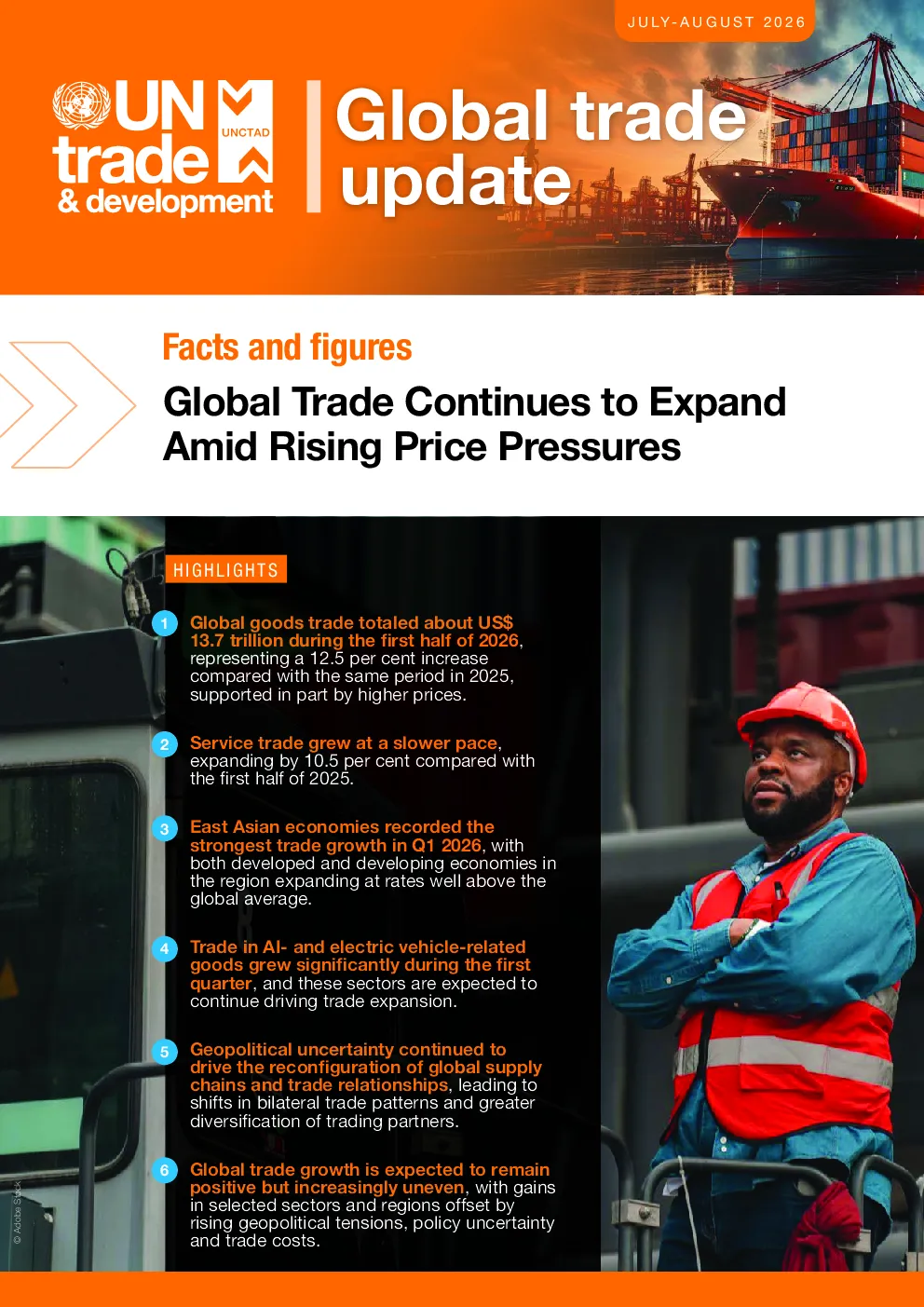
Factsand figures Global Trade Continues to ExpandAmid Rising Price Pressures H I G H L I G H T S 1Global goods trade totaled about US$13.7 trillion during the first half of 2026,representing a 12.5 per cent increasecompared with the same period in 2025,supported in part by higher prices. 2Service trade grew at a slower pace,expanding by 10.5 per cent compared withthe first half of 2025. 3East Asian economies recorded thestrongest trade growth in Q1 2026, withboth developed and developing economies inthe region expanding at rates well above theglobal average. 4Trade in AI- and electric vehicle-relatedgoods grew significantly during the firstquarter, and these sectors are expected tocontinue driving trade expansion. Geopolitical uncertainty continued todrive the reconfiguration of global supplychains and trade relationships, leading toshifts in bilateral trade patterns and greaterdiversification of trading partners.5 Global trade growth is expected to remainpositive but increasingly uneven, with gainsin selected sectors and regions offset byrising geopolitical tensions, policy uncertaintyand trade costs.6 Global trade trends and nowcast Global trade growth was strong in the first quarter of 2026, expanding by approximately 4 percent quarter-on-quarter (QoQ), with goods trade increasing by 4.8 per cent and services by 1.6per cent. UNCTAD’snowcastsuggests continued positive momentum into the second quarterof 2026, with preliminary estimates pointing to QoQ growth of 6.4 per cent for goods and 2.1per cent for services. Overall, global trade is estimated to have increased by about US$2 trillionin the first half of 2026 and is on course to reach a record annual value. First half of 2026: stronger goods trade growth and sluggish servicestrade growth Trade value in goods and services: trailing four quarters and quarterly growth Part of this growth reflected higher trade prices rather than stronger trade volumes. Thedisruption to shipping through the Strait of Hormuz, together with heightened concerns overregional energy supplies, drove up global energy prices and increased transportation, logisticsand production costs across international supply chains. Global trade inflation rose sharply to 3.6per cent QoQ in the first quarter of 2026, while UNCTAD’s nowcast suggests a further increaseof around 5.1 per cent QoQ in the second quarter. Over the past 12 months, trade inflation hasaveraged about 3.4 per cent, indicating particularly persistent price pressure on global trade. Global trade inflation spiked during the first half of 2026 Overall price of traded goods: trailing four quarters and quarterly growth Summary and Outlook In the first quarter of 2026, global trade expanded by about 4 per cent quarter-on-quarter,with goods rising by 4.8 per cent and services by 1.6 per cent. UNCTAD’s nowcast points tofurther growth in the second quarter, particularly for goods. However, a substantial share of theincrease reflects higher prices rather than stronger volumes: trade inflation accelerated in thefirst half of the year as energy, transport, logistics and production costs rose. Performance remained highly uneven across economies and sectors. East Asia was the mainengine of growth, with China and the Republic of Korea recording particularly strong goodstrade, while the rest of Asia experienced slower growth. Africa and the Americas registeredimport growth above the global average but comparatively weaker export performance. At thesectoral level, demand for semiconductors, ICT products, electrical machinery, batteries, criticalminerals and electric vehicles supported expansion, whereas chemicals, iron and steel, andsome renewable-energy products contracted. In Q1 2026, global goods trade growth has been uneven acrosseconomies Imports and exports growth: percentage-point difference from global average Strongdemand for AI-related products,semiconductors,batteries and electric-vehiclecomponents is expected to remain an important driver of trade growth in the second half of2026. At the same time, global trade is increasingly being shaped by evolving trade policiesand geopolitical developments. In the United States, the ongoing trade negotiations are likely tokeep policy uncertainty elevated, with some front-loading of trade expected ahead of potentialpolicy changes. More broadly, renewed trade tensions, persistent risks to shipping through theStrait of Hormuz, and continued geoeconomic fragmentation are expected to raise trade costsand contribute to increasingly uneven trade performance across regions and sectors. Key factors shaping short-term trade outlook Negative Factors Hindering the Trade Outlook Geopolitical Tensions in the Middle East Although efforts to resolve the conflict are ongoing, geopolitical risks persist. Disruptions toregional logistics, shipping routes, and supply chains continue to pose downside risks toglobal trade and economic activity. Renewed tensions could quickly affect transpo