您的浏览器禁用了JavaScript(一种计算机语言,用以实现您与网页的交互),请解除该禁用,或者联系我们。 [麦肯锡]:韧性、领导力和信任的启示:专访凯西·罗斯-杜凯 - 发现报告

韧性、领导力和信任的启示:专访凯西·罗斯-杜凯

2026-07-01 麦肯锡 还是郁闷闷啊
报告封面

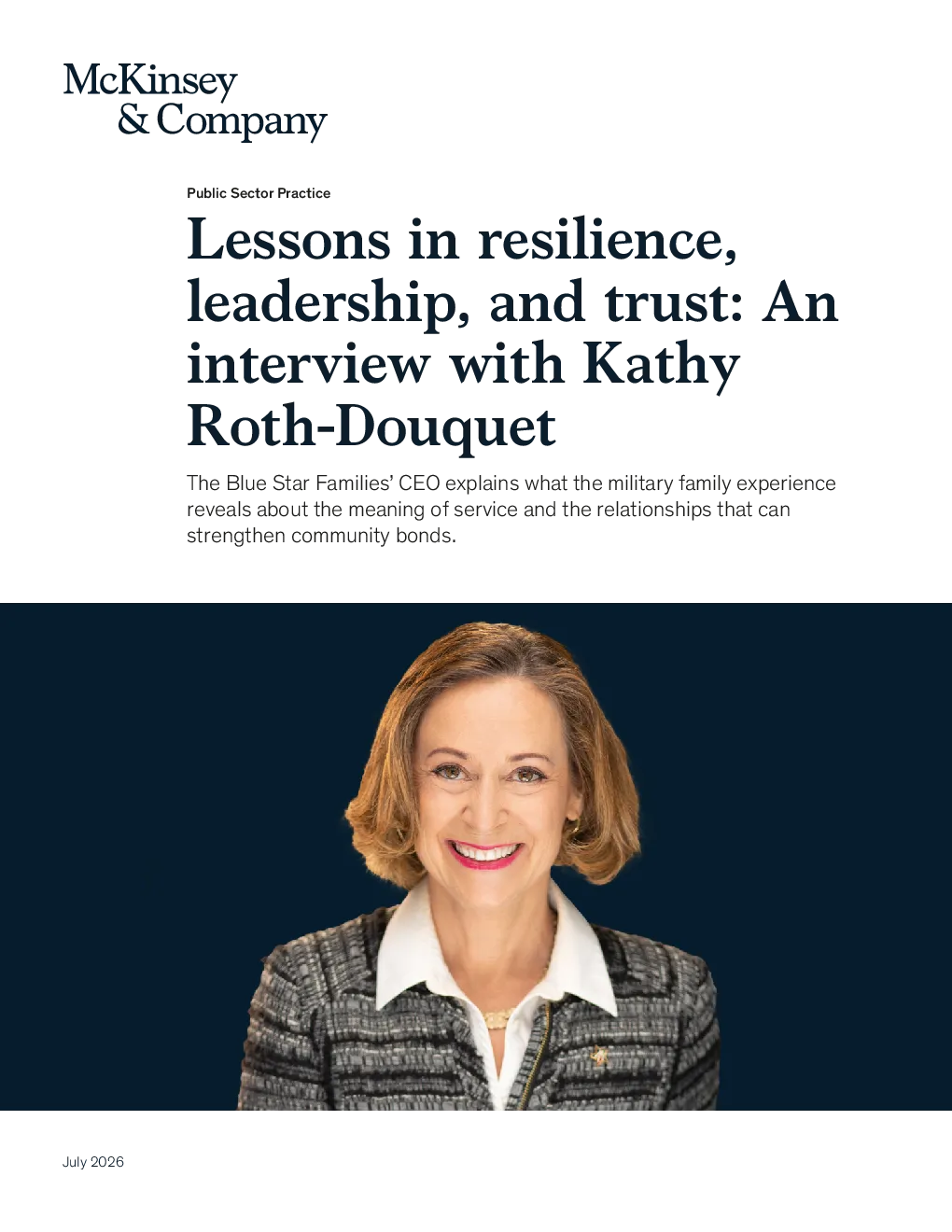
Public Sector PracticeLessons in resilience, leadership, and trust: Aninterview with KathyRoth-Douquet The Blue Star Families’ CEO explains what the military family experiencereveals about the meaning of service and the relationships that canstrengthen community bonds. Kathy Roth-Douquetdid not grow up in a military family. But after marrying a combat Marine,she experienced firsthand the honor and camaraderie—and the sacrifice and isolation—thatcame with military life. In 2009, Roth-Douquet cofounded Blue Star Families to empower othermilitary and veteran families, create communities of mutual support, and amplify these families’experiences and challenges, which were long misunderstood or even absent from the nationalconversation about the military. As its CEO and board president, she has overseen theorganization’s growth to roughly 450,000 members worldwide. As America marks its 250th anniversary, McKinsey is sitting down with public, private, and socialsector leaders to explore the ideas and opportunities that will shape the country’s next chapter.In this interview, McKinsey’s Yocheved Rabhan talks with Roth-Douquet about the military’s rolein American life and as a catalyst for the country’s continual change; how to build trust andbridge gaps across military and civilian communities; and the leadership and talent lessons thathave enabled her success with Blue Star Families. This interview has been edited for length andclarity. Yocheved Rabhan:With America turning 250 years old, we’ve been reflecting on the country’sability to reinvent itself through periods of profound change. Which uniquely American qualitieshave allowed us as a nation to adapt to change? Kathy Roth-Douquet:I love the way America is a country that incorporates change in who weare. We’re a nation of change. We turn over completely who is American, but it doesn’t changethe fact that we are all American from 1776 to 1876 to 1976 to today. That dynamism and thatability to incorporate change and still feel part of the identity: It’s why we as individual Americansare so much part of the country, because we’re the ones who are making that change. Yocheved Rabhan:Looking at your career with Blue Star Families and even before, whichmoments do you feel personify that resilience or capacity to adapt? Kathy Roth-Douquet:First off, I think the experience of being a military family is understandingthat this country is all of us and it takes our blood, sweat, and tears to make this country real. The reason we could be a self-governing democracy is because we have a citizen military, amilitary that comes from the people. People who say, “I’m going to set aside my self-interest fora period of time and do whatever it is that this nation says needs to be done, because a nationneeds a military.” But we also change it because we’re today’s citizens. The military of today andthe families of today are different than those of 50 years ago, and we have to change how wesupport the military to reflect that. My experience with Blue Star Families has been so gratifying because it shows how receptivethe nation really is to change. We’ve seen tremendous receptiveness to the change we’ve beentrying to make in the 17 years we’ve existed. When we started this organization, people didn’t really know that military individuals had families. At the beginning, much of what I did was just say, “And military families.” People wouldsay veterans, and I’d say, “And military families.” They’d say troops, and I’d say, “And militaryfamilies.” Then, a few weeks ago, we were doing a big event with Ford on the deck of the USS Midwaywith NASCAR and the Zac Brown Band. They are celebrating our military and their families. Andthey are fully embracing the idea that when we talk about supporting the troops, there arefamilies that go with these troops. I’ve seen a tremendous change in how we understand thispopulation, and that’s very motivating. Yocheved Rabhan:Blue Star Families is responsible for one of the biggest military familysurveys in the country. I’m curious what you’ve learned through the data about military families’quality of life and what military service asks of families and communities, not only of servicemembers. Kathy Roth-Douquet:We created the first Military Family Lifestyle Survey in 2009. It was thefirst thing we did, because the nation didn’t have any data to aggregate the anecdotalexperiences of those who lived this life. I was a real-life military spouse. My husband was acombat Marine who went into harm’s way. We were moving over and over again—nine times in16 years. I kept losing my job. I kept putting my kids into new schools. I was far from family andfriends trying to cope with it all—my community was, too—and there was no way to talk about itin the larger world other than, “This was my experience as one person.” But what about theaggregate experience? Our first survey asked: “Do you feel the larger society understands and appreciates the workyou do