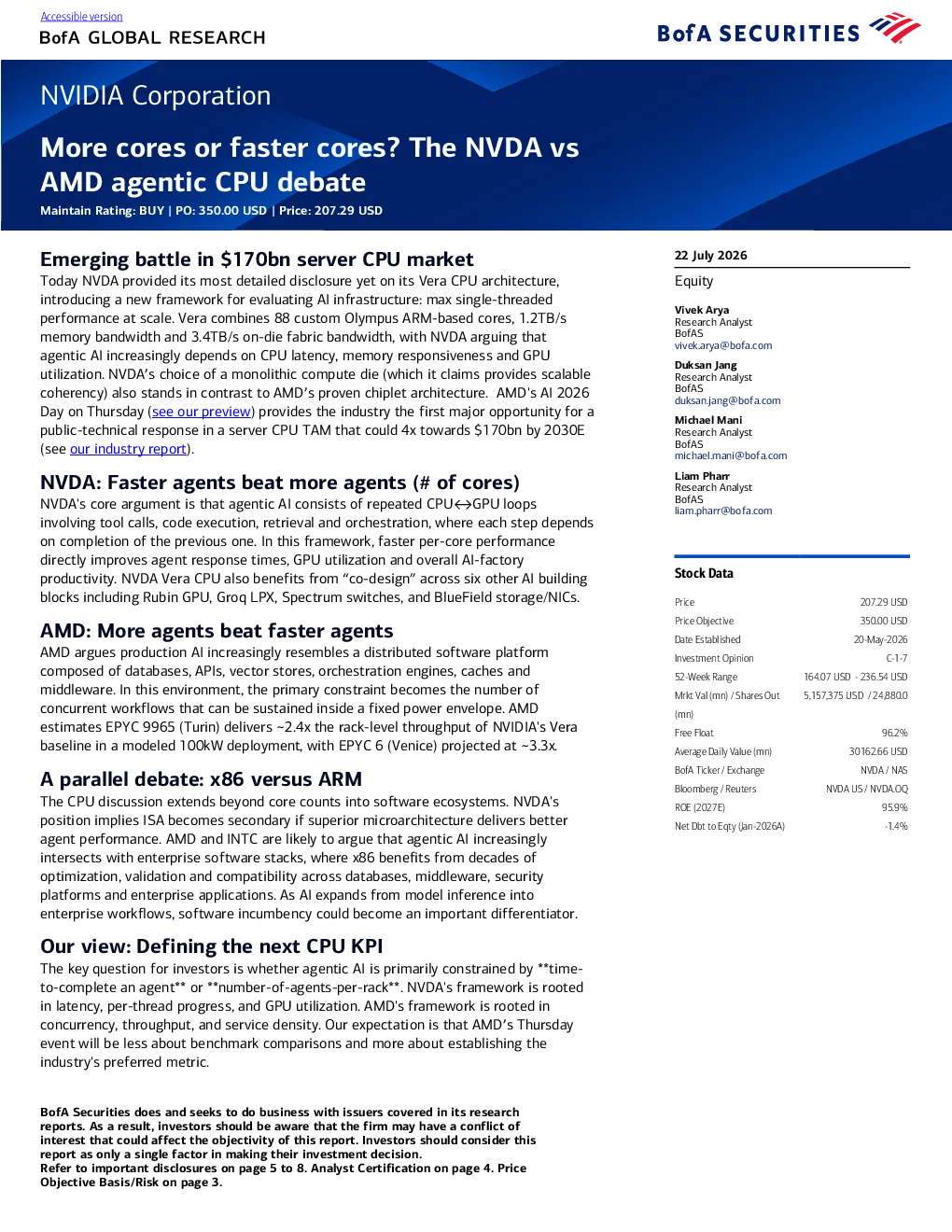
22 July 2026 Emerging battle in $170bn server CPU marketToday NVDA provided its most detailed disclosure yet on its Vera CPU architecture, introducing a new framework for evaluating AI infrastructure: max single-threadedperformance at scale. Vera combines 88 custom Olympus ARM-based cores, 1.2TB/smemory bandwidth and 3.4TB/s on-die fabric bandwidth, with NVDA arguing thatagentic AI increasingly depends on CPU latency, memory responsiveness and GPUutilization. NVDA’s choice of a monolithic compute die (which it claims provides scalablecoherency) also stands in contrast to AMD’s proven chiplet architecture. AMD's AI 2026Day on Thursday (see our preview) provides the industry the first major opportunity for apublic-technical response in a server CPU TAM that could 4x towards $170bn by 2030E(seeour industry report). Equity Vivek AryaResearch AnalystBofASvivek.arya@bofa.com Duksan JangResearch AnalystBofASduksan.jang@bofa.com Michael ManiResearch AnalystBofASmichael.mani@bofa.com Liam PharrResearch AnalystBofASliam.pharr@bofa.com NVDA: Fasteragents beat more agents (# of cores) NVDA's core argument is that agentic AI consists of repeated CPU↔GPU loopsinvolving tool calls, code execution, retrieval and orchestration, where each step dependson completion of the previous one. In this framework, faster per-core performancedirectly improves agent response times, GPU utilization and overall AI-factoryproductivity. NVDA Vera CPU also benefits from“co-design”across six other AI buildingblocks including Rubin GPU, Groq LPX, Spectrum switches, and BlueField storage/NICs. Stock Data Price207.29 USDPrice Objective350.00 USDDate Established20-May-2026Investment OpinionC-1-752-Week Range164.07 USD-236.54 USDMrkt Val (mn) / SharesOut5,157,375 USD / 24,880.0 AMD: More agents beat faster agentsAMD argues production AI increasingly resembles a distributed software platform composedof databases, APIs, vector stores, orchestration engines, caches andmiddleware. In this environment, the primary constraint becomes the number ofconcurrent workflows that can be sustained inside a fixed power envelope. AMDestimates EPYC 9965 (Turin) delivers ~2.4x the rack-level throughput of NVIDIA's Verabaseline in a modeled 100kW deployment, with EPYC 6 (Venice) projected at ~3.3x. Aparallel debate: x86 versus ARM The CPU discussion extends beyond core counts into software ecosystems. NVDA'sposition implies ISA becomes secondary if superior microarchitecture delivers betteragent performance. AMD and INTC are likely to argue that agentic AI increasinglyintersects with enterprise software stacks, where x86 benefits from decades ofoptimization, validation and compatibility across databases, middleware, securityplatforms and enterprise applications. As AI expands from model inference intoenterprise workflows, software incumbency could become an important differentiator. Ourview: Defining the next CPU KPIThe key question for investors is whether agentic AIis primarily constrained by **time- to-complete an agent** or **number-of-agents-per-rack**. NVDA's framework is rootedin latency, per-thread progress, and GPU utilization. AMD's framework is rooted inconcurrency, throughput, and service density. Our expectation is that AMD’s Thursdayevent will be less about benchmark comparisons and more about establishing theindustry's preferred metric. BofA Securities does and seeks to do business with issuers covered in its researchreports. As a result, investors should be aware that the firm may have a conflict ofinterest that could affect the objectivity of this report. Investors should consider thisreport as only a single factor in making their investment decision.Refer to important disclosures on page 5 to 8. Analyst Certification on page 4. PriceObjective Basis/Risk on page 3. Single-threaded core versus throughput quadrant and Vera CPU positioning Glossary: AI – Artificial IntelligenceAMD – Advanced Micro DevicesAPI – Application Programming InterfaceARM – Advanced RISC MachinesCPU – Central Processing UnitGPU – Graphics Processing UnitINTC – Intel CorporationISA – Instruction Set ArchitectureKPI – Key Performance IndicatorkW – KilowattLPX – Groq's Language Processing Unit variantNIC – Network Interface CardNVDA – NVIDIATAM – Total Addressable MarketTB/s – Terabytes per second Price objective basis & risk Advanced Micro Devices, Inc (AMD) Our $620 PO is based on 47x our 2027E non-GAAP EPS. Our PO basis is now towardsmiddle/upper range of historical 13x-58x, but is well supported by AMD's 50%+ annualEPS CAGR potential and its AI CPU/GPU share gain potentials, modestly offset by slowergrowth in cyclical PC/embedded/console markets. Downside risks: 1) Execution on first rack-scale product (MI400 Series), 2)Timing/Magnitude of Middle East AI Projects, 3) Lumpy nature of consumer andenterprise spending that could create delays in acceptance and success of new products,4) High reliance on one outsourced manufacturing partner, 5) Maturity of c