Spotify与美国音乐行业:定价是否已达顶?至少未来一年仍有上行空间
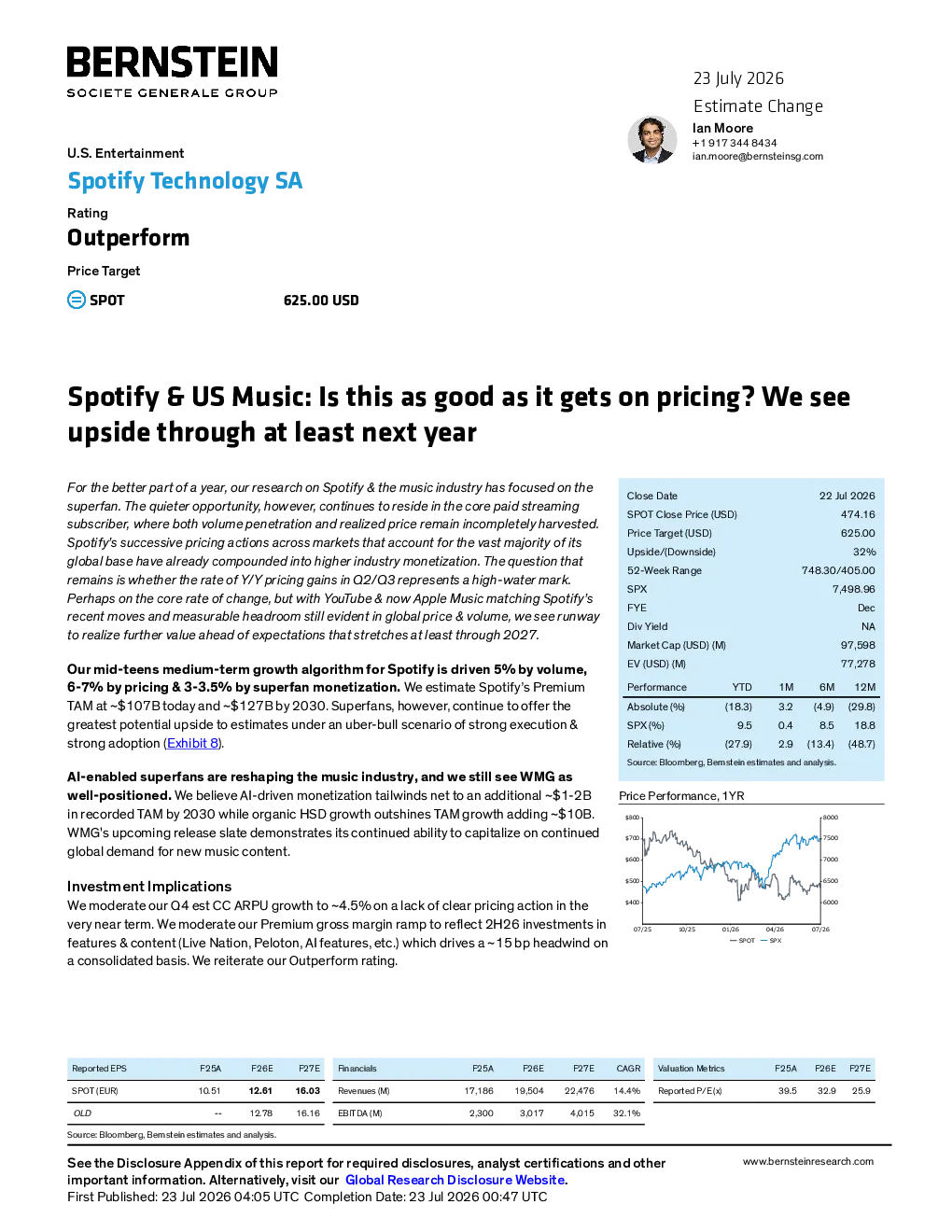
Spotify & US Music: Is this as good as it gets on pricing? We seeupside through at least next year For the better part of a year, our research on Spotify & the music industry has focused on thesuperfan. The quieter opportunity, however, continues to reside in the core paid streamingsubscriber, where both volume penetration and realized price remain incompletely harvested.Spotify’s successive pricing actions across markets that account for the vast majority of itsglobal base have already compounded into higher industry monetization. The question thatremains is whether the rate of Y/Y pricing gains in Q2/Q3 represents a high-water mark.Perhaps on the core rate of change, but with YouTube & now Apple Music matching Spotify’srecent moves and measurable headroom still evident in global price & volume, we see runwayto realize further value ahead of expectations that stretches at least through 2027. Our mid-teens medium-term growth algorithm for Spotify is driven 5% by volume,6-7% by pricing & 3-3.5% by superfan monetization.We estimate Spotify’s PremiumTAM at ~$107B today and ~$127B by 2030. Superfans, however, continue to offer thegreatest potential upside to estimates under an uber-bull scenario of strong execution &strong adoption (Exhibit 8). AI-enabled superfans are reshaping the music industry, and we still see WMG aswell-positioned.We believe AI-driven monetization tailwinds net to an additional ~$1-2Bin recorded TAM by 2030 while organic HSD growth outshines TAM growth adding ~$10B.WMG's upcoming release slate demonstrates its continued ability to capitalize on continuedglobal demand for new music content. Investment Implications We moderate our Q4 est CC ARPU growth to ~4.5% on a lack of clear pricing action in thevery near term. We moderate our Premium gross margin ramp to reflect 2H26 investments infeatures & content (Live Nation, Peloton, AI features, etc.) which drives a ~15 bp headwind ona consolidated basis. We reiterate our Outperform rating. VALUATION COMPS TABLE DETAILS Where does Spotify’s next phase of growth come from? Spotify has matured in many of its largest markets. The question Spotify now faces is how it can grow. We see Spotify growingvia 3 avenues: pricing power, superfan monetization, and expansion in under-penetrated regions. We outline Spotify’s market,depict how pricing power effects market size, and lend our thoughts on superfans and penetration growth in this note. To get Spotify’s TAM, we do the following: count all the people with internet in countries that Spotify operates in, makeassumptions about people’s price sensitivity and exclude people who are unlikely to be willing to pay for Spotify premium basedon price to income ratio of their country and region. Then for each country, multiply the Spotify individual price with an executiondiscount factor by12 months and the eligible population to get TAM. See Exhibit 18 for why using Spotify’s price makes sensefor calculating TAM. Note, this implies that our TAM penetrations are also equivalent to subscriber penetration. We then use estimates about Spotify Premium’s broad regional penetration to extrapolate more granular penetrationsfor Spotify and other DSPs and verify that these penetrations match Spotify Premium revenue with slight room for error.Specifically, we estimate Spotify has 34% of global premium market share implying that there are 860 million premiumsubscribers globally. We estimate that Spotify has 42% market share in North America, 56% in Europe, and 34% in LatinAmerica implying 15% in the rest of the world which gives estimates for total premium subscribers in the broad regions. Next, we allocate premium users for all music DSPs into the smaller regions. North America and Latin America follow easilybecause they aren’t subdivided into other regions. When subdividing Europe and the rest of the world, we use estimates ofrelative demand within the larger region by comparing prices and incomes. After obtaining estimates for total premium users,we determine Spotify’s penetrations by filling in the gaps in a way that matches Spotify’s premium revenue and user numbers. These regional user estimates flow back to country level premium user estimates based off further estimates of relativedemand, which allows us to compute a total premium revenue from the country level. Our model outputs around $18B inrevenue which is $0.5B above Spotify’s 2025 premium revenue demonstrating that our estimates are in the ballpark of the truepenetrations. EXHIBIT 3:We see ample room for Spotify to grow, in particular, Asia, Southeast Asia, and Emerging Europe arelikely underpenetrated volume wise. We also see price growth opportunity across the board. As noted above, our TAM penetrations are equivalent percent wise to subscriber penetrations. However, due to regionalpricing differences, subscriber counts differ in magnitude from TAM and this is also helpful for evaluating where it is importantfor Spotify to grow or take share f