德国2029年军备计划的角力
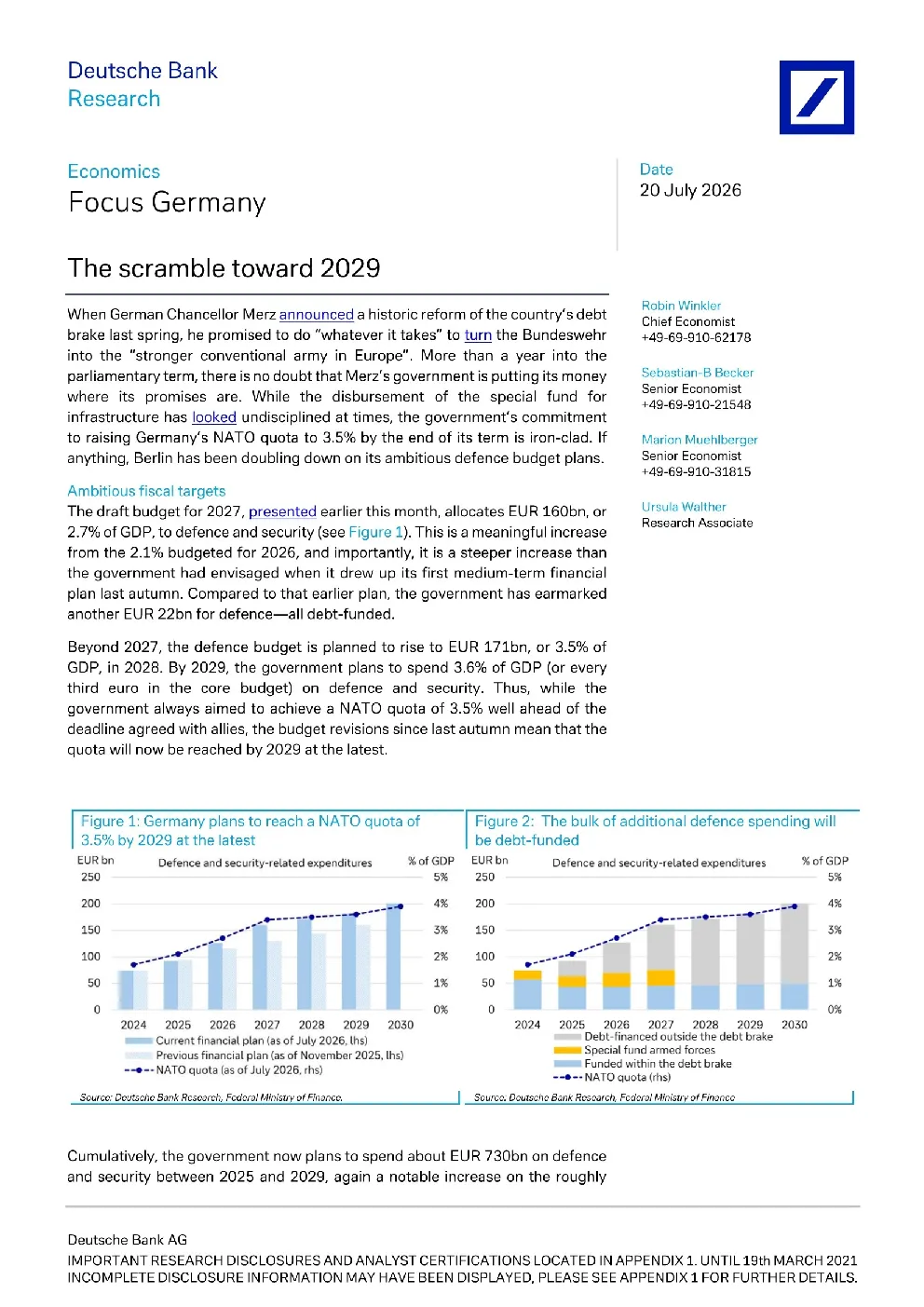
Focus Germany The scramble toward 2029 Chief Economist+49-69-910-62178 brakelastspring,hepromisedtodo"whateverittakes"toturntheBundeswehrinto the "stronger conventional army in Europe". More than a year into theparliamentary term, thereis no doubt that Merz's government is putting its moneywhere its promises are.While thedisbursement of the special fundforinfrastructurehaslookedundisciplinedattimes,thegovernment'scommitmentto raising Germany's NATO quota to 3.5% by the end of its term is iron-clad. Ifanything, Berlin has been doubling down on its ambitious defence budget plans. Senior Economist+49-69-910-21548 Senior Economist+49-69-910-31815 AmbitiousfiscaltargetsThe draft budget for 2027, presented earlier this month, allocates EUR 160bn, or Research Associate 2.7% of GDP, to defence and security (see Figure 1). This is a meaningful increasefrom the 2.1% budgeted for 2026, and importantly,it is a steeper increase thanthe government had envisaged when it drew up its first medium-term financialplanlastautumn.Comparedtothatearlierplan,thegovernmenthasearmarkedanotherEUR22bnfordefence—alldebt-funded. Beyond 2027, the defence budget is planned to rise to EUR 171bn, or 3.5% ofGDP, in 2028. By 2029, the government plans to spend 3.6% of GDP (or everythird euro in the core budget) on defence and security. Thus, while thegovernmentalways aimed to achieve a NATO quota of 3.5%wellahead of thedeadline agreed with allies, the budget revisions since last autumn mean that thequota will now be reached by2029 at the latest. Cumulatively, the government now plans to spend about EUR 730bn on defenceand security between 2025 and 2029, again a notable increase on the roughly expenditures, at least EUR 500bn, will be directly funded via fresh debt, thanksto the generous exemption from the debt brake (only the first 1% of GDP indefence spending counts against the modified debt brake) as well as to theremaining special fund for the armedforces setupin 2022 (see Figure2) This ambitious fiscal plan is fully in line with the modified debt brake, which puts no constitutional constraints on the government's ability to borrowfor defence.(lronically,as we discuss below, the EU fiscal rules could turn out to be a morebinding constraint in the medium term.) It is increasingly evident that carving outdefence spending from the debt brake-with the 1% rule acting as little more thana fig leavewas a far more consequential fiscal regime change than thealternative of setting up another special fund for defence. Indeed, while the EUR 500bn special fund for infrastructure and climatetransformation is at risk of being eroded by rapidly rising construction costs incoming years,the government will be able and willing to protect its ambitiousdefence budgets against rising prices. This is perhaps one reason why thegovernment has started to reallocate some security-relevant infrastructureprojects (rail, roads, bridges) from the infrastructure fund to the defence budget.After all, the distinction between civilian and defence-related infrastructure is ablurry one nowadays. Importantly,thedefencebudgetappearstobeoneofthefewareasonwhichthetwo coalition partners are in unanimous agreement, as Chancellor Merz stressedin a recent press conference. Nor are there any audible grumblings in the rankand file of either party.While some of the reform measures recently announcedand while some of the social expenditure cuts in the draft budget could yet seesome debates overthe summer,thereisno obvious discontent in eitherpartyoverthegovernment'sborrowingplansfordefenceandsecurity. TheobviousreasonforthisstrongconsensusandcommitmentisthattheGermangovernment assesses, in line with NATO, that Russia could be ready for a kineticattack on NATO territory by 2029. The possibility of the US inaugurating in early2029 a new President with more isolationist views on NATO only magnifies theperception that Germany needs to projectboth a credible military deterrent andastrongfinancialcommitmentnolaterthan2029 At the same time, Germany's next federal election, scheduled for spring 2029,current polls, the centrist parties thatjointly reformed the debt brake last spring-CDU/CSU, SPD, and Greens—are polling at 48%, just enough for a slim majorityof seats thanksto the 5%hurdle(seeFigure3Error!Reference sourcenotfound.).If this majority slipped away by the next election, however, it would be difficult tofind supportforlarge debt-funded defence budgets from the othertwo parties. Finally,the government's"whatever it takes"strategy could run into a potentialat the end of 2028.While Germany's deficit currently just about complies with the projects at any rate, it would become hard to avoid an excessive deficit procedureif the escape clause werenot extended beyond 2028.While it is hardto imaginethat Germany's European partners would cry foul loudly, a violation of the EU'sfiscal rules could erode the credibility of a"whatever ittakes" defence strategy inthe domestic politic