您的浏览器禁用了JavaScript(一种计算机语言,用以实现您与网页的交互),请解除该禁用,或者联系我们。 [世界银行]:菲律宾塑料政策的发展:塑料价值链关键利益相关者的见解 - 发现报告

菲律宾塑料政策的发展:塑料价值链关键利益相关者的见解

基础化工 2026-07-13 世界银行 刘银河
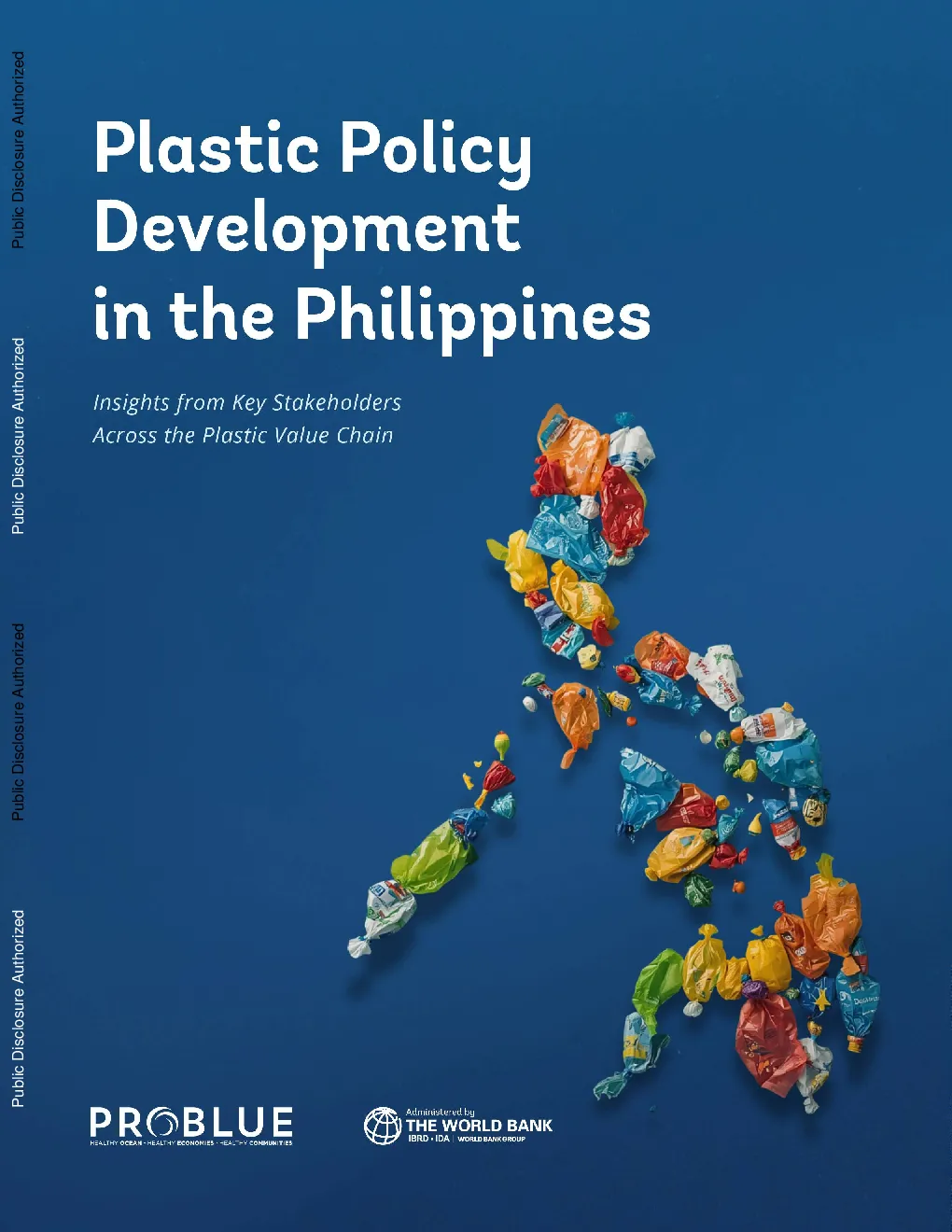
报告封面

© 2026 The World Bank1818 H Street NW, Washington DC 20433Telephone: 202-473-1000; Internet:www.worldbank.org Some rights reserved. This work is a product of The World Bank. The findings, interpretations, and conclusionsexpressed in this work do not necessarily reflect the views of the Executive Directors of TheWorld Bank or the governments they represent. The World Bank does not guarantee the accuracy, completeness, or currency of the dataincludedin this work and does not assume responsibility for any errors,omissions,ordiscrepancies in the information, or liability with respect to the use of or failure to usetheinformation,methods,processes,or conclusions set forth.The boundaries,colors,denominations, links/footnotes and other information shown in this work do not imply anyjudgment on the part of The World Bank concerning the legal status of any territory or theendorsement or acceptance of such boundaries. The citation of works authored by othersdoes not mean the World Bank endorses the views expressed by those authors or the contentof their works. Nothing herein shall constitute or be construed or considered to be a limitation upon or waiverof the privileges and immunities of The World Bank, all of which are specifically reserved. Rights and Permissions Thematerial in this work is subject to copyright.Because The World Bank encouragesdisseminationof its knowledge,this work may be reproduced,in whole or in part,fornoncommercial purposes as long as full attribution to this work is given. Attribution—Please cite the work as follows: “World Bank. 2026. Plastic Policy Development inthe Philippines: Insights from Key Stakeholders Across the Plastic Value Chain. © World Bank.” Any queries on rights and licenses, including subsidiary rights, should be addressed to WorldBank Publications, The World Bank, 1818 H Street NW, Washington, DC 20433, USA; fax: 202-522-2625; e-mail:pubrights@worldbank.org. Plastic PolicyDevelopmentin the Philippines Insights from Key Stakeholders Across the Plastic Value Chain Table of Contents AcknowledgmentsAbbreviations Executive Summary1 Chapter I. Introduction8 Plastic Policies in the Philippines10Methodology12Plastic Lifecycle and Stakeholders16 Chapter II.The Estimated Impacts of Three Policies to ReducePlastic Waste In The Philippines21 Chapter III.The Political Economy of Plastics Reform30 Broad Support for Policies to Reduce Plastic Waste31Environmental Concerns Drive Support for Plastic Reduction Measures31Importance of Enabling Infrastructure and Well-Implemented Policies32A Lack of Alternatives Reduces Support for Plastic Reduction Measures33Concerns about Higher Costs—and Expectations of Opportunity34Importance of a Clear Communication Strategy35Views on Specific Policies Have Important Implications for TheirEffective Implementation37 Chapter IV. Conclusion40 References Annexes49 Annex A: Plastics Policy Simulator (PPS)50Annex B: Informal Workers Survey56Annex C: Qualitative Survey60 Acknowledgments Thereport was prepared by a team of World Bank staff and consultants led byJunu Shrestha (Senior Environmental Specialist), Liliana D. Sousa (Senior Economist), andMathew Wai-Poi (Lead Economist). The core team members were Klaus Sattler (EnvironmentalSpecialist), Sharon Piza (Economist), and Agnes Chung Balota (Senior Environmental Specialist).Reynar Rollan (Solid Waste Management Consultant), Rea Uy Epistola (Consultant), HubertJenny(Technical Consultant),and Benjamin Lavin(Consultant)provided technical andstakeholder engagement support. Ann Bishop (Technical Editor) and Leslie Lim (Designer)played essential roles in preparing the report for publication, and Venessa Vaishali Sarkar(Program Assistant) provided invaluable operational support. TheResources,Environment,and Economics Center for Studies led by Rupert JeremiahBustamante IV developed the Plastics Policy Simulator; the research firm Ipsos led by ShielaElauria, conducted the Informal Workers Survey; and the Philippine Survey and ResearchCenter led by Anna Lissa Bartolome conducted the qualitative Stakeholders Survey. The team is grateful for the valuable recommendations provided by the peer reviewers:Alejandro de la Fuente (Senior Economist, EAEPV) and Delphine Arri (Senior EnvironmentalEngineer, SMAEO). Overall, the study received guidance from Ndiamé Diop (Country Director for Brunei, Malaysia,Philippines, and Thailand), Zafer Mustafaoglu (Division Director, Brunei, Malaysia and thePhilippines), Mona Sur (Practice Manager, Environment, Natural Resources, and the BlueEconomy Global Practice), Marc Sadler (East Asia and Pacific Practice Manager, Environment),Benu Bidani (East Asia and Pacific Practice Manager, Poverty), and Rinku Murgai (East Asia andPacific Practice Manager). The study team would also like to extend special thanks to the private and public sectorstakeholders in the Philippines who generously contributed their time to this study. Thesegovernment agencies and their representat