您的浏览器禁用了JavaScript(一种计算机语言,用以实现您与网页的交互),请解除该禁用,或者联系我们。 [伯思斯坦]:LG能源解决方案2026年快速点评 - 发现报告

LG能源解决方案2026年快速点评

2026-07-07 伯思斯坦 金栩生
报告封面

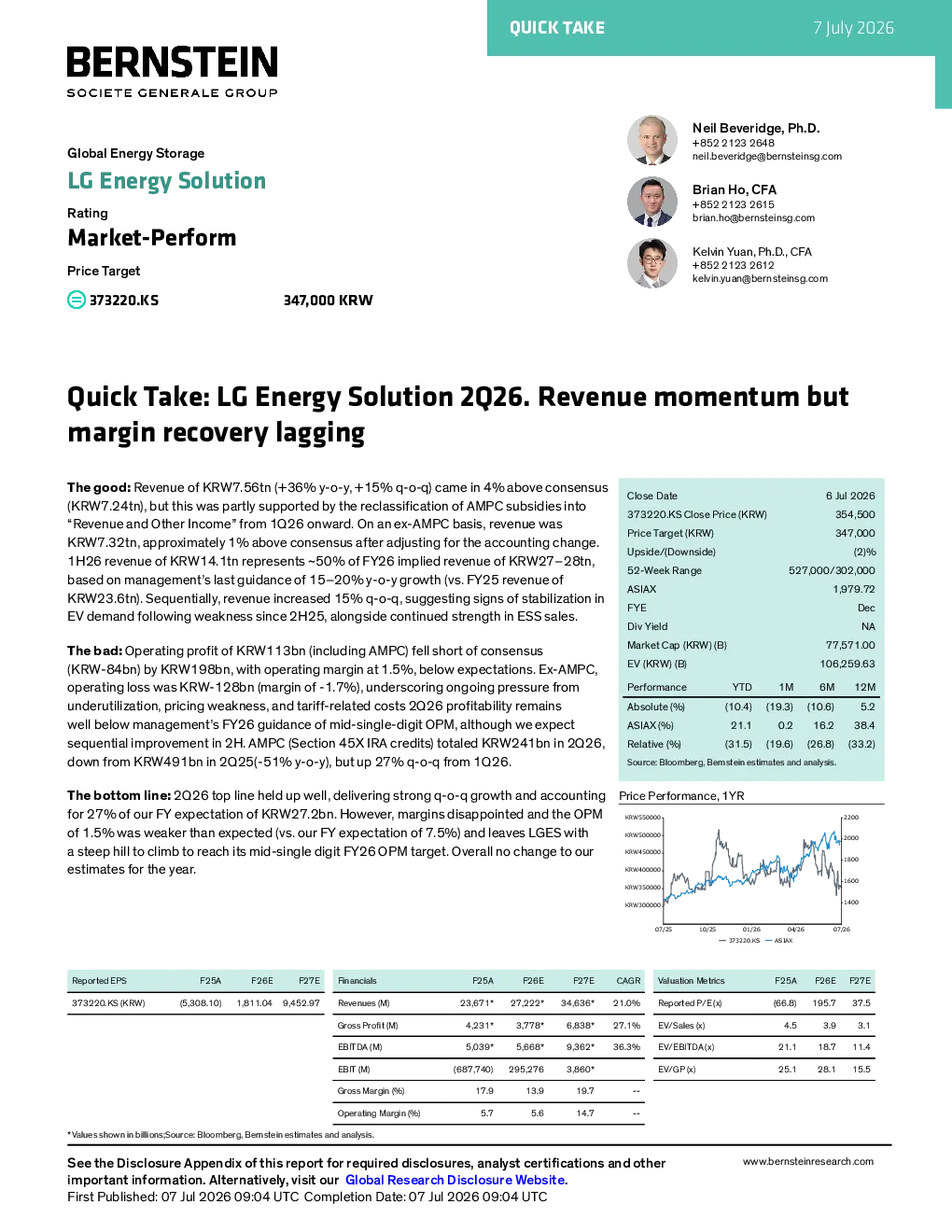
Brian Ho, CFA+852 2123 2615brian.ho@bernsteinsg.com Kelvin Yuan, Ph.D., CFA+852 2123 2612kelvin.yuan@bernsteinsg.com Price Target 373220.KS Quick Take: LG Energy Solution 2Q26. Revenue momentum butmargin recovery lagging The good:Revenue of KRW7.56tn (+36% y-o-y, +15% q-o-q) came in 4% above consensus(KRW7.24tn), but this was partly supported by the reclassification of AMPC subsidies into“Revenue and Other Income” from 1Q26 onward. On an ex-AMPC basis, revenue wasKRW7.32tn, approximately 1% above consensus after adjusting for the accounting change.1H26 revenue of KRW14.1tn represents ~50% of FY26 implied revenue of KRW27–28tn,based on management’s last guidance of 15–20% y-o-y growth (vs. FY25 revenue ofKRW23.6tn). Sequentially, revenue increased 15% q-o-q, suggesting signs of stabilization inEV demand following weakness since 2H25, alongside continued strength in ESS sales. The bad:Operating profit of KRW113bn (including AMPC) fell short of consensus(KRW-84bn) by KRW198bn, with operating margin at 1.5%, below expectations. Ex-AMPC,operating loss was KRW-128bn (margin of -1.7%), underscoring ongoing pressure fromunderutilization, pricing weakness, and tariff-related costs 2Q26 profitability remainswell below management’s FY26 guidance of mid-single-digit OPM, although we expectsequential improvement in 2H. AMPC (Section 45X IRA credits) totaled KRW241bn in 2Q26,down from KRW491bn in 2Q25(-51% y-o-y), but up 27% q-o-q from 1Q26. The bottom line:2Q26 top line held up well, delivering strong q-o-q growth and accountingfor 27% of our FY expectation of KRW27.2bn. However, margins disappointed and the OPMof 1.5% was weaker than expected (vs. our FY expectation of 7.5%) and leaves LGES witha steep hill to climb to reach its mid-single digit FY26 OPM target. Overall no change to ourestimates for the year. •Revenue:LGES reported 2Q26 revenue of KRW7.56tn (36% y-o-y, +15% q-o-q), which was 4% above consensus ofKRW7.24tn (30% y-o-y, 10% q-o-q). From 1Q26, LGES changed its accounting presentation of North American productionsubsidies (AMPC/Section 45X IRA credits), now recorded under "Revenue and Other Income" rather than as a cost offset;prior period figures have been restated on a comparable basis. Excluding AMPC, revenue was KRW7.32tn, still ahead theconsensus of KRW 0.08bn. 2Q26 revenue represents around 27% of FY26 targeted revenue, implying full-year revenue ofKRW27-28tn based on management's guidance of 15-20% y-o-y growth (vs FY25 base of KRW23.6tn). •Operating Profit:2Q26 operating profit including AMPC was KRW113bn, missing consensus of KRW-84bn byKRW198bn. This was higher than KRW-208bn in 1Q26 but lower than KRW492bn in 2Q25. Operating margin includingAMPC came in at 1.5%, still well below management's FY26 guidance of mid-single digit OPM. Excluding AMPC of KRW241bn, operating loss was KRW-128bn with an ex-AMPC operating margin of -1.7%. •Financial Position:LGES has not released financial positions with preliminary results. 1Q26 capex decreased by 40% y-o-y to KRW1.6tn. At the end of 1Q26, ND to equity ratio raised to 70% (vs. 64% in 4Q25). Cash balance at quarterly end wasslightly decreased to KRW3.7tn (vs. KRW3.8tn in 4Q25). •New Orders:At 2025YE, LGES have a cumulative ESS backlog of 140GWh with 90GWh of new orders expected this year.For the 46series (mainly EV) LGES is experiencing strong demand and has a 300GWh backlog. LGES is diversifying itscylindrical battery customer base, with large supply contracts totaling 107GWh, 70% in the US and 30% in Europe. In ESS,2026 LGES with DTE Energy for 6GWh/1.5GW in May. NEAR-TERM OUTLOOK •2026 outlook:For 2026, some US OEM are shifting strategies to prioritize the HEV and EREV, resulting in slowdown in theEV battery demand. Full utilization of local production capacity and a strategic pivot toward ESS will be critical. LGES expectsthe US EV demand to recover in 2027 as more competitive EV models enter the market. LGES secured orders in Europe forboth mass-market EV batteries and ESS, with meaningful growth anticipated in 2026. •Capex: LGES remains highly disciplined on capex and cash flow. In 1Q26, capex declined 47% YoY to about KRW 1.6tn,focused on essential investments such as Arizona cylindrical capacity and Michigan ESS line expansion. Managementreiterated that it will maximize utilization of existing assets, execute only minimum essential investments, and improve cashflow through EBITDA generation, working-capital management, and potential divestment of non-core assets •OEM demand: With EU and US relaxing regulations on fuel standards for vehicles and market demand growth slowing,OEMs are making adjustment to their EV penetration rates in the long term from 50% to 40%. As such, LGES expects to seemore volatility and pacing of OEM’s electrification plans over coming years. In order to get cost savings and competitivenessin EVs, OEM need to target lower costs EVs. LGES is responding to market changes by focusing battery developmenttargeting: 1