塑造美元长期轨迹的三大长期力量
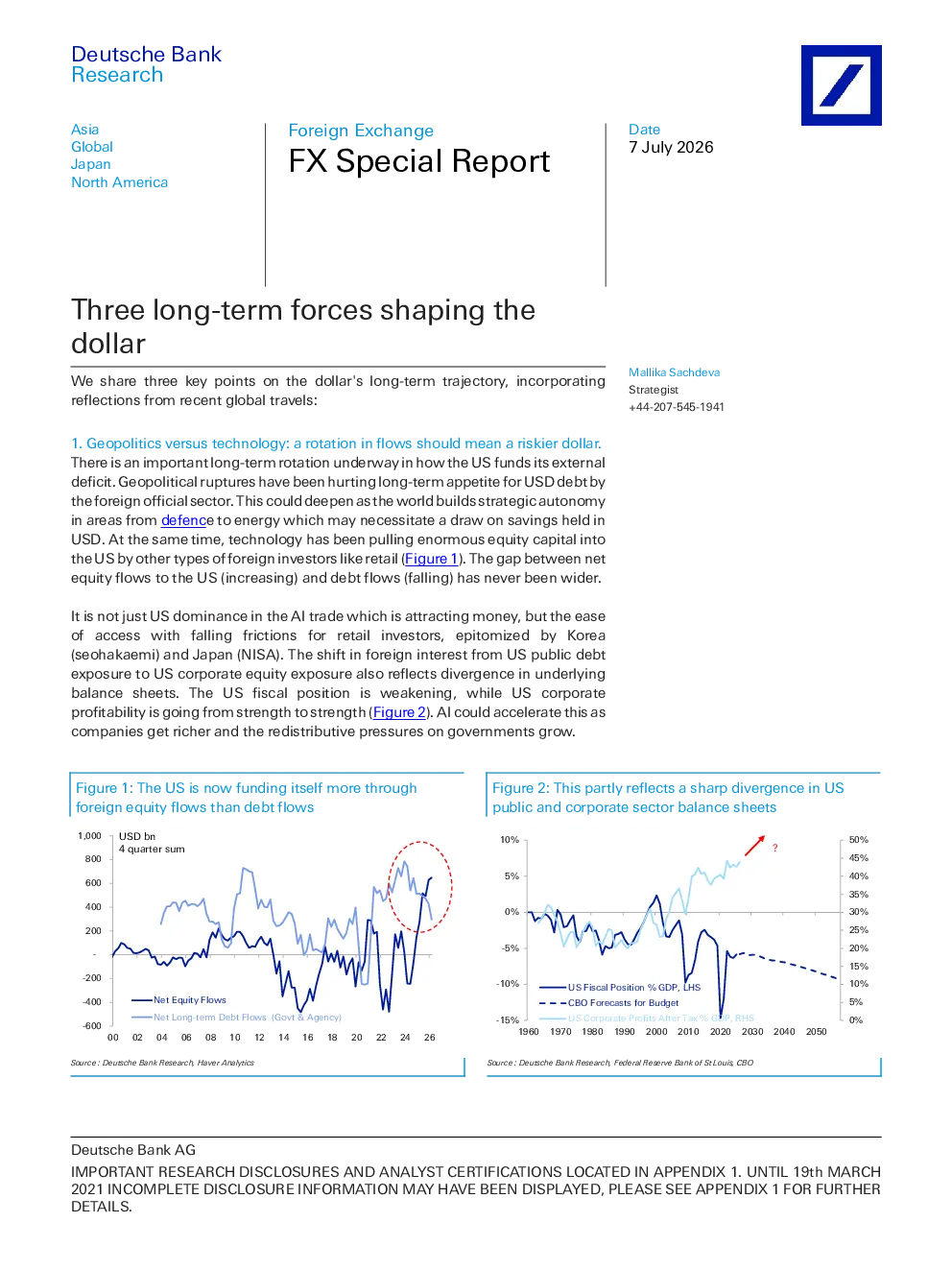
AsiaGlobalJapanNorth America Three long-term forces shaping thedollar Mallika SachdevaStrategist+44-207-545-1941 We share three key points on the dollar's long-term trajectory, incorporatingreflections from recent global travels: 1. Geopolitics versus technology: a rotation in flows should mean a riskier dollar.There is an important long-term rotation underway in how the US funds its externaldeficit. Geopolitical ruptures have been hurting long-term appetite for USD debt bythe foreign official sector. This could deepen as the world builds strategic autonomyin areas from defence to energy which may necessitate a draw on savings held inUSD. At the same time, technology has been pulling enormous equity capital intothe US by other types of foreign investors like retail (Figure 1). The gap between netequity flows to the US (increasing) and debt flows (falling) has never been wider. It is not just US dominance in the AI trade which is attracting money, but the easeofaccess with falling frictions for retail investors,epitomized by Korea(seohakaemi) and Japan (NISA). The shift in foreign interest from US public debtexposure to US corporate equity exposure also reflects divergence in underlyingbalancesheets.The US fiscal position is weakening,while US corporateprofitability is going from strength to strength (Figure 2). AI could accelerate this ascompanies get richer and the redistributive pressures on governments grow. 7 July 2026FX Special Report What are the implications for the dollar of a shift from more debt-based to equity-based funding? The risk profile of the dollar will change. Demand for US Treasurieshas tended to be countercyclical, supporting the dollar in times of recession or riskasset correction. These diversification properties encouraged unhedged USDexposure. A shift to more cyclical, retail driven equity funding should make the USDboth more risky and more leveraged to AI. See pieces here and here. 2. San Francisco to Singapore: US tokenization to RMB internationalization. We spent the last few weeks meeting clients in San Francisco (fintechs and realmoney) and colleagues in Singapore. The slide pack we discussed can be foundhere. The differing focus of conversations between East and West were telling. In the West Coast, there was tremendous energy around - not just AI and USexceptionalism, but also - blockchain technology. It was described as the newfinancial infrastructure on which money will move globally, expanding access tothe US dollar, US finance, and US capital markets. If global leadership is linked toaccessing the most and cheapest global capital – then financial innovation couldwiden the US’s lead by lowering the walls to attracting capital. We have writtenabouthow stablecoins could support USD dominance in payments.Theirforthcoming power could be as a settlement tool for tokenized assets which the USis now actively pushing (Figure 3). DTCC begun tokenizing its real-world custodyassets(universe:USD115tn)this month.We found there was not enoughappreciation of this outside the US. Equally though, in the US, there was not enoughappreciation for trends across the Pacific. There is now a stale skepticism in the West that the RMB’s global ambitions will beconstrained by a capital account that is not fully open. In Asia (and Global Southmorebroadly),however,there is much greater appreciation for RMBinternationalization which is being powered by cross-border RMB lending andfinancing (Figure 4); as well as quieter policy innovations like the PBOC’s new FIMArepo facility that will allow central banks and sovereign wealth funds to swap CGBsfor RMB liquidity. The power of both US tokenization - pulling in capital to the US -and RMB internationalization - pushing capital out of China - should not be ignored. 7 July 2026FX Special Report 3. A continent of cheap currencies: is Asia for turning? The opposite side of the coin of USD strength has long been Asian FX cheapness.Six of the ten cheapest currencies on DB models remain in Asia. These are not smallcountries but include the industrial and demographic behemoths of Korea, Japan,India and China whose combined FX weight in the Fed’s broad USD index is greaterthan the EUR. China will likely continue to pull its FX weight, with growing geopolitical pressureby Europe (Figure 5) around currency undervaluation. A Plaza Accord stylerevaluation seems less likely given China’s study of its impact on Japan. But withdomestic demand in China weakening, China will need external markets andconsumers to remain open to its goods and may be willing to pay a greater currency“price”, particularly if competitiveness is more about innovation and quality nowthan just cost. In India, the revival of the successful 2013 FCNR playbook is seen as providing aslip-stream for near-term strength, but the jury remains out on the long-termmanufacturing potential and services outlook under AI. Korea continues toconfound: exports are up 50%, equities nearly 100%, regul