您的浏览器禁用了JavaScript(一种计算机语言,用以实现您与网页的交互),请解除该禁用,或者联系我们。 [ICI]:提供401(k)计划的经济学:服务、费用和开支,2025年(pdf) - 发现报告

提供401(k)计划的经济学:服务、费用和开支,2025年(pdf)

建筑建材 2026-07-06 ICI 何杰斌
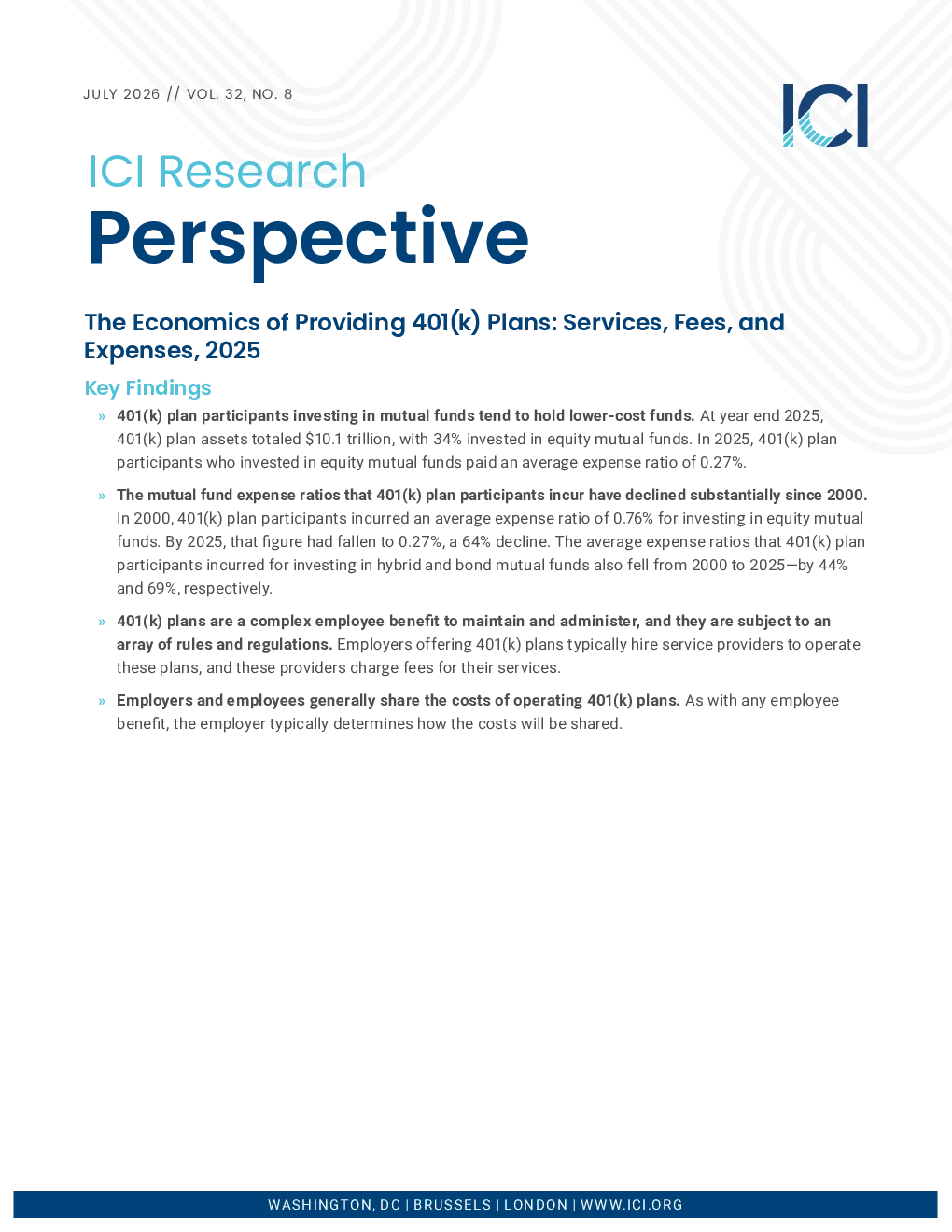
报告封面

The Economics of Providing 401(k) Plans: Services, Fees, andExpenses, 2025 Key Findings »401(k) plan participants investing in mutual funds tend to hold lower-cost funds.At year end 2025,401(k) plan assets totaled $10.1 trillion, with 34% invested in equity mutual funds. In 2025, 401(k) planparticipants who invested in equity mutual funds paid an average expense ratio of 0.27%. »The mutual fund expense ratios that 401(k) plan participants incur have declined substantially since 2000.In 2000, 401(k) plan participants incurred an average expense ratio of 0.76% for investing in equity mutualfunds. By 2025, that figure had fallen to 0.27%, a 64% decline. The average expense ratios that 401(k) planparticipants incurred for investing in hybrid and bond mutual funds also fell from 2000 to 2025—by 44%and 69%, respectively. »401(k) plans are a complex employee benefit to maintain and administer, and they are subject to anarray of rules and regulations.Employers offering 401(k) plans typically hire service providers to operatethese plans, and these providers charge fees for their services. »Employers and employees generally share the costs of operating 401(k) plans.As with any employeebenefit, the employer typically determines how the costs will be shared. Table of Contents 1Why Employers Offer 401(k) Plans2Paying for 401(k) Plan Services6Fees and Expenses of Mutual Funds Held in 401(k) Accounts9Trends in 401(k) Plans’ Mutual Fund Expenses14Conclusion15Notes19References Sarah Holden, senior economic adviser, James Duvall, assistant director of industry and financial analysis, and ElenaBarone Chism, deputy general counsel, retirement policy, prepared this report. Vince Campana, research associate,provided research support. Suggested citation: Holden, Sarah, James Duvall, and Elena Barone Chism. 2026. “The Economics of Providing 401(k)Plans: Services, Fees, and Expenses, 2025.”ICI Research Perspective32, no. 8 (July). Available atwww.ici.org/files/2026/per32-08.pdf. For a complete set of data files for each figure in this report, as well as additional appendix figures, seewww.ici.org/files/2026/per32-08-data.xlsx. Some of these data files include additional time series data not presented in this report. The following conditions, unless otherwise specified, apply to all data in this report: (1) funds of funds are excluded fromthe data to avoid double counting, (2) mutual funds available as investment choices in variable annuities are excluded,and (3) dollars and percentages may not add to the totals presented because of rounding. This material is intended to provide general information on fees paid by participants in a wide variety of plans to provideinsight into average fees across the marketplace. The fees of a particular plan will depend on factors specific to the plan,such as the exact investment options the plan offers and whether administrative and recordkeeping fees are included inthe expense ratios or charged outside of them. Consequently, this material is not intended for benchmarking the costs ofspecific plans to the broad averages presented here. Why Employers Offer 401(k) Plans An attractive workplace benefit, 401(k) plans give workers the ability to defer income tax on the portion of theircompensation that is set aside for retirement. Offering flexibility, 401(k) plans allow employees to make electivedeferrals and typically provide a choice of investments. Indeed, they have become the most common definedcontribution (DC) plan in the United States, holding $10.1 trillion in assets at year-end 2025 (Figure 1).1Mutualfunds are the primary vehicle for 401(k) plan investments, with 58% of employer-sponsored 401(k) plan assetsheld in mutual funds at year-end 2025.2 Employers that offer 401(k) plans, an optional employee benefit, face conflicting economic pressures: the need toattract and retain qualified workers with competitive compensation packages and the need to keep their productsand services competitively priced. As a firm increases overall compensation for its employees, it increases itsability to hire and retain workers but also increases the costs of producing its products and services. To establish and maintain 401(k) plans, employers must obtain a variety of administrative, participant-focused,regulatory, and compliance services. All these services involve costs; generally, the plan sponsor and the planparticipants share these costs. FIGURE1 Billions of dollars, year-end Paying for 401(k) Plan Services 401(k) Plan Services Are Strictly Regulated 401(k) plans are complex to maintain and administer, and they are subject to an array of rules and regulationsthat govern all qualified tax-deferred employee benefit plans, including Section 401(a) of the Internal RevenueCode (IRC), which stipulates the requirements that employee benefit plans must meet to qualify for the deferralof federal income tax.3The Department of the Treasury and Internal Revenue Service (IRS) have issuednumerous reg