您的浏览器禁用了JavaScript(一种计算机语言,用以实现您与网页的交互),请解除该禁用,或者联系我们。 [经济合作与发展组织]:经合组织2026年公共机构信任驱动因素调查结果:应对期待攀升与开拓全新方向 - 发现报告

经合组织2026年公共机构信任驱动因素调查结果:应对期待攀升与开拓全新方向

2026-06-23 经济合作与发展组织 Bach🐮
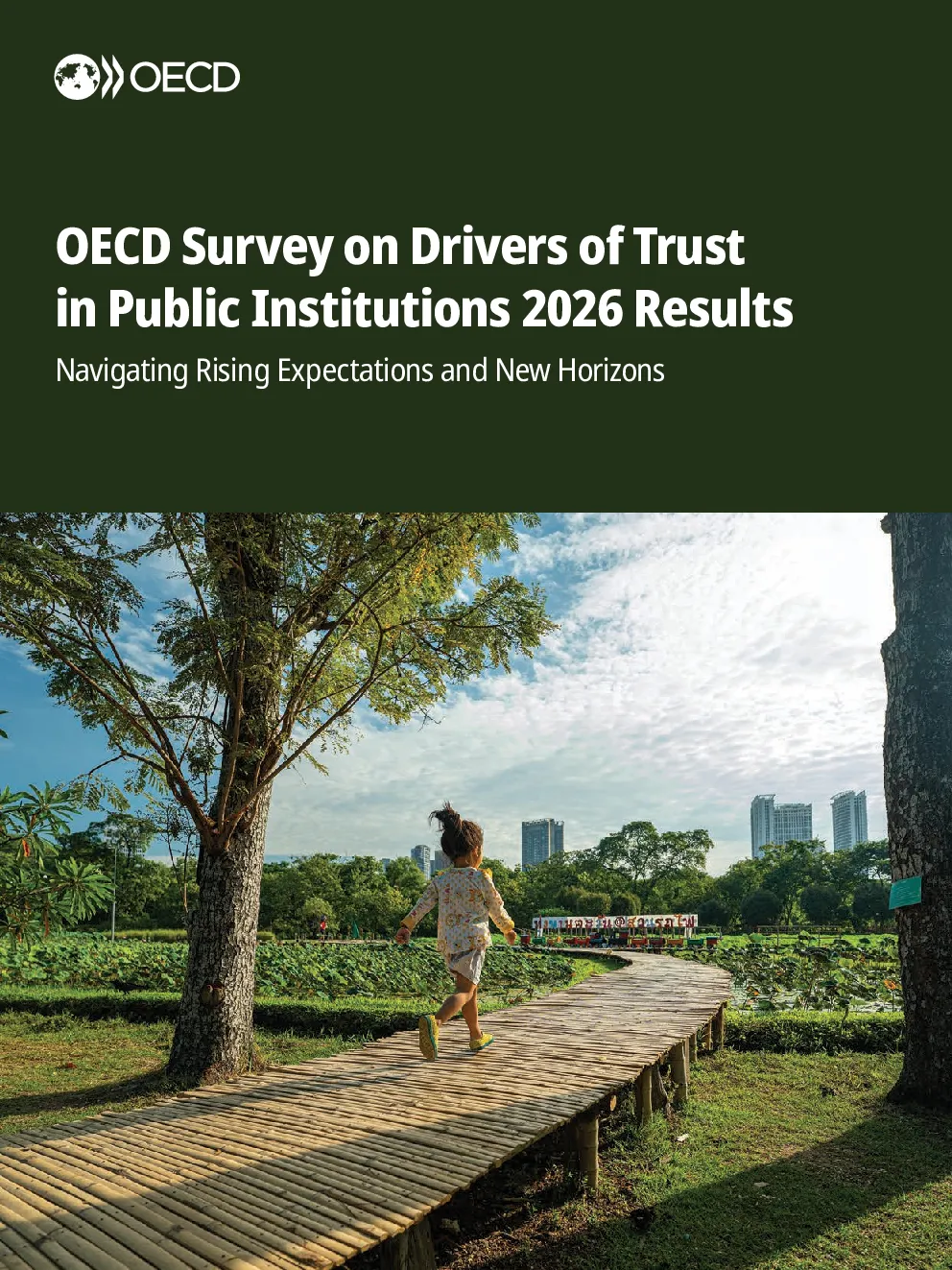
报告封面

Navigating Rising Expectations and New Horizons OECD Survey on Driversof Trust in Public Institutions2026 Results NAVIGATING RISING EXPECTATIONS AND NEWHORIZONS This work was approved and declassified by the Public Governance Committee on 9 June 2026. This document, as well as any data and map included herein, are without prejudice to the status of or sovereignty overany territory, to the delimitation of international frontiers and boundaries and to the name of any territory, city or area. OECD (2026),OECD Survey on Drivers of Trust in Public Institutions 2026 Results: Navigating Rising Expectations and NewHorizons, OECD Publishing, Paris,https://doi.org/10.1787/9eb63fec-en. Photo credits:Cover © Makhh/Shutterstock.com. Attribution 4.0 International (CC BY 4.0) This work is made available under the Creative Commons Attribution 4.0 International licence. By using this work, you accept to be bound by the terms of this licence(https://creativecommons.org/licenses/by/4.0/).Attribution– you must cite the work.Translations– you must cite the original work, identify changes to the original and add the following text:In the event of any discrepancy between the original work and thetranslation, only the text of the original work should be considered valid.Adaptations– you must cite the original work and add the following text:This is an adaptation of an original work by the OECD. The opinions expressed and arguments employed inthis adaptation should not be reported as representing the official views of the OECD or of its Member countries.Third-party material– the licence does not apply to third-party material in the work. If using such material, you are responsible for obtaining permission from the third party and forany claims of infringement.You must not use the OECD logo, visual identity or cover image without express permission or suggest the OECD endorses your use of the work.Any dispute arising under this licence shall be settled by arbitration in accordance with the Permanent Court of Arbitration (PCA) Arbitration Rules 2012. The seat of arbitration shallbe Paris (France). The number of arbitrators shall be one. Foreword TheOECD Survey on Drivers of Trust in PublicInstitutions(“TrustSurvey”)hasbecomethepreeminent measurement tool for understanding thefactors driving trust in government and the factorsdiminishing it. This understanding remains as criticalfor governments today as it was in 2021, when theTrust Survey first launched, as governments continuetoface the challenges of new crises,ageingpopulations, technological change, limited fiscal space,and high public expectations. The OECD Trust Surveyisan important component of the OECD PublicGovernance Committee’s Reinforcing Democracy andGovernmentUnstuck initiatives and relies on theOECD’s longstanding Framework on Drivers of Trust inPublic Institutions. countries in 2021, the Trust Survey has grown into theGlobalTrust Survey Project covering 42 countries,including a regional edition in Latin America and theCaribbean which was launched in 2025. This expansiondemonstratesboth the relevance of the OECDFramework and the strong demand for comparable,actionable data on trust worldwide. The2025 Trust Survey maintains the same coremethodology and questionnaire as in previous waves,ensuring continuity and enabling the analysis of trendsovertime.At the same time,it introduces newquestions that deepen our understanding of emerginggovernance challenges, including perceptions of theroleof artificial intelligence in the public sector,barriers to and impacts of political participation, anddrivers of trust in legislatures as key institutions ofrepresentativedemocracy.These additions reflectevolving policy priorities while preserving the survey’scomparabilityandanalyticalstrength.Mostparticipating countries were surveyed in September toNovember 2025, with data collection in Brazil and Perutaking place in May and June 2025. Building on the 2021 and 2023 Trust Surveys, the 2025Trust Survey continues to offer robust, internationallycomparableevidence on people’s perceptions ofpublic institutions across countries. These perceptions,based on different levels of knowledge, shapepeople’slived experiences of public governance and ultimatelyinfluence their trust in public institutions. This is thevalueof a perception survey:it captures howgovernment action is received and interpreted by thepeopleascomparedtotheirexpectations,complementingperformance indicators that helpgovernments measure how systems do in practice. TheOECD Secretariat acknowledges the strongengagement and contributions of delegates from thePublic Governance Committee and the Global TrustSurvey Project, at both senior and technical levels.Their collaboration has been instrumental in ensuringthe quality, relevance, and timely delivery of this work.The continued commitment of participating countriesunderscores the shared recognition that measuringand understanding trust and its drivers is essential tosup