经合组织公共治理审查:巴勒斯坦权力机构:加强公共行政以取得更好成果
 AI智能总结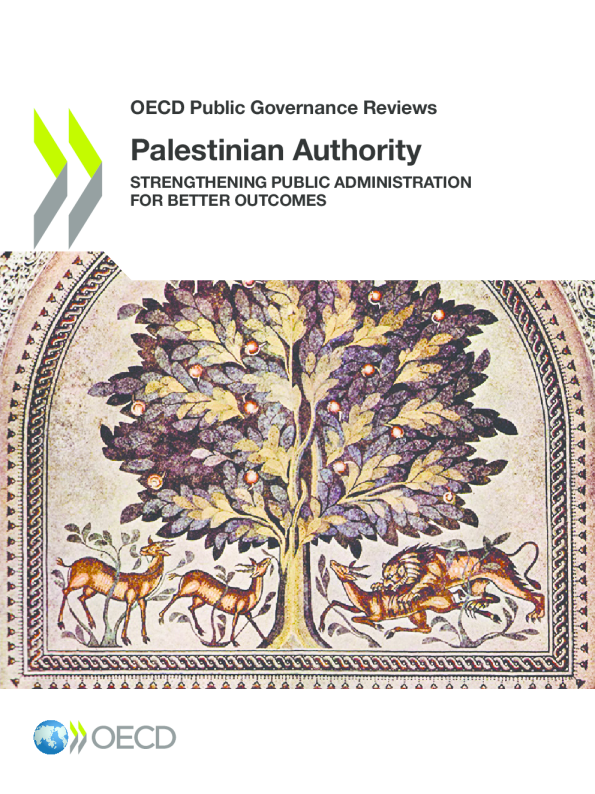
Palestinian Authority STRENGTHENING PUBLIC ADMINISTRATIONFOR BETTER OUTCOMES OECD Public GovernanceReviews: PalestinianAuthority STRENGTHENING PUBLIC ADMINISTRATIONFOR BETTER OUTCOMES This document was produced with the financial assistance of the European Union. The views expressed herein can inno way be taken to reflect the official opinion of the European Union. This document, as well as any data and map included herein, are without prejudice to the status of or sovereignty overany territory, to the delimitation of international frontiers and boundaries and to the name of any territory, city or area. The statistical data for Israel are supplied by and under the responsibility of the relevant Israeli authorities. The use ofsuch data by the OECD is without prejudice to the status of the Golan Heights, East Jerusalem and Israeli settlements inthe West Bank under the terms of international law. Note by the Republic of Türkiye The information in this document with reference to “Cyprus” relates to the southern part of the Island. There is no singleauthority representing both Turkish and Greek Cypriot people on the Island. Türkiye recognises the Turkish Republic ofNorthern Cyprus (TRNC). Until a lasting and equitable solution is found within the context of the United Nations, Türkiyeshall preserve its position concerning the “Cyprus issue”. Note by all the European Union Member States of the OECD and the European UnionThe Republic of Cyprus is recognised by all members of the United Nations with the exception of Türkiye. Theinformation in this document relates to the area under the effective control of the Government of the Republic of Cyprus. Please cite this publication as: OECD (2024),OECD Public Governance Reviews: Palestinian Authority: Strengthening Public Administration for BetterOutcomes, OECD Public Governance Reviews, OECD Publishing, Paris, https://doi.org/10.1787/7425e72f-en. ISBN 978-92-64-86512-9 (print)ISBN 978-92-64-79010-0 (PDF)ISBN 978-92-64-44041-8 (HTML)ISBN 978-92-64-95533-2 (epub) OECD Public Governance ReviewsISSN 2219-0406 (print)ISSN 2219-0414 (online) Photo credits:Cover © Arabischer Mosaizist um 735, Public domain/Wikimedia Commons. Corrigenda to OECD publications may be found at: https://www.oecd.org/en/publications/support/corrigenda.html.© OECD 2024 Attribution 4.0 International (CC BY 4.0) This work is made available under the Creative Commons Attribution 4.0 International licence. By using this work, you accept to be bound by the terms of this licence(https://creativecommons.org/licenses/by/4.0/).Attribution– you must cite the work.Translations– you must cite the original work, identify changes to the original and add the following text:In the event of any discrepancy between the original work and thetranslation, only the text of original work should be considered valid.Adaptations– you must cite the original work and add the following text:This is an adaptation of an original work by the OECD. The opinions expressed and arguments employed inthis adaptation should not be reported as representing the official views of the OECD or of its Member countries.Third-party material– the licence does not apply to third-party material in the work. If using such material, you are responsible for obtaining permission from the third party and forany claims of infringement.You must not use the OECD logo, visual identity or cover image without express permission or suggest the OECD endorses your use of the work.Any dispute arising under this licence shall be settled by arbitration in accordance with the Permanent Court of Arbitration (PCA) Arbitration Rules 2012. The seat of arbitration shallbe Paris (France). The number of arbitrators shall be one. Foreword As highlighted in the OECD Policy Framework on Sound Public Governanceand the SIGMAPrinciples ofPublic Administration,properly designed and implementedpublic administration reforms can lead to amore accountable and effective civilservice, better organisation of the administration, and higher qualityservice delivery for citizens and businesses. To achieve optimal results,public administration reform (PAR)should be undertakencoherently through awhole-of-government approach. An inclusive and evidence-based strategy should be used to identify a setof clear, prioritised, and widely understood reform objectives to be credible and guarantee real change.Concretesteps should also be taken to implement policy goals, together with sufficient financial resources,clear managerial and executive roles, and adequate capacities.Moreover, clear lines of accountabilityamongintervening institutions and departments are necessary, as well as clearly established leadershipofreforms and well-organised coordination and monitoring procedures,at both the political andadministrative levels. This Review analyses the institutional and strategic framework for PAR in the Palestinian Authority (PA).It points to the specific challenges and opportunities