您的浏览器禁用了JavaScript(一种计算机语言,用以实现您与网页的交互),请解除该禁用,或者联系我们。 [联合国]:2022/2025年世界表达自由和媒体发展趋势报告 - 发现报告

2022/2025年世界表达自由和媒体发展趋势报告

文化传媒 2025-12-08 联合国 测试专用号1普通版
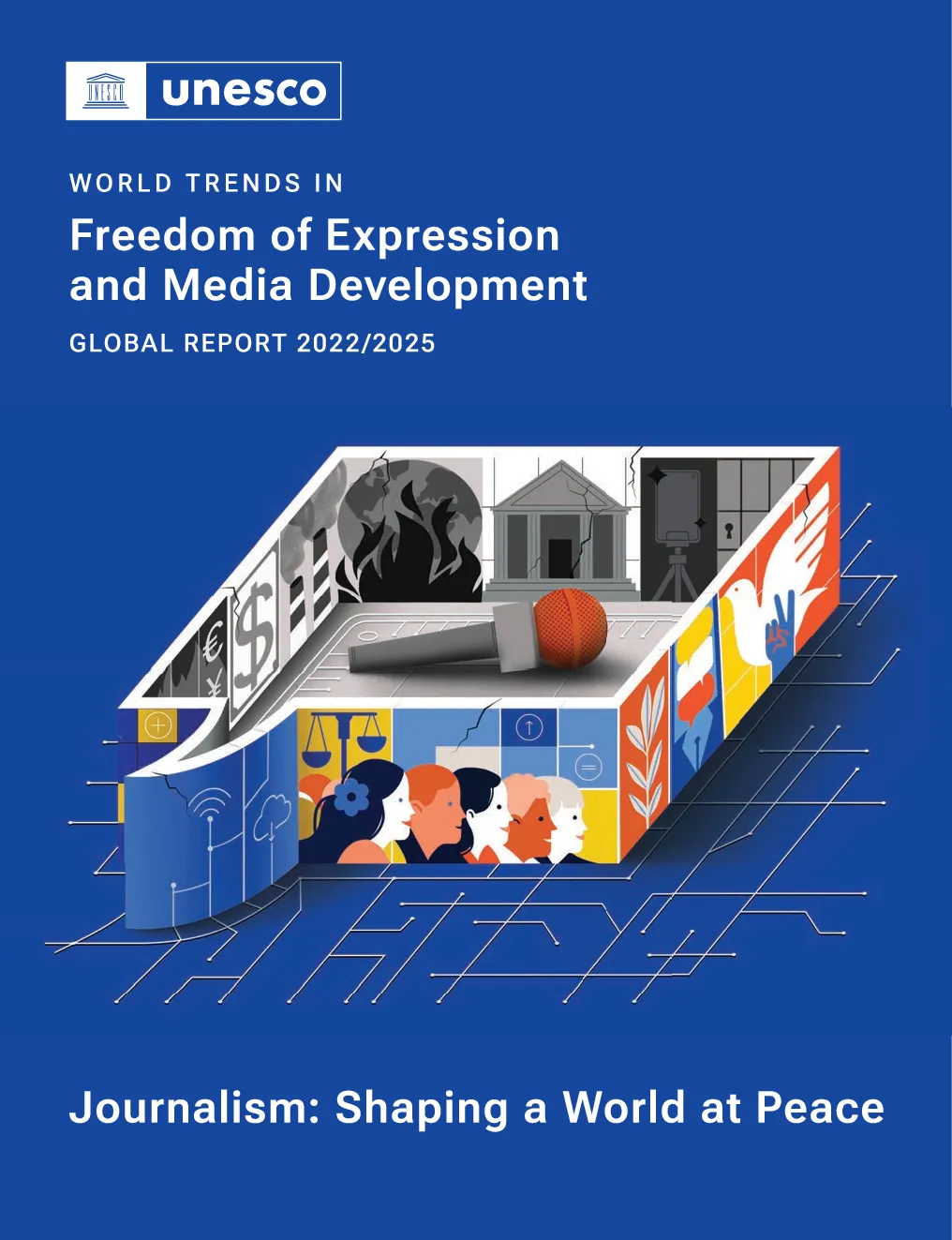
报告封面

S H O R TS U M M A R Y Journalism: Shaping a World at Peace Free, independent, pluralistic, and professional journalism is key for defending human dignity, advancing justice,and sustaining peace. Yet today, freedom of expression is under assault as seldom before. The 2022/2025World Trends Report, Journalism: Shaping a World at Peace, underscores the profound role of free,independent, pluralistic, and professional journalism as a cornerstone of democratic life and as an indispensablecondition for achieving the Sustainable Development Goals (SDGs). Despite some positive developments such as the expansion ofsocial media access, growth in collaborative investigative jour-nalism, subscription models, and legal recognition of communitymedia, this new Report reveals a 10% decline in the Freedom ofExpression Index globally since 2012, and highlights weakenedgovernance, hostility towards journalists, the climate crisis, andAI-driven dis and misinformation. Progress on gender equalityhas stalled, and women continuously face discrimination andviolence. These trends undermine human rights, media freedomand plurality, and well-informed citizenship. The 2022/2025World Trends Reportemphasizes the urgencyof supporting international norms, strengthening informationintegrity, and fostering trusted information to protect democracy,promote accountability, and ensure access to information as apublic good, particularly for vulnerable populations and youth. “Since wars begin in the minds of men and women,it is in the minds of men and women that the defencesof peace must be constructed” Published in 2025 by the United Nations Educational,Scientific and Cultural Organization7, place de Fontenoy, 75352 Paris 07 SP, France © UNESCO 2025 ISBN: 978-92-3-100835-1https://doi.org/10.58338/JQXX3532 This publication is available in Open Access under the Attribution-ShareAlike 3.0 IGO (CC-BY-SA 3.0 IGO) license(https://creativecommons.org/licenses/by-sa/3.0/igo/).By using the content of this publication, the usersaccept to be bound by the terms of use of the UNESCO Open Access Repository(https://www.unesco.org/en/open-access/cc-sa). The designations employed and the presentation of material throughout this publication do not imply the expres-sion of any opinion whatsoever on the part of UNESCO concerning the legal status of any country, territory, city orarea or of its authorities, or concerning the delimitation of its frontiers or boundaries The ideas and opinions expressed in this publication are those of the authors; they are not necessarily those ofUNESCO and do not commit the Organization. This publication should be cited as follows: UNESCO.2025. Journalism: Shaping a World at Peace. World Trendsin Freedom of Expression and Media Development, Global Report 2022/2025.Paris: UNESCO. For the use of any material not clearly identified as belonging to UNESCO, prior permission shall be requested from:publication.copyright@unesco.org. More information and the complete World Trends Report series can be found athttps://www.unesco.org/en/world-media-trends Cover, Graphic design, Illustrations and Typeset:Till Noon Printed byUNESCO With the support of the UNESCO Multi-Donor Programme onFreedom of Expression and Safety of Journalists (MDP). Journalism:Shaping a Worldat Peace Since wars beginin the minds of men andwomen, it is in the mindsof men and women thatthe defences of peace mustbe constructed. UNESCO Constitution Firstly, by safeguarding media viability. In an erawhen support for traditional media is dwindling amideconomic uncertainty, political pressure and techno-logical shifts, defending free, independent journalismmust be recognized as a development priority – and aspart of wider efforts to uphold freedom of expressionand information. Foreword Press freedom is under attack worldwide. The globalFreedom of Expression Index has dropped by 10%since 2012. Proliferating armed conflicts in manyregions of the world continue to inflict unimaginablesuffering on millions of civilians, while numerousgovernments continue to tighten control and dis-information spreads like wildfire across the globalinformation landscape. Promoting transparency in the digital sphere is equallycrucial, although it is difficult to define and hard toachieve. In a globalized, online media landscape,concerted efforts to promote cooperation amongall those involved in the information cycle are vitalto ensure transparent access to information, fosteraccountability and empower users to make informedchoices. Against this backdrop, journalists continue to stand onthe frontlines and report the truth, working to defendhuman dignity and advance justice. Yet, they often doso at the cost of their safety: in too many places, theyare attacked, exiled, or forced into silence. Lastly, as new technologies reshape how informationis created and shared, we must continue to advancemedia and information literacy (MIL). By teaching ci-tizens to critically engage with in