您的浏览器禁用了JavaScript(一种计算机语言,用以实现您与网页的交互),请解除该禁用,或者联系我们。 [莱坊]:2026年6月CGT报告 - 发现报告

2026年6月CGT报告

信息技术 2026-06-26 莱坊 陳寧遠
报告封面

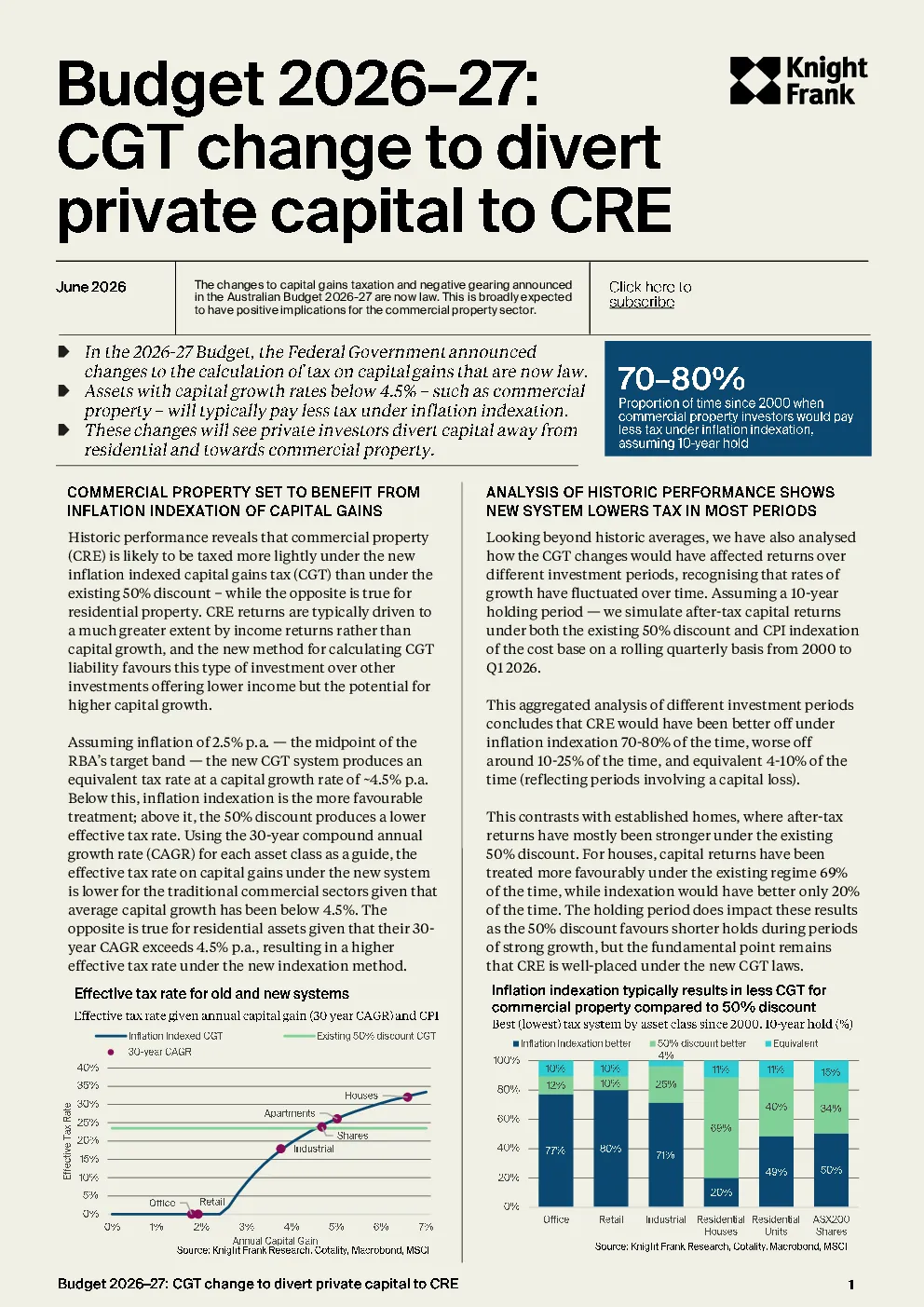
Click here tosubscribe In the 2026-27 Budget, the FederalGovernmentannouncedchanges to the calculation of tax on capitalgainsthat are now law.Assets with capital growth rates below 4.5%–such as commercialproperty–will typically pay less tax under inflation indexation.Thesechanges will see private investors divert capital away fromresidential and towards commercial property. 70–80%Proportion of time since 2000 whencommercial property investors would payless tax under inflation indexation,assuming 10-year hold COMMERCIAL PROPERTY SET TO BENEFIT FROMINFLATION INDEXATION OF CAPITAL GAINS ANALYSIS OF HISTORIC PERFORMANCE SHOWSNEW SYSTEM LOWERS TAX IN MOST PERIODS Looking beyond historic averages, we have also analysedhow theCGTchanges would have affected returns overdifferent investment periods, recognising that rates ofgrowth have fluctuated over time. Assuming a 10-yearholding period—we simulate after-tax capital returns Historic performance reveals that commercial property(CRE) is likely to be taxed more lightly underthenewinflationindexedcapital gains tax (CGT)than under theexisting 50% discount–while the opposite is true for residential property. CRE returns are typically driven toa much greater extent by income returns rather than This aggregated analysis of different investment periodsconcludes that CRE would have been better offunderinflationindexation 70-80% of the time, worse offaround 10-25% of the time, and equivalent 4-10% of the Assuming inflation of 2.5% p.a.—the midpoint of theRBA’s target band—the new CGT system produces anequivalent tax rate at a capital growth rate of ~4.5% p.a.Below this, inflation indexation is the more favourabletreatment; above it, the 50% discount produces a lowereffective tax rate. Using the 30-year compound annual This contrasts with established homes, where after-taxreturns have mostly been stronger under the existing50% discount. For houses, capital returns have beentreated more favourably under the existing regime 69%of the time, while indexation would have better only 20%of the time. The holding period does impact these results growth rate (CAGR) for each asset class as a guide, theeffective tax rate on capital gains under thenewsystem Inflation indexation typically results in less CGT forcommercial property compared to 50% discount Effective tax rate for old and new systems Effective tax rate given annual capital gain (30 yearCAGR)and CPI Best (lowest) tax system by asset class since 2000, 10-year hold (%) The structure of returns matters COMMERCIAL PROPERTY MORE RELIANT ON INCOME INCOME FOCUSED ASSETS WIN UNDER NEW SYSTEM Total investment returns across all the major asset classeshave been relatively similar over the past 30 years,averaging from 8–11%. However, in considering the impact Under the old 50% discount, the composition of returnsdidn't matter much for tax purposes as the effective tax Under inflation indexation, return composition matters.Indexation taxes only real capital gains—growth in valueabove inflation. For commercial property, where capitalgrowth has historically run at or only modestly aboveinflation over the long run, the real gain subject to tax is CRE is typically viewed by investors as a more income-focused asset (with yields averaging ~5.5% in the pastdecade). Capital growth, while welcome, has historicallybeen the smaller part of the investment thesis and Income returns are not directly affected by theCGTchange. For CRE assets already generatingthemajority oftheir return through rent, the reform touches only a smallportion of total investment gains—and the higher the Investors in established homes tend to have a differentapproach, typically buying houses on lower yields (3–4% inmost capital cities) and focusing on the potential for growthin property values which has historically done most of the On the other hand, in residential markets, returns havelargely been driven by capital growth well above theinflation rate, and as a result the shift is more Although total returns have been similar across assetclasses, this difference in return composition translates into Commercial property more reliant on incomeAveragepre-tax average capital and income return by asset class, Total returns similar among assetsTotal annual return by asset class, 30-year CAGR (% p.a.) 30-year CAGR(% p.a.) Split of returns by asset typeShare of total returns by return type, 30 Office returns higher with inflation indexationDifference inpost-tax annual capital gain betweeninflation indexed taxation and a 50% discount, 10-year hold(% p.a.) -year CAGR (% p.a.) Implications and outlook PRIVATE CAPITAL WILL DIVERT TO COMMERCIALASSETS CGTON PRE-1985 ASSETS WILL PROMPT A RETHINK As part of the Budget changes, the governmentwill alsostartto tax assets held since before 1985 that werepreviously exempt from CGT. This includes the long- Thetaxchangeswillencourage more private investors toinvest in commercial property because of its yield