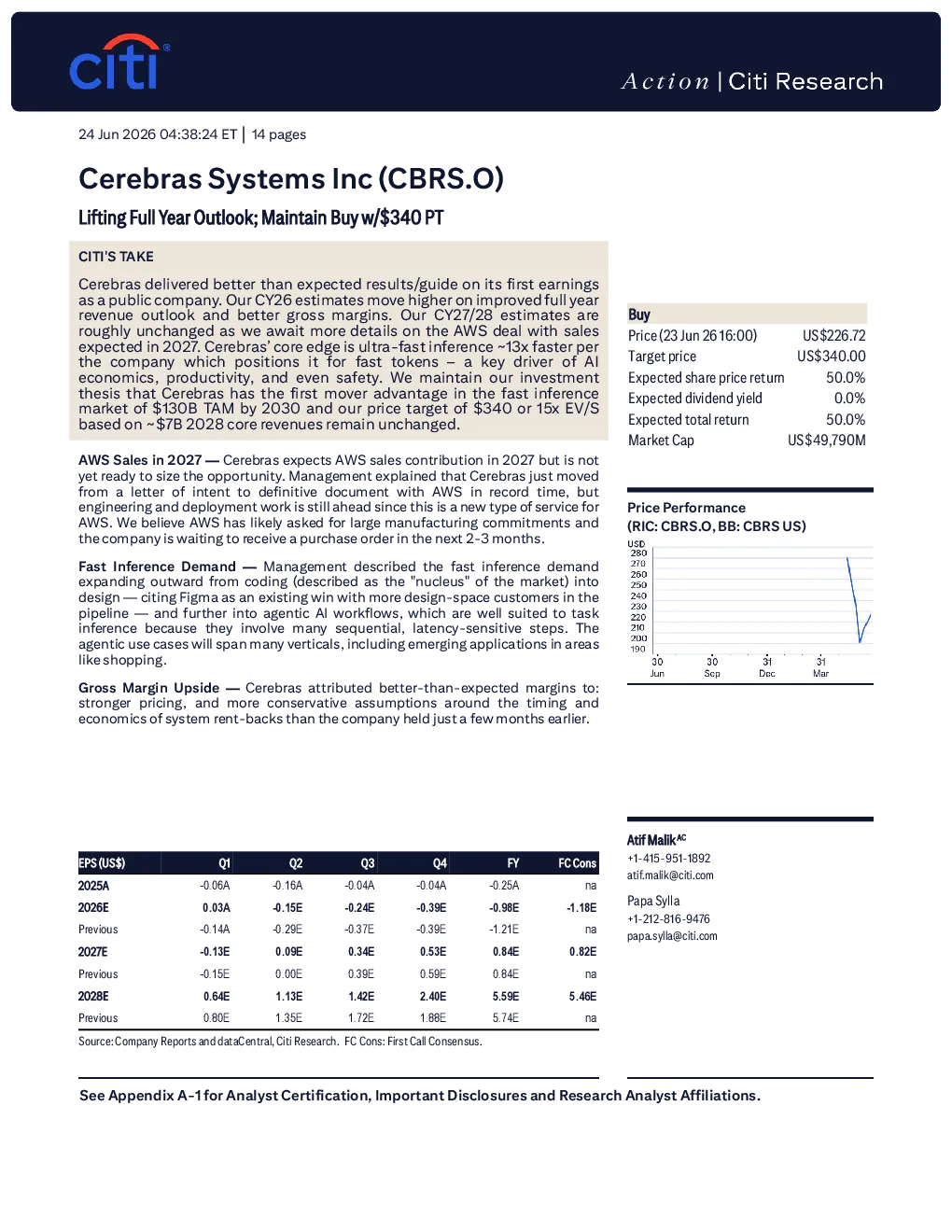
Cerebras Systems Inc (CBRS.O) Lifting Full Year Outlook; Maintain Buy w/$340 PT CITI'S TAKE Cerebras delivered better than expected results/guide on its first earningsas a public company. Our CY26 estimates move higher on improved full yearrevenue outlook and better gross margins. Our CY27/28 estimates areroughly unchanged as we await more details on the AWS deal with salesexpected in 2027. Cerebras’ core edge is ultra-fast inference ~13x faster perthe company which positions it for fast tokens – a key driver of AIeconomics, productivity, and even safety. We maintain our investmentthesis that Cerebras has the first mover advantage in the fast inferencemarket of $130B TAM by 2030 and our price target of $340 or 15x EV/Sbased on ~$7B 2028 core revenues remain unchanged. Price (23 Jun 26 16:00)US$226.72Target priceUS$340.00Expected share price return50.0%Expected dividend yield0.0%Expected total return50.0%Market CapUS$49,790M AWS Sales in 2027—Cerebras expects AWS sales contribution in 2027 but is notyet ready to size the opportunity. Management explained that Cerebras just movedfrom a letter of intent to definitive document with AWS in record time, butengineering and deployment work is still ahead since this is a new type of service forAWS. We believe AWS has likely asked for large manufacturing commitments and Fast Inference Demand—Managementdescribed the fast inference demandexpanding outward from coding (described as the "nucleus" of the market) intodesign — citing Figma as an existing win with more design-space customers in thepipeline — and further into agentic AI workflows, which are well suited to taskinference because they involve many sequential, latency-sensitive steps. The Gross Margin Upside—Cerebras attributed better-than-expected margins to:stronger pricing, and more conservative assumptions around the timing andeconomics of system rent-backs than the company held just a few months earlier. Atif MalikAC+1-415-951-1892atif.malik@citi.com Papa Sylla+1-212-816-9476papa.sylla@citi.com Mar-Q Earnings Review March-Q Results:CBRS reported its first earnings as a public company, and theresults showed strong top-line. GAAP revenue came in at $193.4M, up 94% yoyand 13% qoq, while core revenue was $191.3M, up 92% yoy. Within that, corehardware revenue was $111.6M, up 60% yoy and represented 58% of sales whilecore cloud and inference services revenue was $79.8M, representing a rapid 167%yoy growth as the services side of the business is scaling quickly off a smaller base. Guide:Cerebras guided full-year 2026 core revenue to a range of $855M to$865M, implying about 69% growth at the midpoint. While the company alsoguided core gross margin down sharply to a range of 38% to 41% and coreoperating margin to a range of negative 28% to negative 32%, both came above Citiexpectations of ~30% GM and -44% OM. The margin step-down reflects the costsof standing up capacity for its large new infrastructure commitments as the On the demand side, the company disclosed a contracted backlog, or remainingperformance obligations, of $24.6B. Cerebras also announced a new multi-yearpartnership with Amazon Web Services to deploy Cerebras inference hardware With that in mind, we continue to model the AI inference chip market to grow from$113B in 2025 to $649B by 2030, at a CAGR of 42%, driven by advances in largelanguage models and Agentic AI as enterprises focus on real-time GenAIdeployment and hyperscalers expand infrastructure to support compute-heavy,data-driven decision-making.We believe Cerebras competes in the subset of compute spending by the end of this year, reflecting a structural shift in AIcomputing from training to inference as deployed AI applications scale (see ourrecent initiation report for more details). Other Key Takeaways: Inference latency and "invisible" guardrails.Management explained that many AI-driven actions (e.g., automated guardrail checks) require additional computebehind the scenes, and that speed is the differentiator regardless of where thatcompute runs. They used a VPN-setup analogy from the 1990s to illustrate that Whether hyperscalers will adopt the disaggregated prefill/decode approach? Management suggested hyperscalers may pursue this approach partly as a way to acknowledged rising CPU orchestration demand fits its architecture. Managementexplained that accelerators only generate the work to be done, while CPUs executethe actual actions (e.g., web searches, tool calls) and handle orchestration. This iswhy GPU-to-CPU ratios have shifted from roughly 8:2 toward 4:8 and evendiscussions of 1:1, as agentic workflows generate cascading work for CPUs to Cerebras Systems Inc Company description Cerebras Systems, Inc. engages in the designing of processors for artificialintelligence (AI) training and inference. Its products include inference, AIsupercomputers, AI model services, cloud, systems, and processors. The Investment strategy We rate as CBRS Buy. We believe Cerebras h