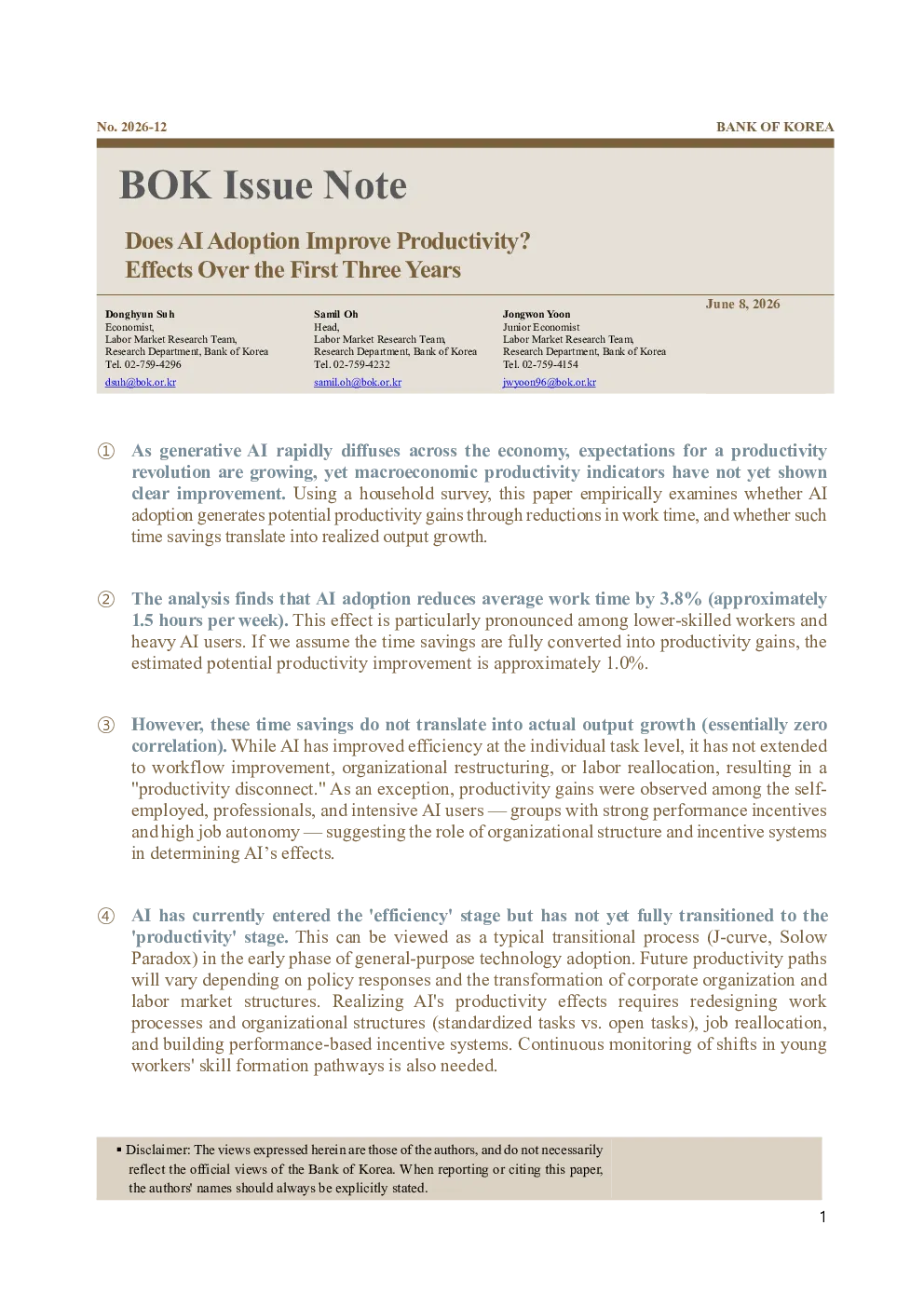
Does AI Adoption Improve Productivity?Effects Over the First Three Years June 8, 2026 Samil OhHead,Labor Market Research Team,Research Department, Bank of KoreaTel. 02-759-4232 Jongwon YoonJunior EconomistLabor Market Research Team,Research Department, Bank of KoreaTel. 02-759-4154 Donghyun SuhEconomist, Labor Market Research Team,Research Department, Bank of KoreaTel. 02-759-4296 jwyoon96@bok.or.kr dsuh@bok.or.kr ①As generative AI rapidly diffuses across the economy, expectations for a productivityrevolution are growing, yet macroeconomic productivity indicators have not yet shownclear improvement.Using a household survey, this paper empirically examines whether AI ②The analysis finds that AI adoption reduces average work time by 3.8% (approximately1.5 hours per week).This effect is particularly pronounced among lower-skilled workers andheavy AI users. If we assume the time savings are fully converted into productivity gains, the ③However, these time savings do not translate into actual output growth (essentially zerocorrelation).While AI has improved efficiency at the individual task level, it has not extendedto workflow improvement, organizational restructuring, or labor reallocation, resulting in a"productivity disconnect." As an exception, productivity gains were observed among the self-employed, professionals, and intensive AI users — groups with strong performance incentives ④AI has currently entered the 'efficiency' stage but has not yet fully transitioned to the'productivity' stage.This can be viewed as a typical transitional process (J-curve, SolowParadox) in the early phase of general-purpose technology adoption. Future productivity pathswill vary depending on policy responses and the transformation of corporate organization andlabormarket structures.Realizing AI's productivity effects requires redesigning work Ⅰ. Introduction Since the introduction of large language model-based generative AI services (ChatGPT, Gemini,Claude, etc.) in the second half of 2022, AI has rapidly spread through workplaces and is drivingfundamental changes in production methods. In particular, usage has surged for cognitive taskssuch as document writing, data analysis, and programming, with AI capabilities advancing at anaccelerating pace. According to the household survey conducted last year, more than half of This rapid diffusion has fueled optimistic expectations that AI will drive a productivity revolution.Indeed, recent studies1show that generative AI improves productivity across a range of individual tasks, with particularly large effects observed among lower-skilled workers. As a general-purposetechnology, AI has the potential to induce broad-based productivity improvements across industries At the same time, a more cautious view has emerged regarding AI’s productivity effects. Given thenatureof general-purpose technologies,the initial phase of adoption typically requirescomplementary innovations — organizational restructuring, task redesign, and labor reallocation— before productivity gains materialize, and these effects may be delayed during the transition.Indeed, no clear improvement has yet been observed in macroeconomic productivity indicators in Note: 1) GDP/Total hours worked, 4-quarter movingaverageSource: Bank of Korea, Ministry of Data and Statistics This ‘gap between technology diffusion and productivity’ raises an important question forunderstanding AI’s economic effects. Building on this motivation, the present study uses householdsurvey data to empirically analyze the impact of generative AI adoption on workers’ work time andoutput. In particular, by separately estimating (i) whether AI adoption generates potentialproductivity gains through time savings, and (ii) whether these gains translate into actual output The results indicate that AI adoption leads to a significant reduction in work time (3.8%, or 1.5hours per week), and the resulting potential productivity gain is estimated at 1.0%. However, thesetime savings do not translate into actual output growth. The correlation coefficient betweenindividual-level reductions in work time and increases in output is estimated at zero, suggestingthat time freed up by AI use is not being reallocated to more productive activities. As an exception, These results mean that while AI is improving efficiency at the individual task level, a ‘productivitydisconnect’ is emerging because those improvements have not diffused to changes in workflows ororganizational structures. Production bottlenecks and distorted incentive structures are alsoidentified as contributing factors. Nevertheless, the productivity disconnect currently observed canbe viewed as a typical lag phenomenon (J-curve, Solow Paradox) in the early phase of general- The remainder of this paper is organized as follows. Section II estimates the productivity effects ofAI adoption, including reductions in work time and increases in output. Section III examines thecauses of the producti