您的浏览器禁用了JavaScript(一种计算机语言,用以实现您与网页的交互),请解除该禁用,或者联系我们。 [世界银行]:让埃塞俄比亚的金融部门为妇女服务:10个基于证据的行动理念(英) - 发现报告

让埃塞俄比亚的金融部门为妇女服务:10个基于证据的行动理念(英)

金融 2026-06-15 世界银行 还是郁闷闷啊
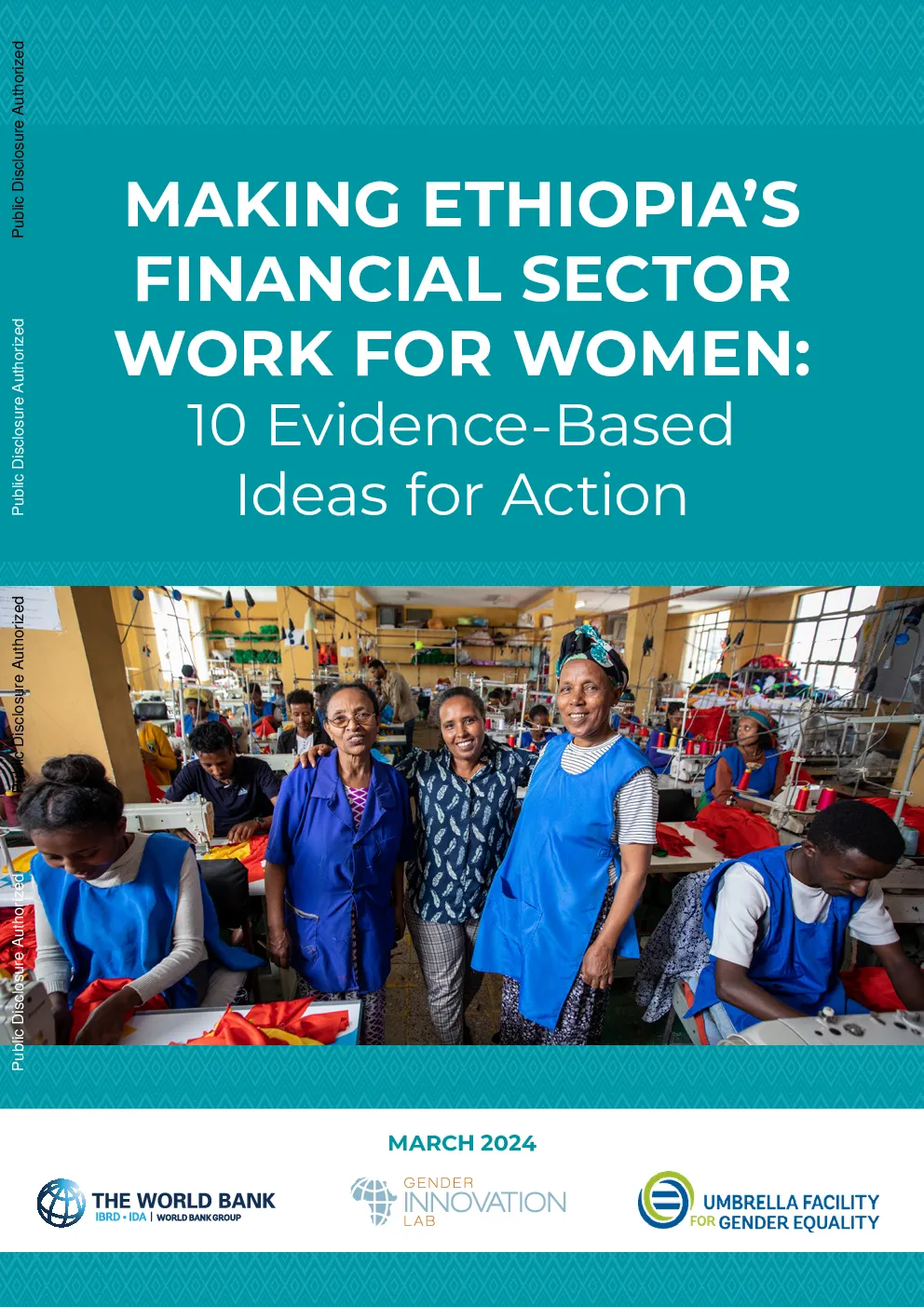
报告封面

10 Evidence-BasedIdeas for ActionPublic Disclosure Authorized Table of Contents Executive Summary Section 1Tackling Ethiopia’s Growing Gender Gap in FinancialInclusionSection 2How to Advance Women’s Careers in FinanceSection 3How to Close Gender Gaps in Access to Credit Endnotes47 AcknowledgementsBibliography 48 This document was produced by the World Bank’s Africa Gender Innovation Lab (GIL), in con-sultation with the National Bank of Ethiopia (NBE), for the March 2024 National Conference onMaking the Financial Sector Work for Women held in Addis Ababa. We thank Global Affairs Executive Summary Making sure that Ethiopia’s financial sector delivers for women is a key pri-ority for the Government of Ethiopia.An increasingly dynamic banking indus-try, the arrival of digital financial services and the spread of mobile money havehelped Ethiopia make great strides in financial inclusion in recent years. However, This document suggests 10 concrete, evidence-based ideas for action.Theideas are based on a review of the available evidence, from Ethiopia and beyond,on ‘what works’ in closing key gender gaps in the use of financial services. Theyalso take into account recent data on financial inclusion in the country as wellas current policy priorities, especially those expressed in the National Bank of ADVANCING WOMEN’S CAREERS IN FINANCE CLOSING GENDER GAPS IN ACCESS TO CREDIT SECTION 1 TACKLING ETHIOPIA’SGROWING GENDER A financial sector that delivers for women is crucial for achieving gender equality, women’seconomic empowerment.Whether women are homemakers, employees, farmers, or businessowners, financial inclusion provides them with the tools for accumulating assets, generating Over the past decade, Ethiopia has seen great advances in the nature and extent of finan-cial services offered.According to annual reports from the National Bank of Ethiopia (NBE), thenumber of bank branches has tripled during this time, from 3,000 in 2012 to 9,000 in 2022.2Newbanks and microfinance institutions (MFIs) have entered the industry, including institutionsserving specific market segments such as housing and customers looking for sharia-compli- However, the acceleration of financial inclusion has come at the cost of a widening gendergap.For a variety of reasons – which include men’s higher levels of education, financial literacy,awareness of financial services, and ownership of mobile phones – men have been faster to Ethiopia’s gender gap in formal financial According to three rounds of Findex survey data, Ethiopia’s gender gap in account own-ership has grown significantly over the past decade.Account ownership is a key metric offinancial inclusion and is defined as having a formal financial account at either a bank, an MFI,or with a mobile money operator. In 2021, 39% of women and 55% of men owned formal finan-cial accounts – a 16 percentage points gap, and one which has been rapidly increasing, from Figure 2. Global, Regional, and Ethiopia Gender Gaps in account ownership Source: World Bank Findex database Gender differences in the uptake of mobile money accounts are one of the drivers of theoverall gap.Supply-side data provided by NBE shows that as of December 2023, Ethiopia has90 million mobile money accounts, of which only 14% are owned by women.3What is more, Rural and poor women make up an especially large segment of the unbanked population. Overall, the unbanked population is 58% female and 80% rural.4Formal financial account own-ership stands at 10% for rural women, as compared to 26% for rural men, 50% of urban women,and 69% of urban men.5Amongst the unbanked population, the top reason given for not havingformal financial accounts is lack of money. Other major obstacles to financial inclusion for thispopulation include low literacy, financial literacy, and digital literacy; and lack of awareness ofand exposure to available financial services. Amongst the unbanked population, reasons for notowning an account that are cited more by women than men include “can use someone else’saccount” and “no need”. Section 4 discusses three evidence-based ideas to close the gender gap in the use of digi-tal financial services.These include developing and promoting relevant use cases for women; Ethiopia’s gender gap in access to credit Gender disparities also exist in the ability to borrow money –an important aspect of finan-cial inclusion, and a key determinant of business growth.Data from the 2021 Findex surveyindicates that men are 1.5 times more likely than women to have received a formal loan in thepast 12 months.6GIL research also documents that when women are able to take out loans, theyare limited to smaller loan sizes: the average value of loan capital accessed by male business Figures 3-4: Gender gap in access to business finance Source: World Bank Enterprise Surveys – Ethiopia (2015) Women entrepreneurs are particularly disadvantaged because they have less access tocollateral.Most financial inst