HCA:下调目标价,因政策风险和EBITDA增长放缓降低目标倍数;维持市场表现
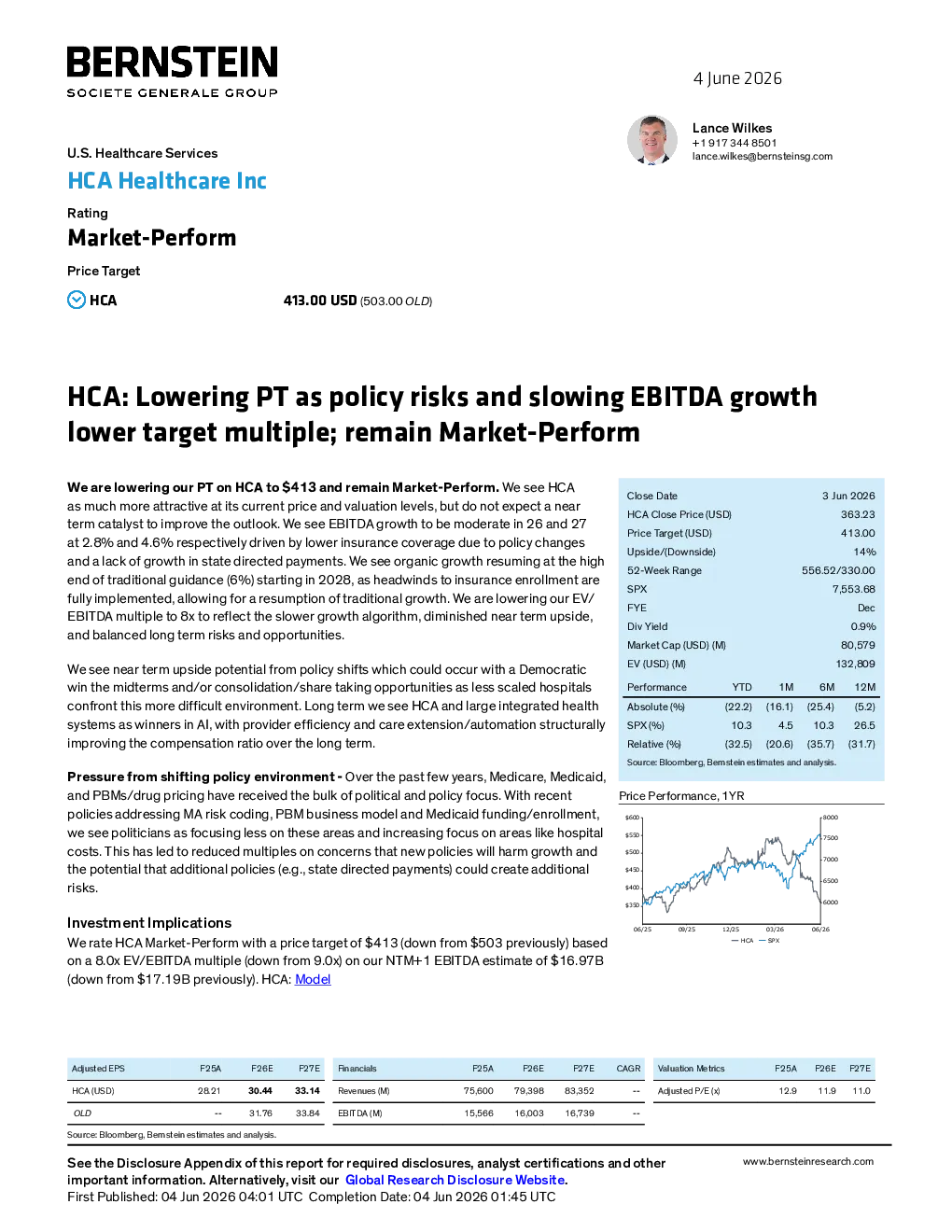
HCA: Lowering PT as policy risks and slowing EBITDA growthlower target multiple; remain Market-Perform We are lowering our PT on HCA to $413 and remain Market-Perform.We see HCAas much more attractive at its current price and valuation levels, but do not expect a near term catalyst to improve the outlook. We see EBITDA growth to be moderate in 26 and 27at 2.8% and 4.6% respectively driven by lower insurance coverage due to policy changesand a lack of growth in state directed payments. We see organic growth resuming at the highend of traditional guidance (6%) starting in 2028, as headwinds to insurance enrollment arefully implemented, allowing for a resumption of traditional growth. We are lowering our EV/EBITDA multiple to 8x to reflect the slower growth algorithm, diminished near term upside,and balanced long term risks and opportunities. We see near term upside potential from policy shifts which could occur with a Democraticwin the midterms and/or consolidation/share taking opportunities as less scaled hospitalsconfront this more difficult environment. Long term we see HCA and large integrated healthsystems as winners in AI, with provider efficiency and care extension/automation structurallyimproving the compensation ratio over the long term. Pressure from shifting policy environment -Over the past few years, Medicare, Medicaid,and PBMs/drug pricing have received the bulk of political and policy focus. With recentpolicies addressing MA risk coding, PBM business model and Medicaid funding/enrollment,we see politicians as focusing less on these areas and increasing focus on areas like hospitalcosts. This has led to reduced multiples on concerns that new policies will harm growth andthe potential that additional policies (e.g., state directed payments) could create additionalrisks. Investment Implications We rate HCA Market-Perform with a price target of $413 (down from $503 previously) basedon a 8.0x EV/EBITDA multiple (down from 9.0x) on our NTM+1 EBITDA estimate of $16.97B(down from $17.19B previously). HCA: Model DETAILS Drivers of PT change We decrease our price target to $413 (vs $503 earlier) for HCA. We derived our price target by applying an EV/EBITDA multipleof 8.0x (vs. 9.0x earlier) to our NTM+1 EBITDA estimate of $16.97B (vs. $17.19B earlier). Our HCA investment thesis -We see HCA as much more attractive at its current price and valuation levels, but do not expecta near term catalyst to improve the outlook and thus remain Market-Perform. We see EBITDA growth to be moderate in 26and 27 at 2.8% and 4.6% respectively driven by lower insurance coverage due to policy changes and a lack of growth instate directed payments. We see organic growth resuming the high end of traditional guidance (6%) starting in 2028, asheadwinds to insurance enrollment are fully implemented, allowing for a resumption of traditional growth. We are lowering ourEV/EBITDA multiple to 8x to reflect the slower growth algorithm, diminished near term upside and balanced long term risks andopportunities. We see near term upside potential from policy shifts which could occur with a Democratic win the midterms and/orconsolidation/share taking opportunities as less scaled hospitals confront this more difficult environment. Long term we seeHCA and large integrated health systems as winners in AI, with provider efficiency and care extension/automation structurallyimproving the compensation ratio over the long term. Volumes are decelerating from elevated levels -HCA’s same facility equivalent admissions grew 4.4% in each of ‘23/’24,with a peak of 5+% in 1H 2024. Current consensus sits at 2.0% same facility equivalent admissions growth for FY26,representing like-for-like volume growth deceleration of ~240 bps. HCA seemed to believe that 1Q run rate equivalentadmissions growth was around 2.0%, adjusted for flu and weather. We see this 2% run rate for 2026 as being lower than prioryears due to a normalization of capacity growth post-COVID (see below) and reduced insurance coverage. On the insurancecoverage side, this is driven by reduced Medicaid coverage, reduced Marketplace coverage, and the shift of people fromMedicaid to Marketplace / Employer, which have higher out-of-pocket amounts and therefore reduce utilization. We expectthese pressures on Medicaid enrollment to persist into 2028 driven by the OBBBA and also Trump Administration verificationefforts. Payroll growth, which equates to capacity growth, has moved down meaningfully over the past year.Total payrollgrowth for hospital and ambulatory settings has dropped from a peak of 4.2% year-over-year in May ‘24 to 2.6% in Apr’26(click here for our updated model). Hospital payroll growth has been hovering below 3%, down from a peak of 4.3% in Mar ’24.Ambulatory payroll growth was 2.7% in Apr ’26 vs. ~3.5% to 4+% over the past couple of years. We track both data sets, as thecombined environment best describes overall care provider capacity. Combined hospital and ambulatory