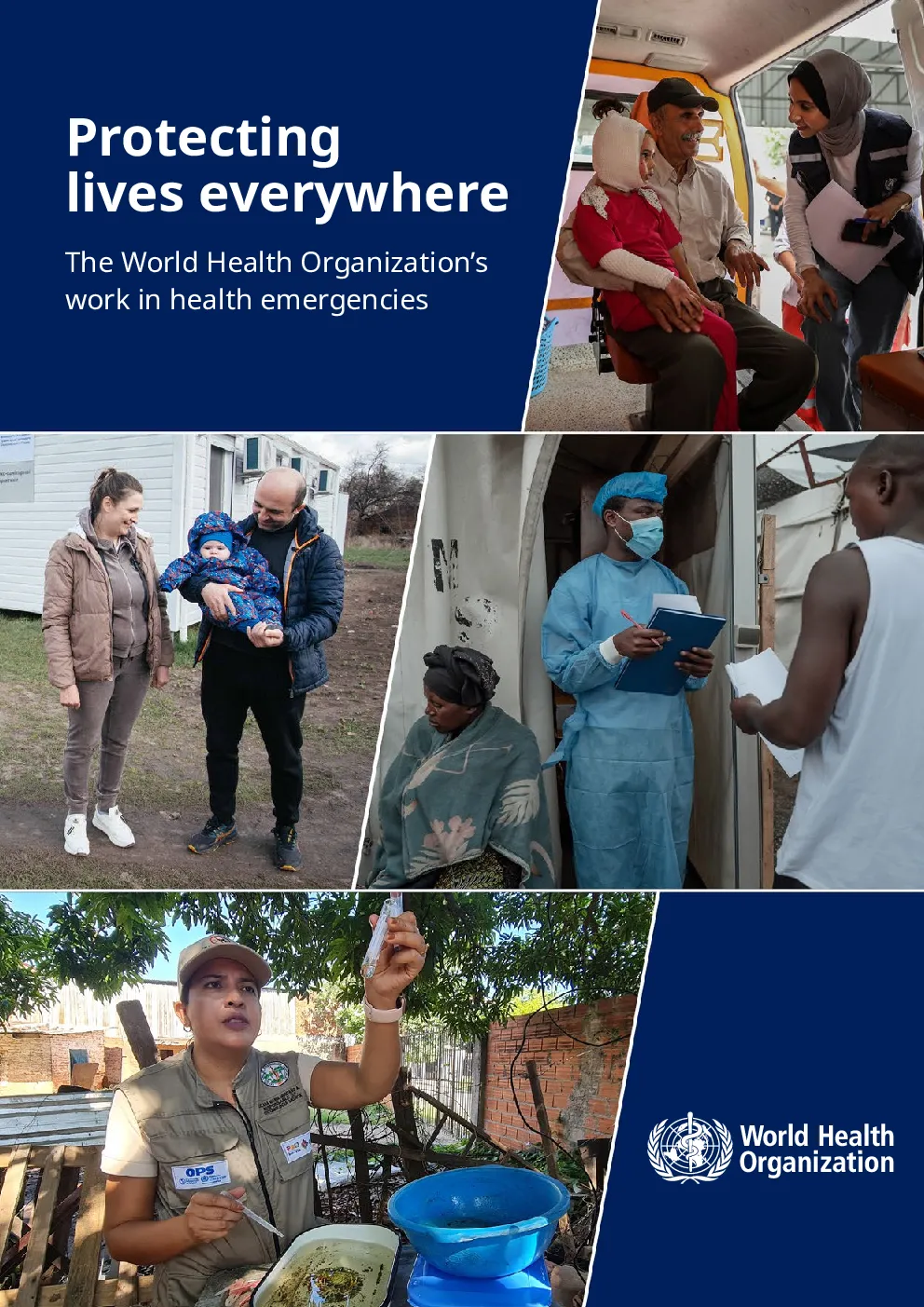
The World Health Organization’swork in health emergencies Protecting lives everywhereThe World Health Organization’swork in health emergencies Contents Foreword������������������������������������������������������������������������������������������������������������������� iv 1Global pressures shaping health emergencies��������������������������������������������� 1 2The evolution of the WHO Health Emergencies Programme���������������������� 6 3Adapting to a new funding environment: prioritization and new ways ofworking������������������������������������������������������������������������������������������������������������� 10 4What the WHO Health Emergencies Programme delivered in 2025�������� 14 5Looking ahead, moving forward������������������������������������������������������������������� 23 Foreword When the WHO Health Emergencies Programme (WHE) was established in May 2016, it was a direct responseto hard‑learned lessons�The West Africa Ebola outbreak had exposed weaknesses in global health emergencypreparedness and response�Warning signs had been missed, systems moved too slowly, coordinationwas fragmented and critical support arrived too late�The creation of WHE reshaped WHO’s work in health WHE’s work does not begin with the detection of an outbreak or the start of a humanitarian crisis�Longbefore emergencies occur, WHE supports Member States to strengthen surveillance systems, laboratories,emergency workforces and coordination mechanisms�Fast detection and early response help prevent When emergencies do occur, WHE helps countries act quickly in accordance with best practices�Working withinternational and national partners, WHE keeps health facilities open in conflict zones or after floods; WHEsupports outbreak control and emergency medical care, and delivers treatment to malnourished children WHE has continued to deliver on its commitments to Member States�As 2026 marks 10 years of WHE, wehave reached a critical inflection point in our evolution to adapt to a continuously changing context and With sustained commitment and strong partnerships, we can ensure that every country is better equipped toprotect its people, maintain essential health services in times of crisis and contribute to a safer, more stable Dr Chikwe Ihekweazu Executive Director, WHO Health Emergencies Programme 1Global pressuresshaping health We are at a pivotal moment for global health security, marked byheightened vulnerability, with climate‑driven shocks, escalatingconflict, overlapping health emergencies and one of the most Climate change is driving more frequent and severe weather events. Storms, floods, droughts and heatwavesdamage hospitals and water systems, forcing people from their homes and increasing the spread of disease� Conflicts and protracted crises, such as those in Gaza, Ukraine and Sudan, are driving humanitarian needs torecord levels�Attacks on health facilities and personnel weaken already fragile systems and reduce access to Disease outbreaks accelerate in fragile settings, from the return of polio after 25 years in the occupiedPalestinian territories, to widespread cholera and measles across Sudan and the Sahel�Outbreaks of Marburgvirus disease in Ethiopia and Ebola in the Democratic Republic of the Congo highlight how quickly deadly The world is spending more on creatinghumanitarian emergencies, and less on Thesepressures are unfolding against a backdrop of strained multilateralism�Geopolitical tensionsmake coordinated global action more challenging at a time when stronger cooperation is needed�At thevery moment when needs are rising, WHO and other global actors are facing the starkest funding cutsin a decade�Geopolitical tensions and shifting national priorities mean that countries are directing theirfinancing increasingly towards domestic concerns and defence budgets. While global defence spending now Yet the world also came together�In 2025, Member States adopted the landmark WHO Pandemic Agreementand brought amendments to the International Health Regulations into force – a clear signal of their continued Despite severe funding pressures, WHO sustains its life‑saving role preparing for and responding to healthemergencies through the work of the Health Emergencies Programme (WHE)�In 2025 alone, WHE respondedto 50 graded emergencies across 82 countries, supported more than 30million people with essentialhealth services, kept thousands of facilities functioning, deployed thousands of mobile clinics to hard‑to‑ Modern treatment centre improves Ebola care In 2025, with WHO support, the Democratic Republic of the Congo rapidly controlled an outbreak of Ebolavirus disease, successfully containing it within six weeks – a remarkable achievement. For the first timeduring an Ebola outbreak, an innovative treatment unit – developed by WHO in collaboration with the World “At the old site, there were five of us in one room. Here, each person has their own room with a toilet. It’sso m