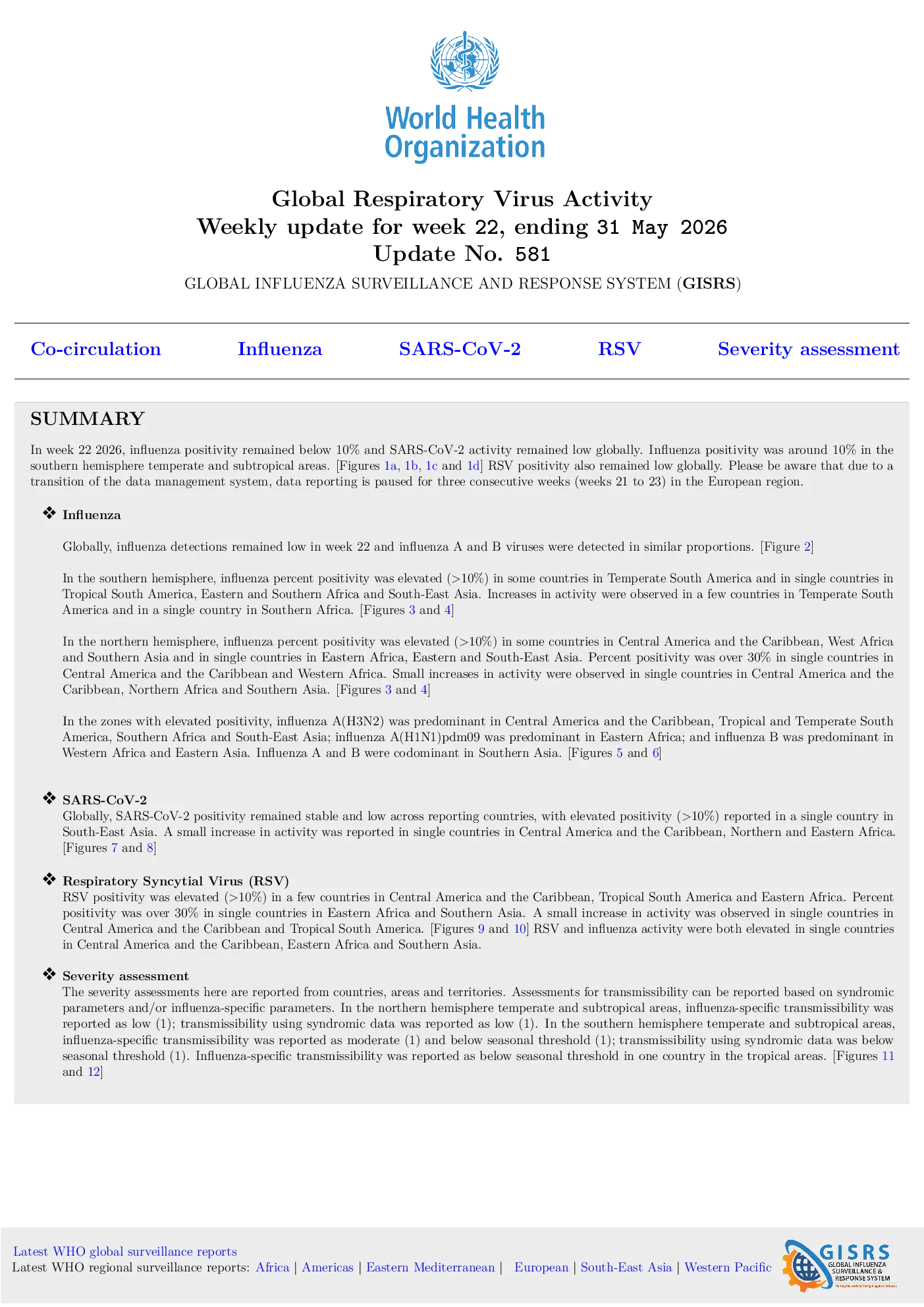
GLOBAL INFLUENZA SURVEILLANCE AND RESPONSE SYSTEM (GISRS) Co-circulationInfluenza SUMMARY In week 22 2026, influenza positivity remained below 10% and SARS-CoV-2 activity remained low globally. Influenza positivity was around 10% in thesouthern hemisphere temperate and subtropical areas. [Figures 1a, 1b, 1c and 1d] RSV positivity also remained low globally. Please be aware that due to a qInfluenza Globally, influenza detections remained low in week 22 and influenza A and B viruses were detected in similar proportions. [Figure 2] In the southern hemisphere, influenza percent positivity was elevated (>10%) in some countries in Temperate South America and in single countries inTropical South America, Eastern and Southern Africa and South-East Asia. Increases in activity were observed in a few countries in Temperate South In the northern hemisphere, influenza percent positivity was elevated (>10%) in some countries in Central America and the Caribbean, West Africaand Southern Asia and in single countries in Eastern Africa, Eastern and South-East Asia. Percent positivity was over 30% in single countries in In the zones with elevated positivity, influenza A(H3N2) was predominant in Central America and the Caribbean, Tropical and Temperate SouthAmerica, Southern Africa and South-East Asia; influenza A(H1N1)pdm09 was predominant in Eastern Africa; and influenza B was predominant in qSARS-CoV-2 Globally, SARS-CoV-2 positivity remained stable and low across reporting countries, with elevated positivity (>10%) reported in a single country inSouth-East Asia. A small increase in activity was reported in single countries in Central America and the Caribbean, Northern and Eastern Africa. qRespiratory Syncytial Virus (RSV) RSV positivity was elevated (>10%) in a few countries in Central America and the Caribbean, Tropical South America and Eastern Africa. Percent positivity was over 30% in single countries in Eastern Africa and Southern Asia. A small increase in activity was observed in single countries inCentral America and the Caribbean and Tropical South America. [Figures 9 and 10] RSV and influenza activity were both elevated in single countries qSeverity assessmentThe severity assessments here are reported from countries, areas and territories. Assessments for transmissibility can be reported based on syndromic parameters and/or influenza-specific parameters. In the northern hemisphere temperate and subtropical areas, influenza-specific transmissibility wasreported as low (1); transmissibility using syndromic data was reported as low (1). In the southern hemisphere temperate and subtropical areas,influenza-specific transmissibility was reported as moderate (1) and below seasonal threshold (1); transmissibility using syndromic data was belowseasonal threshold (1). Influenza-specific transmissibility was reported as below seasonal threshold in one country in the tropical areas. [Figures 11and 12] Co-circulation of influenza and SARS-CoV-2 1b) Weekly numbers of influenza andSARS-CoV-2 virus specimens tested and 1c) Weekly numbers of influenza andSARS-CoV-2 virus specimens tested and Influenza SARS-CoV-2 8) Change in proportions of specimens that tested Respiratory syncytial virus 10) Change in proportions of specimens that testedpositive for RSV (year-week:2026-22) Severity assessment Additional information Data and methods The data presented in this report originates from virologic surveillance conducted by countries, areas, and territories (CATs) and submitted to WHO FluNet through participation orcollaboration with the Global Influenza Surveillance and Response System (GISRS). These CATs employ diverse methodologies to monitor respiratory virus activity, which may resultin variations between this report and other surveillance summaries published elsewhere. To assess trends, the proportion of specimens tested positive for influenza or SARS-CoV-2 was smoothed over a 3-weeks period. This analysis includes only countries that tested 10 ormore specimens in at least two of the three weeks. Weekly changes in the smoothed positivity rate for each virus were calculated as absolute differences from the previous week. These The influenza transmission zones map is based on data aggregated over a 3-weeks period, moving backward from the current week until a minimum threshold of 100 tested samples isreached within each influenza transmission zone. Pie charts are displayed on the map only if the total percent positivity in a influenza transmission zones map is 20% or higher. All Activity summaries are organized by geographical groupings of CATs. These groupings are intended solely for geographic reference and do not imply uniformity in respiratory virustransmission patterns within each group. It is important to note that specimens tested for influenza, SARS-CoV-2, and RSV may not originate from the same sample sources within Severity assessments: The severity assessments here are reported from countri