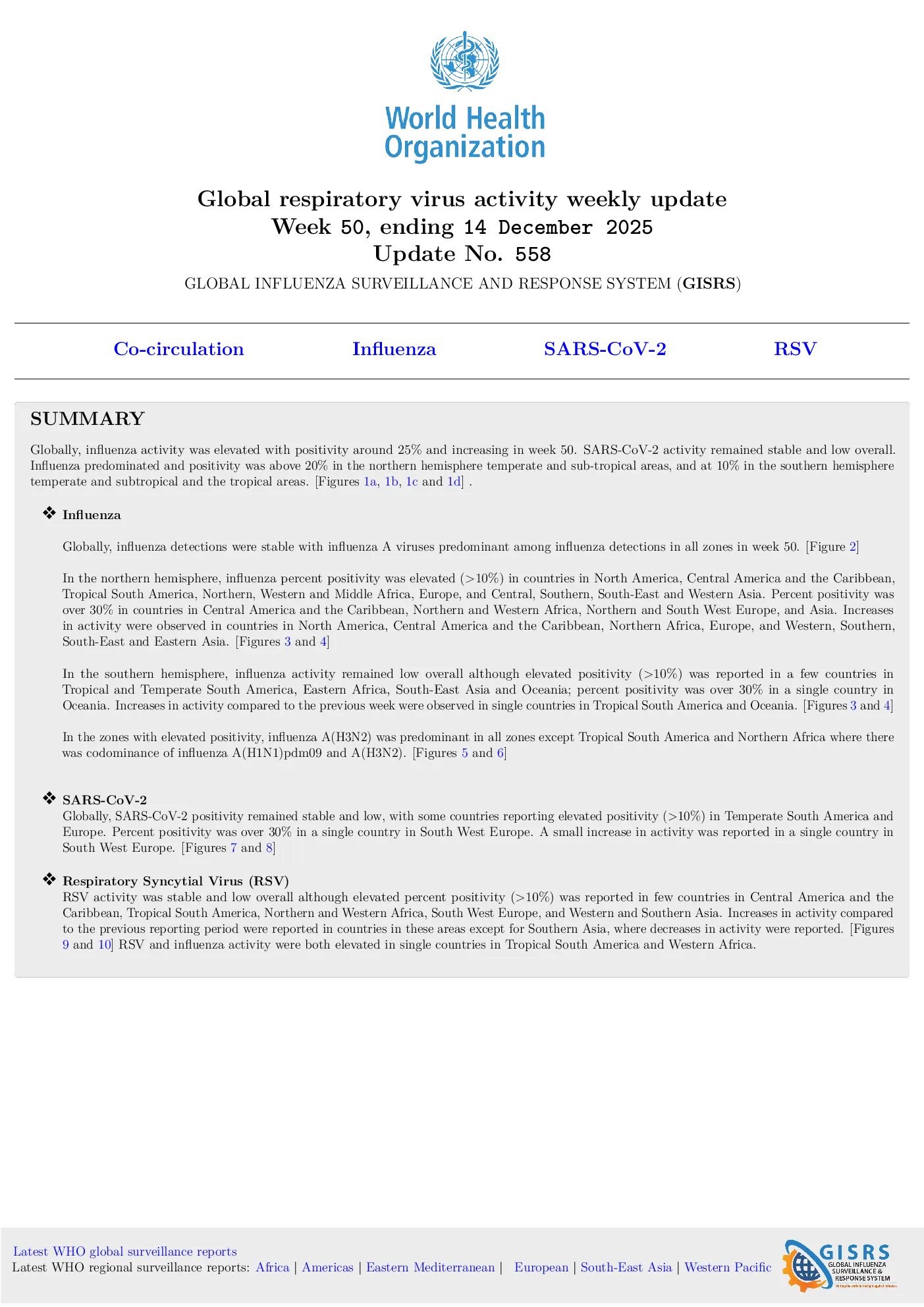
GLOBAL INFLUENZA SURVEILLANCE AND RESPONSE SYSTEM (GISRS) Co-circulationInfluenza SUMMARY Globally, influenza activity was elevated with positivity around 25% and increasing in week 50. SARS-CoV-2 activity remained stable and low overall.Influenza predominated and positivity was above 20% in the northern hemisphere temperate and sub-tropical areas, and at 10% in the southern hemisphere qInfluenza Globally, influenza detections were stable with influenza A viruses predominant among influenza detections in all zones in week 50. [Figure 2] In the northern hemisphere, influenza percent positivity was elevated (>10%) in countries in North America, Central America and the Caribbean,Tropical South America, Northern, Western and Middle Africa, Europe, and Central, Southern, South-East and Western Asia. Percent positivity wasover 30% in countries in Central America and the Caribbean, Northern and Western Africa, Northern and South West Europe, and Asia. Increases In the southern hemisphere, influenza activity remained low overall although elevated positivity (>10%) was reported in a few countries inTropical and Temperate South America, Eastern Africa, South-East Asia and Oceania; percent positivity was over 30% in a single country in qSARS-CoV-2 Globally, SARS-CoV-2 positivity remained stable and low, with some countries reporting elevated positivity (>10%) in Temperate South America andEurope. Percent positivity was over 30% in a single country in South West Europe. A small increase in activity was reported in a single country in qRespiratory Syncytial Virus (RSV) RSV activity was stable and low overall although elevated percent positivity (>10%) was reported in few countries in Central America and theCaribbean, Tropical South America, Northern and Western Africa, South West Europe, and Western and Southern Asia. Increases in activity comparedto the previous reporting period were reported in countries in these areas except for Southern Asia, where decreases in activity were reported. [Figures9 and 10] RSV and influenza activity were both elevated in single countries in Tropical South America and Western Africa. Co-circulation of influenza and SARS-CoV-2 1a) Weekly numbers of influenza and SARS-CoV-2 virus specimens tested and percent positivity at the global level 1b) Weekly numbers of influenza andSARS-CoV-2 virus specimens tested and Influenza SARS-CoV-2 Respiratory syncytial virus Additional information Data and methods The data presented in this report originates from virologic surveillance conducted by countries, areas, and territories (CATs) andsubmitted to WHO FluNet through participation or collaboration with the Global Influenza Surveillance and Response System This report includes virologic data from bothsentinel surveillance and other systematically conducted surveillance. Dueto differences in surveillance strategies, direct comparisons of percent positivity between CATs should be interpreted with caution. To assess trends, the proportion of specimens tested positive for influenza or SARS-CoV-2 was smoothed over a 3-weeks period. Thisanalysis includes only countries that tested 10 or more specimens in at least two of the three weeks. Weekly changes in the smoothedpositivity rate for each virus were calculated as absolute differences from the previous week. These absolute changes were cate- The influenza transmission zones map is based on data aggregated over a 3-weeks period, moving backward from the current weekuntil a minimum threshold of 100 tested samples is reached within each influenza transmission zone. Pie charts are displayed on Activity summaries are organized by geographical groupings of CATs.These groupings are intended solely for geographicreference and do not imply uniformity in respiratory virus transmission patterns within each group. It is important to note that Suggested citation:Global respiratory virus activity:weekly update No 558 (week 2025-50).Geneva:World HealthOrganization; 2025; Licence: CC BY-NC-SA 3.0 IGO. Disclaimer: The designations employed and the presentation of the material in this publication do not imply the expression of any opinionwhatsoever on the part of WHO concerning the legal status of any country, territory, city or area or of its authorities, or concerning The mention of specific companies or of certain manufacturers’ products does not imply that they are endorsed or recommendedby WHO in preference to others of a similar nature that are not mentioned.Errors and omissions excepted, the names of All reasonable precautions have been taken by WHO to verify the information contained in this publication.However, thepublished material is being distributed without warranty of any kind, either expressed or implied. The responsibility for the Additional surveillance outputs:WHO Influenza Surveillance OutputsContact:fluupdate@who.int or Click here to subscribe to the mailing list.