您的浏览器禁用了JavaScript(一种计算机语言,用以实现您与网页的交互),请解除该禁用,或者联系我们。 [科法斯]:在经济环境恶化的背景下,破产率再次上升 - 发现报告

在经济环境恶化的背景下,破产率再次上升

2026-06-11 科法斯 Explorer丨森
报告封面

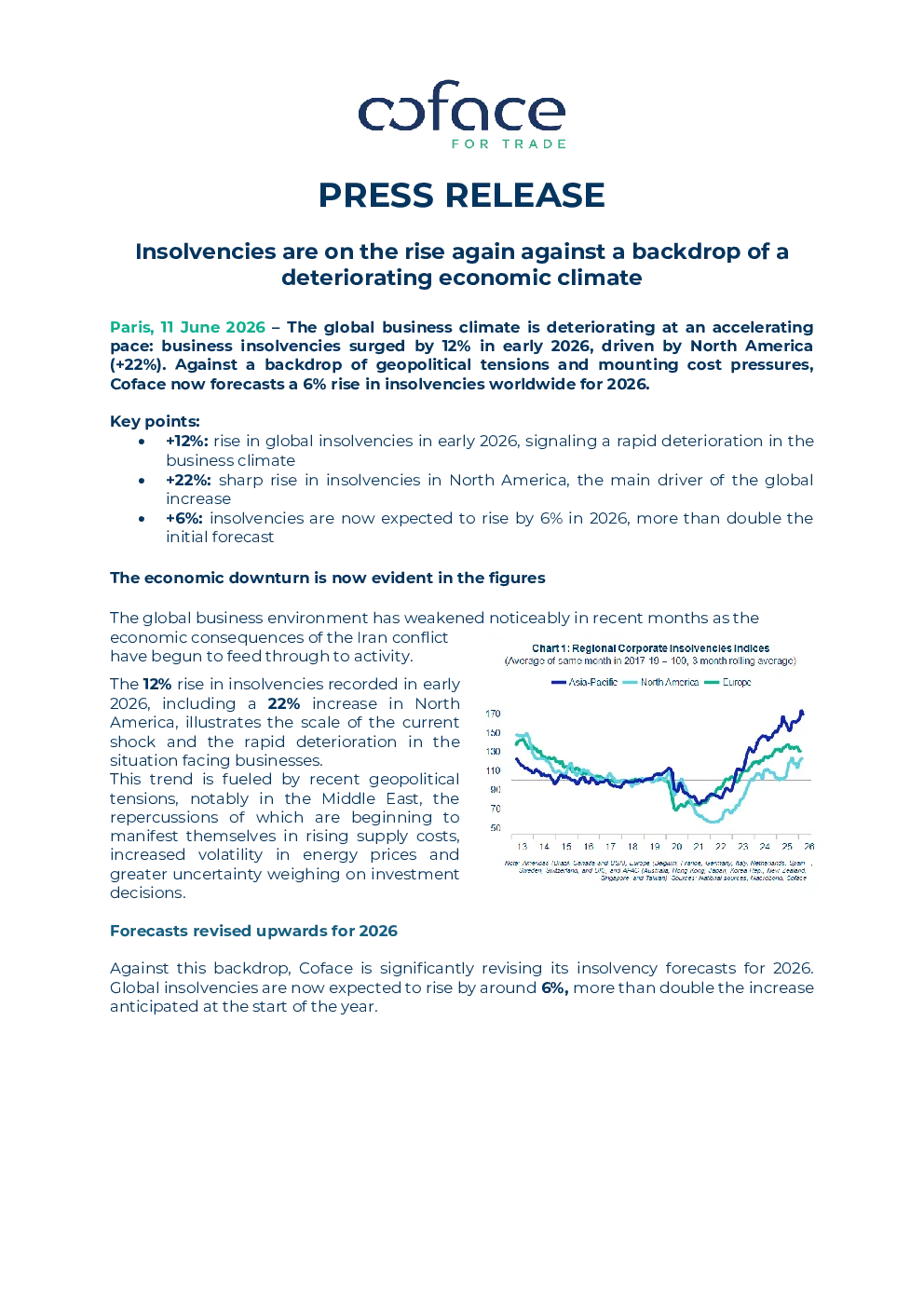
Insolvencies are on the rise again against a backdrop of adeteriorating economic climate Paris,11June2026–The global business climate is deteriorating at an acceleratingpace: business insolvencies surged by 12% in early 2026, driven by North America(+22%). Against a backdrop of geopolitical tensions and mounting cost pressures,Coface now forecasts a 6% risein insolvencies worldwide for 2026. Key points:•+12%:rise in global insolvencies in early 2026,signalinga rapid deterioration in the business climate•+22%:sharp rise in insolvencies in North America, the main driver of the globalincrease•+6%:insolvencies are now expected to rise by 6% in 2026, more than double theinitial forecast The economic downturn is now evident in the figures The global business environment has weakened noticeably in recent months as theeconomic consequences of the Iran conflicthave begun to feed through to activity. The12%rise in insolvencies recorded in early2026,including a 22%increase in NorthAmerica, illustrates the scale of the currentshockand the rapid deterioration in thesituation facing businesses.This trend isfueled by recent geopolitical tensions,notably in the Middle East,therepercussionsof which are beginning tomanifest themselves in rising supply costs,increasedvolatility in energy prices andgreater uncertainty weighing on investmentdecisions. Forecasts revised upwards for 2026 Against this backdrop, Coface is significantly revising its insolvency forecasts for 2026.Global insolvencies are now expected to rise by around6%,more than double the increaseanticipated at the start of the year. Significant increases are expected inthe United States(+8%), France(+8%)and Japan(+7%), whilst Germany andthe Netherlands are expected to seerisesof around 5%.More moderateincreases,ranging between 2%and3%,are expected in Spain, Italy and theUnited Kingdom. Interest rates exacerbate an alreadyfragile situation Against this already fragile backdrop,financingconditionscontinuetoweigh heavily on businesses. Despitethestart of a easing cycle,interestrates remain at high levels followingseveral years of monetary tightening,whichis making the cost of creditpersistently expensive. This constraint is all the more significant given that businesses are entering this phase withhistorically high levels of debt. Consequently, even small changes in financing conditionscan have a disproportionate impact: a rise of just25 basis pointsin borrowing rates wouldbe enough to accelerate global defaults once again and bring their growth closer to thelevels observed in 2025. The persistence of high interest rates thus acts as an aggravatingfactor in an already deteriorating environment, limiting companies’ ability to refinance theirdebt and absorb further shocks. Cyclical sectors on the front line Pressures remain particularly acute in the sectors most sensitive to economic cycles andfinancingconditions.Construction,chemicals and textiles continue to be the mostvulnerable sectors, due to their high exposure to production costs and demand. In several major economies, these vulnerabilities are already having a tangible impact:•UnitedStates: the industrial and construction sectors are being hit by rising financing costs and slowing demand.•Germany: industry, particularly the chemical and construction sectors, remainsunder pressure due to high energy costs and still-weak activity.•France:the construction sector is suffering from high interest rates,industryremainsweakened by energy costs,and the retail sector is suffering fromconstrained purchasing power.•Japan: the most indebted sectors are weakened by financing conditions that havebecome persistently tighter. In these sectors, the combination of high production costs, squeezed margins and tighteraccess to finance significantly reduces companies’ ability to adjust.This vulnerability is even more pronounced for SMEs, which are often less diversified and more exposed to cash flow fluctuations. As a result, in several regions, these sectors areamong the main contributors to the rise in insolvencies observed since 2025, confirmingthe now structural nature of the pressures at play. Government intervention unlikely to provide the same buffer The relatively subdued level of insolvencies between 2020 and 2023 was largely attributabletoextensive government support in response to the Covid-19 pandemic and theconsequences of the Ukraine war. While support measures are being reintroduced in somecountries, they remain significantly more limited in scale. In major European economies–including France, Germany, Italy, Spain and the UK–fiscal support in 2022–2023 amountedto approximately 2–4% of GDP. By contrast, current measures are far smaller,with thelargest program observed in Spain at around 0.3% of GDP. Moreover, recent interventionsare more targeted in nature. While this should help the most vulnerable sectors and firms,it is unlikely to provide the broad-based cushion seen during previous crises. As a